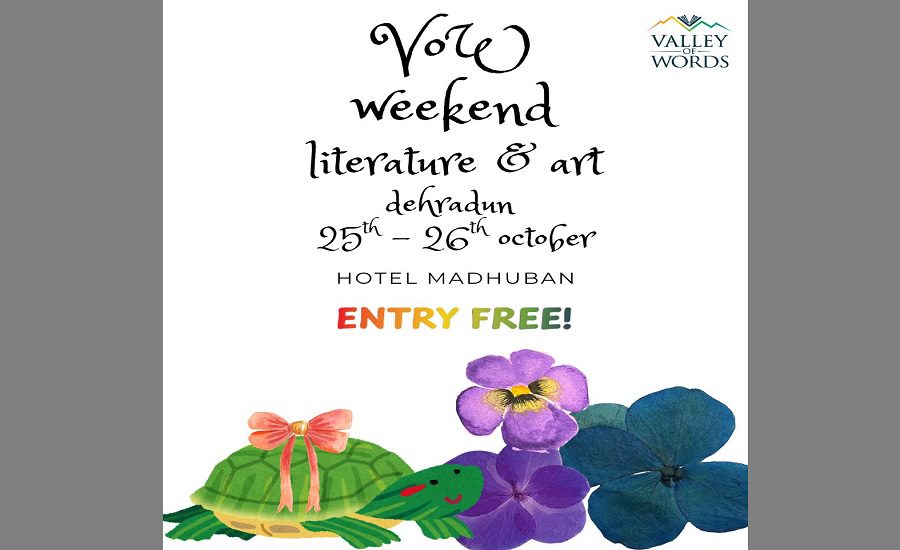
The 9th edition of the Valley of Words (VoW) Festival in Dehradun illuminated a remarkable truth, that India’s civil services are not only pillars of governance but also beacons of intellectual and cultural enrichment. This year’s festival stood as a powerful reminder that administrators, diplomats, and police officers are often among the country’s most profound thinkers and storytellers, capable of bridging bureaucracy with creativity and policy with poetry.
VoW 2025 paid tribute to this intersection of service and soul, featuring voices from the Indian Administrative Service (IAS), Indian Police Service (IPS), and Indian Foreign Service (IFS) whose engagement went far beyond official duties. Their participation reaffirmed that leadership in public life requires not just efficiency but empathy, an understanding of human stories, culture, and conscience.
Across two days, the officers demonstrated that the essence of civil service extends beyond administration, into writing, reflection, and moral leadership. Whether through the poetry of policy, the discipline of diplomacy, or the compassion of storytelling, their presence at Valley of Words 2025 symbolised India’s finest blend of intellect and integrity.
In their hands, literature became governance in verse; governance became literature in action. Together, they reminded the audience that serving the nation is not merely a matter of office, but of imagination, the ability to see a better world and shape it, one word and one policy at a time.
The presence of Lakshmi Murdeshwar Puri (IFS, Retd.) at the VoW Book Awards 2025 for English Fiction epitomised this fusion of diplomacy and creative power. Her novel Swallowing the Sun emerged not merely as a literary work but as a statement of values, gender justice, resilience, and self-realisation. As a seasoned diplomat and global advocate for equality, Puri’s transition from international negotiations to storytelling reflected how service to humanity extends beyond borders. Her work reminded audiences that those who represent India on global platforms also carry a deep reservoir of personal stories that resonate with universal truths.
Equally compelling was the session, Cabinet Notes to Haiku, which captured the poetic undercurrent that runs through administrative lives. Senior IAS officers, Mugdha Sinha, Pramod Jain, and Mukul Kumar, shared how the rigour of policy formulation often finds balance in the brevity and beauty of poetry. Their reflections revealed that even within the machinery of governance, there exists a contemplative heart that observes, records, and transforms experience into art. Through their haikus, minimalist yet profound, they offered audiences a glimpse of civil servants as philosophers and humanists, quietly chronicling the essence of everyday life.
On the second day, N. Ravi Shanker, former Chief Secretary of Uttarakhand, brought depth and insight to the festival’s Keynote Session, exploring how governance in the hill state must draw upon its cultural and ecological consciousness. His reflections on public service as stewardship, of nature, of heritage, and of people’s trust resonated with the festival’s ethos of responsibility and reflection. His words reminded attendees that administrative leadership, when guided by conscience, becomes an act of preservation as much as progress.
The discussion titled Individuals, Institutions, Ideas further underscored the enduring legacy of India’s administrative thinkers. Chaired by Shishir Priyadarshi (CRF), and featuring Abhinav Kumar (BSF), Ashok Vishandass (CACP), and Sanjeev Chopra (LBSNAA), the conversation celebrated the institutional memory that defines India’s governance framework. These officers highlighted how strong institutions, shaped by visionary individuals, sustain democracy, efficiency, and ethical public service. The session became a mirror to the collective integrity of the civil services: steadfast, thoughtful, and forward-looking.
In Doon ke Lekhak (Authors from the Valley), civil servants who had turned to writing offered a softer lens to their profession. Writers such as Anil Raturi, Amit Srivastav, and Kripa Ram Nautiyal reflected how their administrative experiences shaped their literary voices. Their writings, grounded in the people, landscapes, and struggles of Uttarakhand, revealed the deep empathy that underlies effective governance. Through literature, they translated the invisible labour of public service into stories that humanise power and connect policy with emotion.
The thematic richness continued with Neha Mittal’s participation in Dev Bhoomi Mein Mahabharat, where she examined Uttarakhand’s living connection to India’s epic heritage. Her reflections connected mythology, anthropology, and contemporary governance, illustrating how local traditions, when understood deeply, can guide inclusive and culturally rooted policymaking. Mittal’s perspective, shaped by administrative sensitivity, captured how the civil services act as both custodians of culture and catalysts of change.
Finally, the session Uttarakhand Mein Rajyabhasha: Sanskrit, chaired by Dr Indu Pande (IAS, Retd.), added an academic and philosophical dimension. Known for her pioneering work in education and heritage, Dr Pande spoke about the responsibility of governance in nurturing language as a vessel of knowledge and identity. Her reflections on Sanskrit as a living, evolving heritage underscored how administrators play a vital role in cultural continuity, ensuring that India’s intellectual legacy remains alive for future generations.
As the festival concluded beneath the autumn light of Dehradun, the message was clear: India’s civil services are not just administrators of the state; they are custodians of its conscience. The Valley of Words once again stood as a platform where public service met public imagination, and the result was nothing short of transformative.