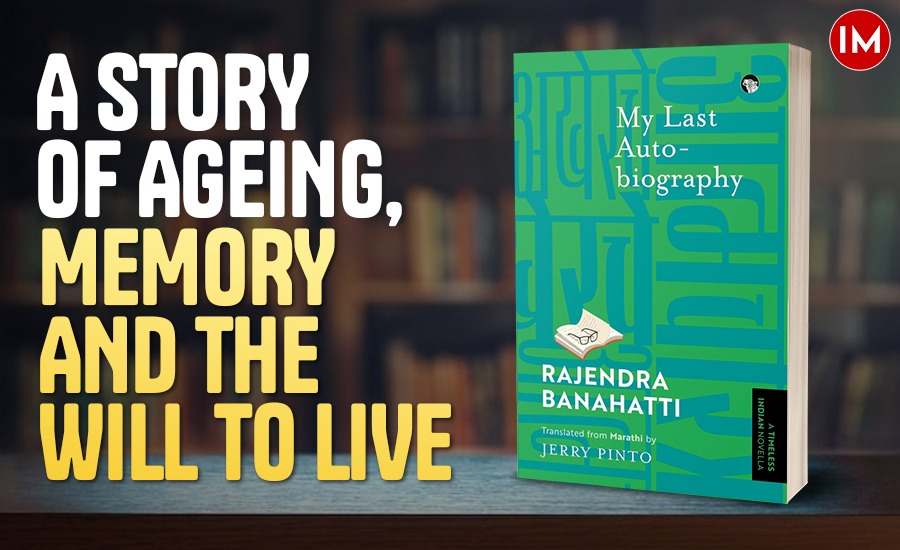
Forty-three years after it was penned by Rajendra Banahatti in 1982, Akherche Atmacharitra has been given a new lease of life by Jerry Pinto’s excellent translation under the title ‘My Last Autobiography’. Banahatti’s protagonist as himself is a 94-year-old ‘immortal engineer’ who speaks of his shrinking world with a sense of profound understanding. He bears no malice, but is not unaware of how his favourite son, a well-established doctor, goes through the motions of being concerned about his health and welfare even as he actually becomes increasingly irritated with his father’s unexpected longevity.
Apart from deeper philosophical questions about the purpose of life and the meaning of death, this book gives us an idea of how everyday norms changed from the 1890s to 1980s. These included the salience of fasts and feasts to mark special occasions, and the recall of events as per the Indic calendar- Paush, Magh and Phalgun – instead of January, February and March. The All India Radio was the most important and perhaps the only source of news, entertainment and information about everything from national and global affairs to cinema to cricket to crop advisories for farmers. We also learn that Rs 450/ per month was the pension for a high-ranking government engineer: a sum good enough for a comfortable existence if one lived in one’s own house.
A word about the world of Ajoba — the father of four sons and four daughters, of whom one was estranged for she had eloped with a Parsi boy. At this advanced stage of life, his most salient interactions are with his maids Sitabai who looks after him from dawn to dusk, and Chandrabai who takes over from her for the night shift. His son calls on him at least twice a day, with a stethoscope in hand, while going to and coming back from his clinic on the ground floor of the three-storeyed house which they inhabit together.
His wife, whom he had married when she was ten and he was sixteen, had passed on a decade earlier. Theirs had been a fine partnership for seventy-five years. He misses her affection and companionship, as well as her culinary skills – homemade modaks, shrikhand and the range of vegetable dishes from bottle gourd, turnips, yam, beans, capsicum and a wide variety of pickles. The memory of those delicious foods endure, and he cannot stand the staid staple fare offered instead by his daughter-in-law Suman, a working professional who held the view that cooking was the ‘territory of servants’. Suman exercised complete control over the household expenses, and along with her husband had fixed his discretionary spending at Rs 50 per month.
Where and how does a nonagenarian who cannot move out of his room spend his money? The first expense is on the barber who shaves his beard once a week and his head once a fortnight. The second is for vegetables which he buys when Suman is not at home (which is more often than not). But this gives him the ‘power’ to decide what he wants to eat. His third indulgence is on perfume and attar, for now he cannot go to the garden to capture the fragrance of the flowers. Last but not the least is the expenditure for his palate again – he is fond of pedha, barfi, kalakand, farsan, Threptin biscuits, and buys extra sugar to add to the tepid tea which is made as per Suman’s instructions.
When he suffers a paralytic attack, his son’s friend, Dr Sukhatme whispers that ‘the old man had just seven or eight days to live’. These were the best days of his life, for the extended circle of friends and family all came rushing to call on him to express his concern about failing health. His tenant from the first floor comes with a copy of the Bhagwad Geeta and reads from the second chapter (Samkhya Yoga): Vaansansi jeernaananiya thaavi haay… Just as a person sheds old clothes… the implication is that it is time for him to say his final goodbyes.
His eldest son, Nana, a pensioner like him, wants to start work on his autobiography! That indeed would be a very different kind of narrative, for unlike our protagonist who looked forward to a transfer every few years – from Karachi to Quetta, from Lahore to Mangalore to Cochin and Trivandrum – which gave him the chance to explore new cities and make new friends, Nana would feign sickness and make all kinds of excuses to avoid any change in the set pattern of his life.
Even as these ‘last visits’ continue, much to the shock of everyone around him, he not only survives the designated period assigned to him but also manages to regain control of his limbs. Now he hallucinates between life and death, and the interregnum in between, so much so that all around him start regarding him as a living demon. Is he senile, or frustrated, or are others around him unwilling to accept what he is at his age when the hands tremble, the heart is weak and the digestion is indifferent, but the mind is still alert… for it retains its reservoirs of memory, as well as the strong desire to assert authority over his son and certainly over his other caregivers!
Why is this book called The Last Autobiography? He wrote his first autobiography when he was sixty-five, and the second when he became Sahastra Chandra Darshan – a person who has seen one thousand full moons in a milestone that usually occurs around the age of 80 years and 8 months. He is looking forward to welcoming the Lord of Death, Yama, who refuses to embrace him, and thus leaves him and others around him distraught. But the closing lines of this book offer the possibility of yet another edition, for he says ‘As we live, we write. And as we write, we live. In other words, who knows if this is the last autobiography, the last word? Who can say?’
Thank you, Jerry, for this wonderful story of a man who is dismissed by the world as having outlived his innings. To me, this is a story of hope, of meditation and memory; it reminded me of Nirad Chaudhary’s ‘Horsemen of the Third Apocalypse’ also written in his centenary year. Thank you to Rajendra, for writing this remarkable autobiography about the inevitability of our human bodies aging—and living, despite it all.
Also Read – Haunted by History, Carried by the Brahmaputra: An Anthology That Bridges Assam’s Many Worlds