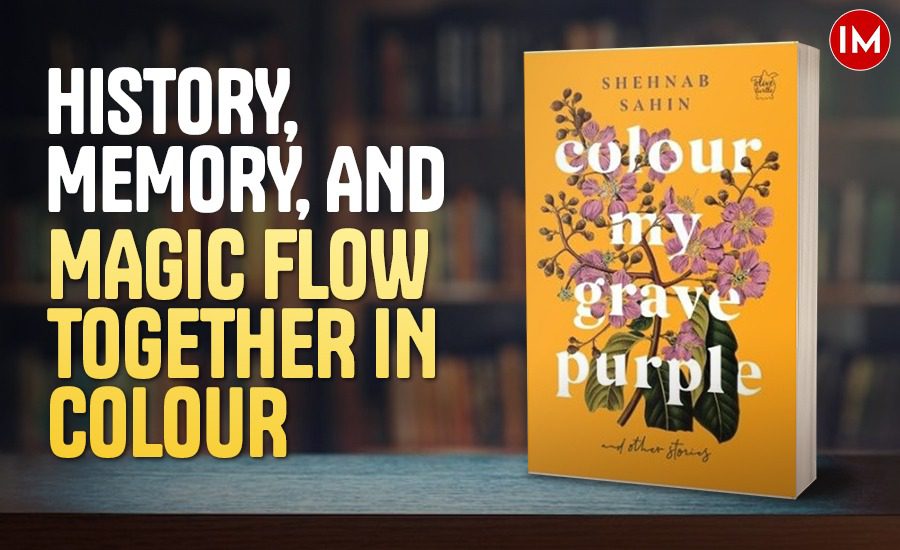
“The history of Assam and its people is as meandering as the mighty Brahmaputra that flows through it,” writes Shehnab Sahin in the Author’s Note to her debut collection of short fiction. To explore this vast riverine coast without losing the rhythm of different waves is the aim of this book. An ambitious timeline, from 1958 to 2019, merges historical fiction into contemporary currents. Natural and supernatural exist in the same waters, amidst tides of ancient spiritual faiths recalibrating to new religious depths.
From 1858 is the story “Two Leaves and a Bud” about botanist Samuel Addington, a British empire-builder whose commission to study the Camellia sinensis funded his travels to China, Nepal, Bhutan, and finally the Chinnamara Tea Estate in Assam, where he arrived as manager along with his pregnant Cantonese wife. A year prior, a local aristocrat known as Maniram Dewan had conspired with rebels to reinstate Ahom rule. He had been publicly hanged to death for this revolt. Yet his legacy continued to haunt the estate and its new occupants — the “ojha” occult practitioner who could perhaps have helped appease his spirit, whom the Kachari tribals wanted to call, was not summoned by the rational white manager.
“Freedom in My Blood (1920)” also makes brief mention of an ojha. Ten-year-old Mamoni is experiencing menarche, and an unsettling first sight of blood followed by a strange new world of atonements reminds her of a mantra taught by her powerful grandmother to weaken enemies. Isolated in a separate room by her ritualistic mother, Mamoni begins to write a letter to the Mahatma who is scheduled to visit her state soon: “Dear Gandhiji, … Jai Hind…” She is unsure about what else can be written. “She wanted Gandhiji to know how very excited she was to see such a great man and how she would join him like her father and brothers and drive the British out of her country.” Warriors bleed at home and in the world; battlegrounds require distance from family; strength appears in unexpected satyagrahas.
Read Also: At the Ends of the Rainbow: A Memoir of Slow Travel, Soulful Encounters and Survival
If “Bellows of a Wilted Poppy” from 1860 highlights kanee – opium – used traditionally in medicine by “bez” healer Rebo until the British came up with an elaborate self-serving scheme to commercialise it, “Ursula (1943)” begins with soothsayer Ramgakpa leaving his study of mystical mushrooms to examine the sand-patterns created by a python as an oracle of what was to come: “queen, war, memory.” The eponymous Miss Ursula Graham Bower, or “Naga Queen”, was asked to assist refugees fleeing from Japanese attacks in Burma. Laisong locals – who had been cultivating for the British for nearly a century – began preparing for a world war in which they had no direct stakes. Their former ways of life would be memorialized in the photographs of “Uu-su-la Memsahab.”
After the Independence of India, there are “Sunsets in the East (1962)”. The advance of Chinese troops push a far-sighted bank manager in Tezpur to burn currency notes and dump coins in a pond, whilst the inmates of a mental asylum are set free, and Prime Minister Jawaharlal Nehru expresses his sympathies for Assam on the radio. A decade later, in “Devotional Defiance”, cinema and theatre become avenues of escape for young men trapped in rigid village norms: “The harmony is lost, my brothers,” says an actor depicting a raiz mel discussion, “If our music has started pouring out sounds of despair, it is because we have allowed others to play us.” In “Alliances (1986)”, friendships are fractured over political revolt when young men from the village begin joining the Asom Gana Parishad to protest the illegal hordes of Bangladeshi refugees taking up slim opportunities for employment in their state.
Perhaps the most moving story in Sahin’s collection is the titular “Colour My Grave Purple (1980-2000s)”. Sara makes meaning from signs the universe offers. After the death of her father, a police officer stationed in Assam for much of her life, she searches for catharsis in the pages of his journals. She had been sheltered from the worst sorrows of his career, she realises, as she reads the chilling descriptions of the ULFA insurgency and militancy he had seen as a public servant in a troubled state. “While so much violence tainted people’s everyday lives, she only remembered boat rides across the Baghbor river, spotting a river dolphin for the first time in her life with her father beside her, his thrill more childlike than hers.” He had made sure to share his love of nature in a biodiverse state. Years later, when Sara visits his final resting place in a kabristan from which she had earlier been forbidden due to her gender, she discovers proof irrefutable of an offering by a benevolent universe.
“Animal Instinct (2004)” and “Love is a Flimsy Kite (2019)” both feature young women studying in Delhi University as protagonists. Ideals blur into self-righteousness and self-preservation differently based on whom the young women speak to — a “new driver who had been assigned to her that morning for the airport drop as her regular driver had to attend to some official duty”, versus a lover with a “broad chest and sinewy arms and the lingering smell of Axe Chocolate, sweat and cigarettes that she has grown to fawn over”. The degrees of reflection which her exchanges prompt vary as well, but something in the nature of Sahin’s reflective writing suggest that while the book ends here, the stories are likely to continue beyond its pages.
Each of the ten stories in Colour My Grave Purple map the shifting shores of Axomiya identity over the centuries as they have silted into the understudied paradoxes which characterise contemporary Assam. From traditional witchcraft, animist shamanism, Vaishnavite Hinduism, evangelical Christianity, Tibetan Buddhism, and Sylheti Islam to the gendered tensions and contested politics which are mired under these surfaces, this anthology builds a bridge to a fascinating land defined by the mighty, unquiet Brahmaputra.
Read Also: Sita Was Never Silent: How Sita’s Veil Reimagines the Goddess as a Symbol of Strength