The QS World University Rankings 2027 reaffirm the dominance of the Massachusetts Institute of Technology and the continued concentration of global higher education power in the United States and the United Kingdom.
India has expanded to 52 ranked universities, its highest ever, but this growth is largely numerical rather than a clear rise in global competitiveness. Indian Institute of Technology Delhi leads India, followed by Indian Institute of Technology Bombay and Indian Institute of Technology Madras. Beyond the IITs and Indian Institute of Science Bengaluru, most Indian institutions still lag in research, reputation, and global integration. Overall, India’s higher education expansion remains uneven, with limited translation into global academic excellence.
QS 2027: Higher Education still led by the West, but no longer defined by it
The QS World University Rankings 2027 assess more than 1,500 universities across 106 countries, making it one of the most comprehensive global benchmarking exercises in higher education. At the apex, the Massachusetts Institute of Technology (MIT) retains the world’s number one position for the 15th consecutive year, scoring a perfect 100.
The geographical concentration of global higher education remains heavily skewed towards the United States and the United Kingdom, which continue to dominate the top tier. The United States remains the most represented country with 184 institutions, followed by the United Kingdom with 93, China with 85, and Germany with 60.
Read Also: How Punjab Became India’s Best-Performing State in School Education
In contrast, Asia and the Middle East are steadily rising. China shows strong upward mobility with 29 institutions improving by more than 20 positions, while Singapore, the United Arab Emirates, and Saudi Arabia are rapidly strengthening their global academic presence. King Fahd University of Petroleum and Minerals in Saudi Arabia achieves the highest ever Middle East ranking at 67, while Khalifa University in the UAE enters the global top 150 for the first time. This shift reflects a deeper structural transformation in global higher education, where investment in research ecosystems, international collaborations, and policy-driven university expansion is reshaping traditional hierarchies.
India’s Rising Footprint in Global Rankings
India’s performance in QS World University Rankings 2027 marks its strongest-ever presence, with 52 universities featuring in the global list. This represents an increase from just 11 institutions in 2015, showing a 271 percent expansion in representation over a decade. With this, India becomes the fifth most represented higher education system globally, behind the United States, United Kingdom, China, and Germany.
Despite this expansion, India’s performance remains structurally uneven. Only three Indian institutions feature in the global top 200: the Indian Institute of Technology Delhi at rank 118, the Indian Institute of Technology Bombay at 134, and the Indian Institute of Technology Madras at 170. IIT Delhi retains its position as India’s highest-ranked institution, improving from 123 to 118, thereby matching India’s best-ever global rank in QS history. Its performance is driven by strong research output and employer reputation indicators.
This dual reality defines India’s ranking moment in 2027. On one hand, the country has achieved unprecedented expansion in global presence. On the other hand, the conversion of scale into elite global performance remains limited to a small institutional core.
IIT Ecosystem and the Concentration of Excellence
The Indian higher education system continues to be anchored by the IIT ecosystem and the Indian Institute of Science Bengaluru. IIT Delhi leads at 118, followed by IIT Bombay at 134, IIT Madras at 170, IIT Kharagpur at 205, IIT Kanpur at joint 221 alongside IISc Bengaluru, IIT Roorkee at 335, IIT Guwahati at 349, IIT Indore at 546, and IIT Hyderabad at 588. This cluster forms the backbone of India’s global academic identity.
However, this concentration of excellence exposes a limitation. Despite decades of expansion in higher education, India has not successfully diffused global competitiveness beyond a small set of elite institutions. The IIT system functions as an island of excellence within a broader ecosystem that remains uneven in research capacity, faculty strength, and international integration. This imbalance continues to limit India’s ability to break into the global top 100 on a sustained basis.
The persistence of this concentration suggests that India’s higher education expansion has been additive rather than transformative. New institutions have been added to the system, but systemic capacity building has not kept pace with numerical growth.
Institutional Spread and Mixed Performance Dynamics
India’s 52 ranked institutions in QS 2027 show broad participation across public universities, technical institutions, and emerging private universities. The University of Delhi emerges as the highest-ranked non-technical institution at 322, followed by Anna University at 470 and Jawaharlal Nehru University at 555. Among private universities, 24 institutions feature in the rankings, with Shoolini University at 452, Chandigarh University at 526, and Birla Institute of Technology and Science Pilani at 575.
The most significant upward movement among Indian institutions is recorded by the Vellore Institute of Technology, which climbs 94 positions to reach 597 globally. Jamia Millia Islamia stands at 686, Symbiosis International University at 655, and IIT (BHU) Varanasi at 510. This distribution indicates an increasing diversification in India’s higher education landscape.
However, performance within this expanded system remains uneven. Out of 52 institutions, 26 improved their rankings, 9 remained stable, 15 declined, and 2 entered the rankings for the first time. Additionally, 18 institutions achieved their highest-ever QS ranking this year. This indicates momentum but also volatility, suggesting that India’s higher education system is still in a transitional phase rather than a consolidated growth trajectory.
Research Performance and Citation Strength
A key driver of India’s improved QS performance is its growing strength in research output and citation impact. In the citations per faculty indicator, which carries a 20 percent weightage in QS methodology, 11 Indian institutions feature in the global list. The Indian Institute of Science Bengaluru ranks 21 globally in this metric, although it drops six positions from the previous year.
This performance highlights a critical insight. India’s research strength is concentrated in a small set of institutions, while the broader university ecosystem continues to struggle with research productivity. Faculty shortages, uneven funding distribution, and limited access to global research networks remain structural constraints.
Despite improvements in output, India still faces challenges in converting research activity into globally competitive impact at scale. The uneven distribution of research capacity continues to limit systemic advancement.
Employer Reputation and Employment Outcomes
India performs relatively better in employability indicators, showing stronger alignment between universities and industry demand. In employer reputation, which carries 15 percent weightage, IIT Bombay ranks 32 globally, improving from 39 in the previous year. This indicates strengthening perception of Indian graduates in global and domestic labour markets.
In employment outcomes, which carry 5 percent weightage, only the University of Mumbai and the University of Delhi make it into the global top 100. This indicates partial success in linking education with workforce readiness, but also highlights the limited scale of such success across institutions. The improving employability metrics reflect broader economic shifts in India’s technology and services sectors, where demand for skills in artificial intelligence, clean energy, advanced manufacturing, and digital technologies is influencing curriculum reform and industry collaboration. However, this alignment remains uneven across institutions and regions.
Academic Reputation and Internationalisation Deficit
A major structural weakness in India’s higher education system lies in academic reputation and internationalisation. In academic reputation, which carries the highest weightage of 30 percent in QS methodology, no Indian institution features in the global top 100. This represents a significant gap in global perception and academic prestige.
Internationalisation remains an even more persistent challenge. Indian universities continue to lag in attracting foreign faculty, enrolling international students, and building global research collaborations. These gaps significantly constrain India’s ability to compete in the top tier of global rankings.
The contrast with countries such as China, Singapore, the United Arab Emirates, and Saudi Arabia is notable. These countries are aggressively building international academic ecosystems through targeted policy interventions, global partnerships, and research funding expansion.
Read Also: The New Power Cadres: How Haryana and Rajasthan Became the Top Choice for Civil Service Couples
Policy Architecture: NEP 2020 and Reform Ambitions
India’s higher education trajectory is closely linked to the National Education Policy 2020, which seeks to transform the system through multidisciplinary education, research expansion, academic mobility, and international collaboration. The Kasturirangan Committee, which shaped the NEP framework, highlighted fragmentation in institutional structures, weak research ecosystems, and limited flexibility as core constraints.
The policy recommends institutional consolidation, graded autonomy, and the development of research-intensive universities. The establishment of the ‘Anusandhan National Research Foundation’ is intended to strengthen research funding and ecosystem development.
However, implementation remains uneven. Regulatory constraints, limited institutional autonomy, and fragmented governance structures continue to slow down systemic transformation. While policy intent is ambitious, execution capacity remains a critical bottleneck.
Global Model Shift: Skills, AI, and Employability Transformation
Global higher education is undergoing a fundamental transformation driven by artificial intelligence, automation, and shifting labour market demands. Universities are increasingly moving from knowledge delivery models to employability-focused education systems.
Emerging trends include the development of T-shaped curricula that integrate deep specialization with interdisciplinary exposure, particularly incorporating AI across disciplines such as law, healthcare, agriculture, and governance. Micro-credentials, short-term skill-based learning, and flexible education pathways are gaining prominence as learners seek faster transitions into employment.
At the same time, rapid technological change is creating both job displacement and job creation, requiring large-scale reskilling and upskilling systems. Mid-career learning is becoming increasingly important globally, particularly in developed economies.
For India, which has a large young population, the challenge is dual: scaling access while simultaneously upgrading quality and employability outcomes.
Higher Education Capacity Challenge and Structural Constraints
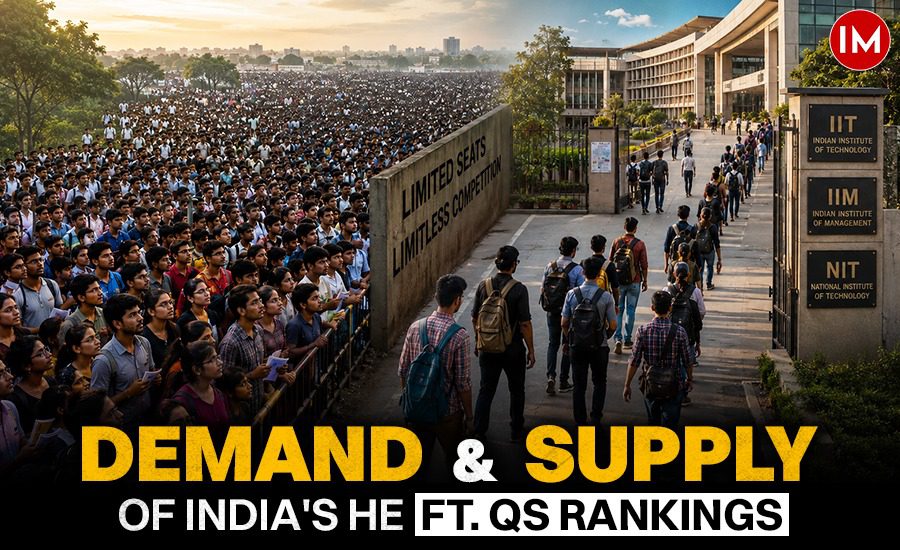
India’s higher education system faces a significant capacity challenge. Estimates suggest that the country would require approximately 14 new universities every week until 2035 to meet ambitious enrolment targets. This highlights the magnitude of demand pressure facing the system.
International branch campuses are emerging as one potential solution. States such as Maharashtra are developing education hubs such as International EduCity near Navi Mumbai International Airport, designed to host global universities with regulatory autonomy, flexible academic design, and shared infrastructure models. Institutions such as the University of York and the University of Western Australia are among those exploring such opportunities.
These developments are example of shift toward hybrid global education models, including joint degrees, co-teaching arrangements, credit transfers, and cross-border academic collaborations. However, regulatory complexity, faculty shortages, and funding constraints continue to limit scalability.
Reality Check: HE Expanding at Scale, but Collapsing in Quality at the Core
Despite India’s growing visibility in global rankings, multiple government reports, NITI Aayog assessments, parliamentary data, and independent studies reveal a crisis, one that is increasingly difficult to ignore. A foundational weakness is the acute faculty shortage across universities. Parliamentary and policy findings consistently show 30–40% vacancies in teaching posts, with some institutions reporting even higher shortages at senior levels. This directly weakens classroom learning, mentorship, and research output, turning many universities into under-resourced teaching hubs rather than knowledge institutions.
The crisis is most severe in State Public Universities (SPUs), which educate nearly 80% of India’s higher education students. A NITI Aayog report (2025) highlights that over 40% faculty positions remain vacant, and only small fraction of institutions have adequate research infrastructure, severely limiting academic quality and innovation capacity.
Funding patterns further expose imbalance. Gross Expenditure on Research and Development (GERD) in India remains around 0.6-0.7% of GDP, far below global innovation leaders like China (2.6%) and South Korea (5%+), according to recent policy analyses and government-linked R&D assessments. This chronic underinvestment has left universities producing publications, but not global-impact science or scalable innovation.
A parallel concern is the industry-academia disconnect, where despite rising graduate output, a large share of institutions remain poorly aligned with labour market needs. Though there are good efforts in this direction at policy level, but reports indicate high graduate unemployment and underemployment, with structured skill mismatches persisting even among degree holders, reflecting weak employability design in curricula and training systems.
The system also suffers from a deep research and innovation bottleneck. A NITI Aayog-backed “Ease of Doing Research” survey found that 76% of researchers report minimal industry support for R&D, along with delays in funding and weak postdoctoral ecosystems, highlighting why India struggles to convert academic output into innovation leadership.
On the infrastructure side, uneven and often inadequate learning environments, particularly in State universities and affiliated colleges, where outdated facilities, limited digital access, and weak library and lab systems remain widespread barriers to quality education.
Apart from this, one of the most critical issues is international isolation. Indian universities continue to lag in attracting foreign faculty and students, and remain weakly embedded in global research networks, limiting their visibility, collaboration, and competitiveness compared to rapidly advancing systems in China, Singapore, and the Middle East.
Policy Recommendations and the Road Ahead
India’s QS 2027 performance highlights the need for a deeper structural reset rather than incremental improvement. The core policy imperative lies in transforming scale into excellence through sustained investment in research ecosystems, institutional autonomy, and global collaboration frameworks.
Strengthening research funding through long-term institutional grants, expanding the role of industry-academia partnerships, and enhancing faculty recruitment flexibility are essential. Equally important is the need to deepen internationalisation by increasing foreign faculty participation, student mobility, and global research networks.
Curriculum reform must align more closely with industry demand, particularly in emerging sectors such as artificial intelligence, green technologies, and advanced manufacturing. Universities must evolve toward flexible, interdisciplinary, and skill-integrated models of education.
Without these structural shifts, India risks remaining a high-representation but mid-tier performance system in global higher education rankings.
Read Also: Why UPSC Prelims 2026 Has Sparked a Debate on Fairness and Inclusivity