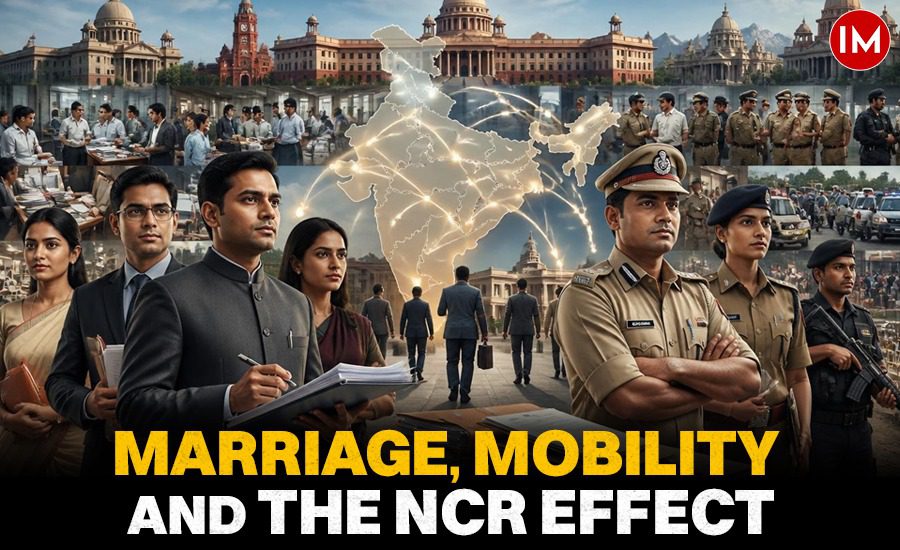
Haryana and Rajasthan emerged as preferred destinations for officers of the All-India Services, seeking inter-cadre transfers after marriage. Its proximity to New Delhi offers administrative roles and access to top-tier urban infrastructure, making it especially attractive for dual-career couples. The trend shows changing priorities among civil servants, who increasingly value work-life balance, family stability, and long-term quality of life alongside career growth. Haryana’s manageable cadre size and access to national policy networks further enhance its appeal.
However, the clustering of officers in one State raises concerns about equitable distribution of administrative talent across India, indicating a need to reassess how policy balances personal choice with systemic fairness.
New ‘magnet’ in the cadre map
Indian civil services have long had their “elite” postings, cadres like Uttar Pradesh, Maharashtra, Gujarat, Karnataka, and Tamil Nadu traditionally drew top preference for their scale, visibility, and administrative weight. But a quiet shift is seen in recent years. Increasingly, officers of the Indian Administrative Service and Indian Police Service are choosing Haryana, Rajasthan not at the time of initial allocation, but later, through marriage-linked cadre transfers.
Also Read – The Source Code Playbook: Rewriting India’s Defence Strategy for Tomorrow’s War
What was once a procedural exception is now a pattern. Haryana has, in effect, become the densest cluster of “power couples” in the All-India Services. The question is not just why Haryana or Rajasthan, but what this trend reveals about the evolving priorities of India’s bureaucracy. The answer lies at the intersection of policy design, geography, aspiration, and the lived realities of modern civil servants.
Rulebook that enables choice
The legal foundation of this trend rests in Rule 5(2) of the AIS Cadre Rules, administered by the Department of Personnel and Training. The rule permits inter-cadre transfers on marriage grounds, provided both spouses belong to All India Services and subject to approval by the Centre and concerned states. However, one crucial restriction applies: no officer can be transferred to their home state. This single clause has far-reaching consequences. It channels demand away from home cadres and toward “near-home” alternatives. Haryana, for officers from Punjab, Himachal Pradesh, Rajasthan, or even western Uttar Pradesh, becomes the closest viable substitute. The policy’s intent is humane, keeping couples together, but its design inadvertently creates geographic clustering. Over time, repeated approvals have normalised Haryana and Rajasthan as a preferred receiving cadre.
Geography as destiny: NCR effect
If policy opens the door, geography makes the two States, irresistible. These States wraps around New Delhi on three sides, placing it at the heart of the National Capital Region. Districts like Gurugram and Faridabad are not just adjacent to Delhi, they are functionally integrated with it. For civil servants, this proximity gives a rare administrative advantage: the ability to serve in a State cadre while enjoying the ecosystem of the national capital. This includes access to premier schools, advanced healthcare, policy networks, and professional opportunities for spouses.
In some cases, officers can even reside in Delhi while serving in Haryana and bordering Rajasthan, blurring the line between State and central postings. No other cadres offer this exact combination without the constraints of the AGMUT system. Therefore, the two States under consideration, becomes a “best of both worlds” option, field governance with metropolitan life.
Marriage as a policy lever: Exception to generalized trend
A look at recent transfers reveals the scale of the shift. Officers from cadres as diverse as Himachal Pradesh, Uttar Pradesh, Tripura, Andhra Pradesh, West Bengal, and Tamil Nadu have moved to Haryana and Rajasthan following marriage approvals. These include IAS, IPS, and even IFoS officers, cutting across batches and services. The pattern is consistent: one spouse is already in either Haryana or Rajasthan, and the other seeks relocation under spousal grounds. The approvals, granted by authorities such as the Ministry of Home Affairs or DoPT, reinforce the viability of the pathway.
Over time, this creates a feedback loop. Each successful transfer signals to future applicants that the two States is both desirable and attainable. The cadre becomes self-selecting. Importantly, very few officers from Haryana seek to leave under similar provisions, indicating asymmetry in preference. Haryana is not just receiving officers; it is retaining them.
Work, life, and the new bureaucratic aspirations
The rise of Haryana and Rajasthan also signals what civil servants value. Earlier generations prioritised scale of governance or political visibility. Today’s officers, particularly dual-career couples, weigh work-life balance, family stability, and long-term quality of life more heavily. Thus, these two States offers a hybrid model: meaningful administrative roles in districts that are geographically compact and well-connected, combined with access to NCR’s urban ecosystem.
For couples managing two demanding careers, this reduces the “coordination cost” of life, schooling, healthcare, employment opportunities for spouses, and proximity to extended family. The result is a more sustainable professional trajectory. Officers are no longer choosing between career and life; they are optimising both. Haryana and Rajasthan bordering the NCR, fits that equation unusually well.
Cadre economics and career calculus
Beyond lifestyle, there is a career growth dimension. Haryana is a mid-sized cadre, which often emerges into faster visibility, closer interaction with senior leadership, and potentially quicker access to key postings. Compared to very large cadres, where competition is intense and hierarchies layered, Haryana can offer a more direct administrative trajectory.
At the same time, Rajasthan’s bordering with NCR and its proximity to Delhi ensures that officers remain plugged into national policy conversations. This creates a dual advantage: State-level experience with central-level exposure. For ambitious officers, this combination is particularly attractive. It allows them to build a diverse profile without formally shifting to central deputation.
Rules and reality: Complexities and workarounds
Despite its appeal, the pathway to these NCR proximity States, is not always straightforward. The prohibition on home-state transfers can complicate cases, as seen when officers must choose alternative cadres or approach judicial bodies like the Central Administrative Tribunal. In some instances, both spouses cannot be accommodated in either cadre, leading to third-cadre solutions such as Punjab. There are also cases involving deputation when one spouse is not part of the All-India Services. These complexities highlight the tension between rigid rules and flexible realities. Yet, even within these constraints, Haryana often emerges as the preferred outcome. Its consistent appearance in such cases underscores its structural advantage within the cadre system.
Clustering effect: Efficiency vs equity
The concentration of officers in Haryana raises important questions. From an individual perspective, the choice is rational, driven by policy, geography, and personal priorities. But at the system level, it creates imbalances. Certain cadres may experience a relative outflow of officers, while others, like Haryana, accumulate talent. This clustering could affect administrative equity across states, particularly those already facing shortages.
The AIS framework was designed to ensure national integration and balanced distribution of talent. Trends like this test that design. Should policy be recalibrated to prevent clustering? Or should it adapt to evolving realities of dual-career households? There are no easy answers, but the questions are unavoidable.
Conclusion: More than a cadre, a signal of change
NCR Proximity State’s emergence as the preferred destination for civil service couples is not an anomaly, it reveals how policy frameworks, geographic advantages, and changing aspirations intersect to reshape institutional behavior. The AIS system, once defined by rigidity, is becoming more responsive to human realities. Yet, this responsiveness comes with trade-offs, particularly in terms of equitable distribution. As more officers make similar choices, the system will need to reconcile individual welfare with collective balance. Haryana today is the focal point of this tension. Tomorrow, it may well define how India rethinks the relationship between governance, geography, and the people who run the system.
Also Read – How Bihar’s NBPDCL Became One of India’s Top 5 DISCOMs Through Smart Governance and Technology