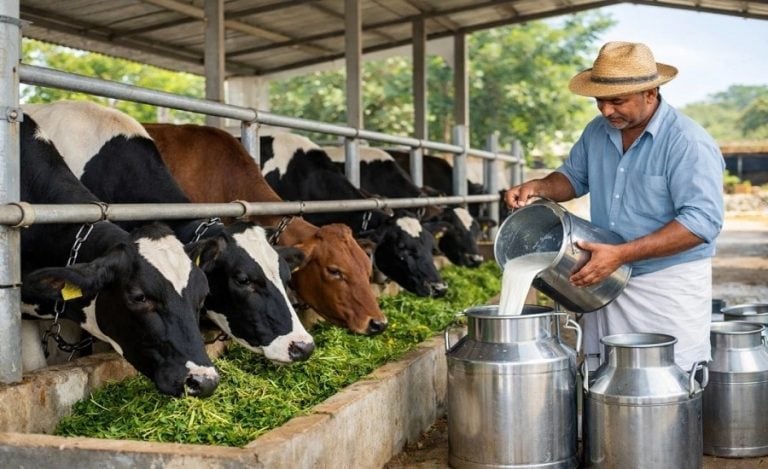
Since the first case of the deadly lumpy skin disease, which affects cattle, was reported on April 23 in Kutch, Gujarat, the outbreak of the disease has now been reported in over 20 states, the worst affected being Gujarat and Rajasthan. Farmers are becoming helpless as their cows are dying. Nearly 2 lakh cattle across the country have been affected by the Lumpy Skin disease and over 7300 cattle have lost their lives because of it.
To curb the spread of the rapidly spreading disease in Jodhpur, Rajasthan, the district administration launched the ‘Lumpy Skin Disease Prevention and Awareness Campaign’, which is proving to be successful.
In an exclusive conversation with Indian Masterminds, Additional District Magistrate of Jodhpur, Ram Chandra, shared details about the same.
WHAT IS LUMPY SKIN DISEASE (LSD)?
As per health officials, Lumpy skin disease (LSD) is a contagious viral disease that affects cattle. It is transmitted by blood-feeding insects, such as certain species of flies, mosquitoes, or ticks. It causes fever, and nodules on the skin and can also lead to death.
The infectious disease is caused by a virus called Poxviridae and is also known as the Neethling virus. Some of the basic symptoms of LSD in cattle are enlarged lymph nodes, lumpy skin, fever, and difficulty in movement.
Though LSD is spreading fast among cattle in India, officials and medical experts have confirmed that the disease does not spread in humans, even if they are in contact with sick cattle. However, it is extremely important to curb its spread as it is very dangerous for cattle.

SPREADING AWARENESS IN JODHPUR
As soon as the information about lumpy skin disease in cows came to the fore, all-around efforts were started by the district administration on a large scale. Under the direction and leadership of District Collector Himanshu Gupta, efforts were made to create awareness among the livestock farmers, while working on mission mode to deal with lumpy skin disease. The administration issued this instruction by making them aware of the initial symptoms of lumpy skin disease.
The concerned officials organized Gram Sabhas at the village level, where extensive information was shared regarding this disease. In these meetings, the general public and public representatives were made aware of the infection, prevention, natural measures as well as misleading information about this virus. The result of these meetings was that within a few days, people started gathering for the prevention of this disease, due to which efforts were made to save the cows from lumpy skin disease.
“We invited every single farmer, herder, and cattle-rearers from all the villages and collected them in a gathering. We explained to them the disastrous effect of LSD and made them aware of its symptoms. Further, we asked them to survey their respective cows to see if any of them show symptoms of the disease. If so, they were asked to contact us immediately,” Mr. Chandra said.

ISOLATION CENTRES
Just like affected humans were quarantined during the Covid pandemic, the affected cattle of Jodhpur are also being quarantined to further spread the disease from animal to animal. A large number of isolation centres established at different places in the district have proved to be very effective in breaking the chain of infection.
“As soon as these symptoms appear, we asked them to keep the infected cows separately and keep healthy cows at a safe distance from them. They were made to isolate the infected cows and immediately contact the Animal Husbandry Department to start their treatment,” he told Indian Masterminds.
The District Collector, after brainstorming on the information and measures to control the disease spread in animals, implemented the strategy made against it along the lines of Corona Guidelines. Due to this, the preventive and control activities stopped the spread of lumpy skin disease and the administration has been successful in controlling the disease to a great extent.

PRECAUTIONARY MEASURES
The farmers and herders were instructed to pay attention to all kinds of precautionary measures to protect the cows from infection. Special attention was asked to be paid to the cleanliness of the cowsheds and the place of keeping the cows to keep the remaining healthy animals from disease.
After surveying the domestic cattle, the administration then shifted their focus to stray cattle in the city, which weren’t under anyone’s care and, therefore, was at higher risk.
“This was a big challenge for us as there was no one to take care of them. The domestic cattle were being looked after and treated by their respective owners but this wasn’t the case with strays, who are extremely large in number. We formed teams of young volunteers and cattle protectors on Gram Panchayat Levels who were provided with financial assistance, necessary equipment, and human resources to take care of the strays in their respective areas,” shared Mr. Chandra.
If LSD symptoms were found in any cow, they were immediately shifted to isolation centres where their treatment began.

NATURAL REMEDIES
To save the cows from lumpy skin disease, the villagers used all possible indigenous and traditional medical methods at their level which proved to be beneficial as well.
“To protect the cows from infection, turmeric laddus are being fed to the cow mother, by the villagers, and at some places, an indigenous decoction is being given to cattle for consumption. Burning dry leaves of neem on cow dung in gaushalas also brought good results as smoke from it prevented the breeding of germs, mosquitoes, and flies. Similarly, regular bathing of cows with alum water is also proving to be very effective,” Mr. Chandra told Indian Masterminds.
As per the instructions of the District Collector, the officers are regularly inspecting the gaushalas of their respective areas to ensure cleanliness and fogging, spraying of medicines, and the implementation of all the arrangements to keep infected cows separate from healthy cows. Along with this, the work of vaccinating cows is also being done on a large scale.

PROPER BURIAL OF DECEASED COWS
It was very important for the administration to dispose of the bodies of dead cows properly. They couldn’t be left out in the open as flies and mosquitoes could breed on them and then come in contact with the healthy cows, thereby further spreading the disease.
Burial spaces were provided to the villagers for proper disposal of their deceased cows and the administration provided them with the help required for it. All the officials ensured the proper disposal of the dead cows in their respective areas on priority.

LSD STATISTICS
According to the statistical data provided by Mr. Chandra, as of 31 August 2022, a total of 11,14,906 cows have been surveyed in Jodhpur, out of which 1,06,705 cows were found to have symptoms of Lumpy Skin Disease.
Amongst them, a total of 1,01,440 cows went for immediate treatment. Out of them, 87,685 were successfully treated with LSD. However, around 3414 cows, unfortunately, lost their lives. The dead bodies of the deceased cows have been disposed of properly through burial.

With the directions and strict monitoring of the District Collector, war-level efforts were carried out in every field to save the cows from this disease. Along with administrative and departmental officers, doctors and personnel of the Animal Husbandry Department have been working day and night on mission mode, showing their strong and remarkable participation.
As a result, in just a few days, the mobility and mortality rate caused by this virus decreased and the situation became progressively under control than before.
It is the effect of the multi-faceted efforts in the Jodhpur district, that the administration was successful in preventing the spread of infection in time, which helped in controlling the disease.