Nestled in Maharashtra’s northwestern frontier, Nandurbar district unfolds across 5,955 square kilometers of verdant forests, rolling Satpura ranges, and vibrant tribal communities. Carved out from Dhule in 1998, this predominantly tribal region is both a land of natural splendor—home to the scenic Toranmal hill station—and a place of persistent challenges, from malnutrition to limited economic opportunities. Yet, a quiet revolution is underway, driven by design thinking and a vision for sustainable change.
Leading this transformation is Dr. Mittali Sethi, a 2017-batch IAS officer of the Maharashtra cadre and the District Collector of Nandurbar, who has partnered with BITS Design School Mumbai to reimagine the district’s future.
Over a five-week Transformational Design Course students from BITS, under Dr. Sethi’s mentorship, have collaborated with the district administration on three dream projects centered on nutrition, rural livelihoods, and entrepreneurship. This partnership, blending academic creativity with administrative resolve, is turning Nandurbar’s challenges into opportunities, empowering self-help groups (SHGs), strengthening farmer-producer organizations (FPOs), and fostering a cultural economy that promises to sustain generations.
A COLLABORATIVE VISION
Launched in early September 2025, the Transformational Design Course at BITS Design School Mumbai brought students into Nandurbar’s fold to tackle pressing challenges through a design lens. “My only condition was that I wouldn’t just teach; the students had to give me something tangible for my district,” Dr. Sethi shared in an exclusive interview with Indian Masterminds. This reciprocity transformed the academic module into a catalyst for four key “verticals”—projects tailored to Nandurbar’s needs, three of which were identified as dream initiatives: reimagining anganwadis, establishing a rural mart at Toranmal, and branding the Nandurbar Collective. The fourth, a pioneering transgender cafe, emerged as a beacon of inclusive entrepreneurship.
To ensure real-world impact, Dr. Sethi insisted on field immersion. Over two weeks, two batches of students travelled across Nandurbar’s Aspirational Blocks, interacting with SHGs, FPOs, and community stakeholders. “Coming to the field, talking to people, and seeing what Toranmal looks like when we talk about opening a rural mart was crucial,” Dr Sethi emphasised. This hands-on approach bridged abstract ideas with ground realities, enriching both the students’ perspectives and the district’s initiatives.
VERTICAL ONE: NOURISHING FUTURES THROUGH ANGANWADIS
The first vertical focuses on anganwadis—India’s frontline childcare centers—through a partnership with Feeding India, a Zomato-backed NGO combating hunger and malnutrition. Feeding India’s Daily Feeding Program reaches over 100,000 children nationwide, providing nutritious meals to low-income families. In Nandurbar, the administration is working with Feeding India to improve anganwadi facilities and ensure consistent meal delivery to address malnutrition among tribal children.
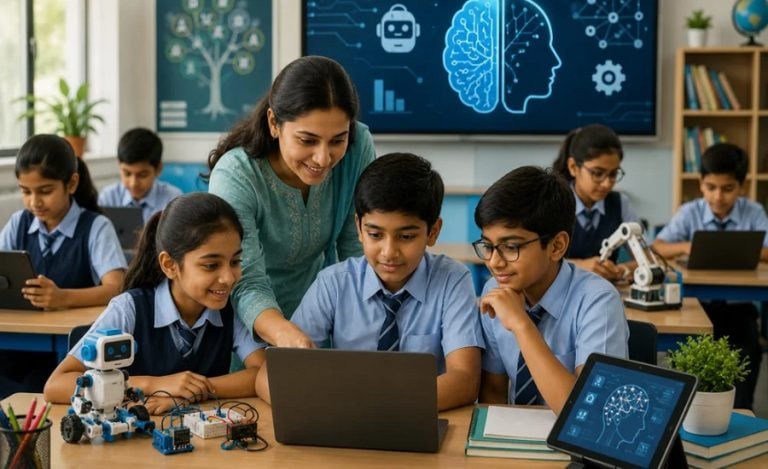
Students were tasked with creating feedback loops to ensure consistent attendance and effective nutrition delivery. “How do kids really envision an anganwadi and how is that entire ecosystem?” Dr. Sethi asked. Through field interactions, students gathered insights to design child-friendly centers. The first set of anganwadis is nearing completion, set to launch within a month, promising better nutrition and early education for Nandurbar’s youngest residents.
VERTICAL TWO: REIMAGINING THE RURAL MART AT TORANMAL HILL STATION
Toranmal, Maharashtra’s second-coolest hill station, is a scenic gem known for its millet flours, bamboo crafts, herbal oils, and handwoven shawls. Yet, as Dr. Sethi noted, “A lot of tourists come, but there is nothing that we are selling. That could be a low-hanging fruit.” The district is prototyping a Rural Mart, a cultural and commercial landmark blending sustainable architecture with local motifs. This mart will provide SHGs and artisans a unified platform to showcase their products, transforming fragmented sales into a cohesive experience that bridges tribal identity with urban and tourist demand.
Students contributed ideas on location, materials, and design, ensuring the mart reflects Nandurbar’s heritage. Funded locally, the project is in its early stages but is expected to take shape within four to six months, turning Toranmal into an economic hub for the region.
VERTICAL THREE: STORIES IN EVERY PACK: THE NANDURBAR COLLECTIVE
Nandurbar’s fertile lands yield strawberries and millets, nutrient-rich grains gaining global traction. The third vertical, part of the district’s dream projects, involves branding and packaging these products as the “Nandurbar Collective.” “Every product carries a story of its people and practices, but these often get lost in generic packaging,” Dr Sethi explained. Students were tasked with creating a unified identity that embeds cultural motifs, sustainability, and authenticity, enabling SHGs and FPOs to compete in local haats and digital marketplaces like Amazon.
This initiative not only boosts entrepreneurs’ incomes but also aligns with India’s push for millet-based foods. The students’ designs will create marketable products, potentially sold at the Toranmal mart, fostering economic self-reliance for rural communities.
VERTICAL FOUR: PIONEERING INCLUSION WITH TRANSGENDER CAFE
The most groundbreaking vertical is Nandurbar’s first transgender cafe, a container-based eatery set to open in the civil hospital. Partnering with the Centre for Youth Development and Activities (CYDA), a Pune-based NGO focused on LGBTQIA+ empowerment, the cafe will serve millet-based, homestyle meals 24/7 to patients and visitors. “It’s very special that we’ve trained transgenders to open a cafe of their own,” Dr. Sethi shared with Indian Masterminds. “We’re looking at how it can be a 24/7 thing.”
This project is part of broader inclusion efforts. On August 15, 2025, Dr Sethi launched a Transgender Cell in the collector’s office, creating personalised files for benefits, skill mapping, and livelihoods for every transgender individual. With CYDA’s support through entrepreneurship programmes and identity camps, Dr. Sethi aims to mainstream the community. “Our point is to make it feel normal,” she said. The cafe, nearly complete despite recent rains, is expected to open within a month, with initial seed capital provided but an emphasis on self-sustainability. “I told them, ‘I’ll give you the initial capital, but you have to run it. You’re no different from any other SHG,’” Dr. Sethi asserted.
Students demonstrated remarkable commitment, traveling to Nandurbar to inspect the cafe’s container, ensuring their design inputs enhance its functionality and symbolism.
The collaboration’s strength lies in its mutual enrichment. “They are young students… Even they bring such richness because their perspective is very different. I didn’t expect so much from them, but hearing their ideas has been very valuable.”
Through this vision, Nandurbar is weaving a tapestry of change. From anganwadis nurturing young minds to a rural mart celebrating tribal craftsmanship, from a collective that amplifies local stories to a cafe embracing inclusion, these initiatives reflect a district redefining its future. With each step, Nandurbar moves closer to a model of sustainable progress, where design and empathy converge to uplift lives and inspire hope.