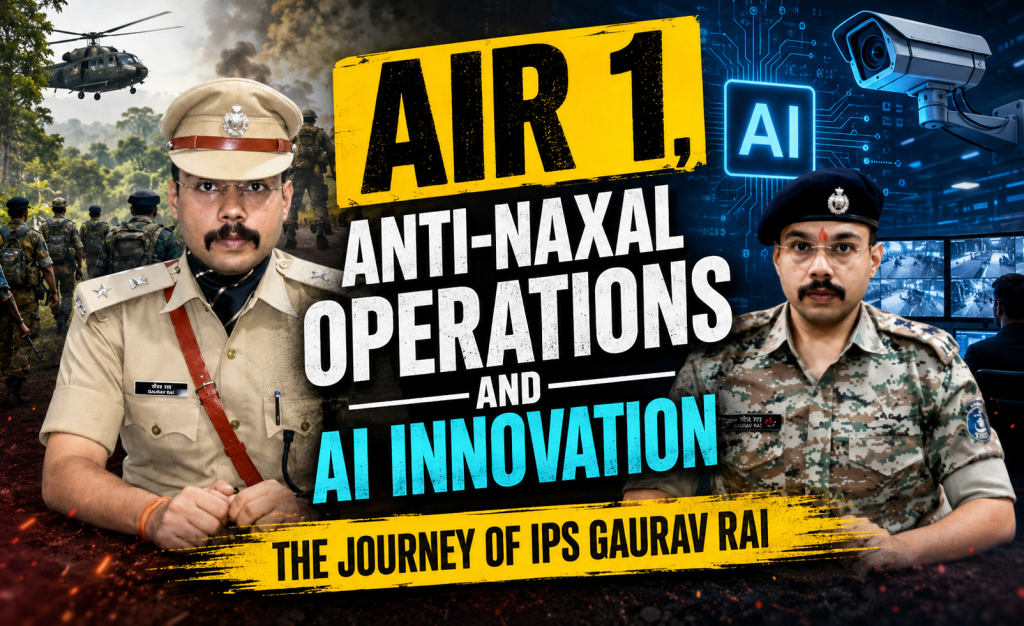
“I was a five-pointer in engineering college. If someone had told me then that I would one day secure AIR 1 in Engineering Services and become an IPS officer, I probably wouldn’t have believed them,” recalls Gaurav Rai, a 2019-batch Indian Police Service (IPS) officer of the Chhattisgarh cadre.
Today, Rai serves as the Superintendent of Police (SP) of Baloda Bazar-Bhatapara district. But long before he became known for leading successful anti-Naxal operations or developing an AI-powered policing tool, he was an average engineering student struggling to decide what to do next.
His story is not just about clearing one of India’s toughest examinations. It is about believing that consistent effort can overcome an ordinary beginning. It is about learning from every failure, embracing technology, leading from the front, and remembering that policing is ultimately about solving problems—not just enforcing the law.
An Average Student with Extraordinary Determination
Unlike many toppers who excel throughout their academic life, Rai says he was an average student during engineering.”I was not a brilliant student in college. I was what people call a five-pointer,” he says with a smile. There was no clear career plan. Like many engineering graduates, he often wondered what to do after college.
“My biggest question was, ‘What next?'” That answer came from his father, a civil engineer, who encouraged him to prepare for the Engineering Services Examination (ESE).
Rai admits he knew very little about the examination initially. But once he decided to prepare, he gave it everything he had. “I made every minute count.”
The effort produced an extraordinary result. He secured All India Rank 1 in the UPSC Engineering Services Examination (ESE) 2014, proving that determination matters far more than past academic performance. “Your past performance does not decide your future. If you dedicate yourself completely to a goal, you can achieve results you never imagined.”
Choosing the IPS for a Bigger Impact
After joining government service through Engineering Services, Rai could have settled into a comfortable career. Instead, he decided to prepare once again—this time for the Civil Services Examination. He says several senior officers encouraged him to attempt UPSC CSE because they believed he had the potential.
More importantly, he wanted to work where the impact on society would be larger. “It wasn’t about one service being better than another. Every public servant contributes in different ways. But I felt that civil services offered a wider opportunity to make a difference.”
The journey, however, was far from smooth. Balancing a full-time government job with UPSC preparation proved difficult. Multiple attempts did not produce the desired result. There were moments when he questioned whether he could ever give his best.
It was during this phase that his wife became his strongest support system. “She told me to take a long leave and prepare properly so that I would never regret not giving my best.”
He followed her advice.That final attempt earned him a place in the Indian Police Service. Looking back, Rai believes persistence mattered more than talent.
Leading from the Front in Bastar
As an IPS officer, Rai’s most defining assignment came in Bastar, where he served in anti-Naxal operations before becoming Superintendent of Police in Dantewada. When he took charge in Dantewada in 2023, morale among the force was low. Just weeks earlier, an IED blast had killed ten security personnel and a civilian driver.
Instead of rushing into action, Rai chose to listen. “I first wanted to understand my men, understand the enemy and understand the local society.” He spent days interacting with jawans, commanders and officers, trying to understand why operations were not delivering the desired results. He concluded that courage was never the issue.
The real challenge lay in planning, coordination and clarity. His objective became simple:
Maximum operational success with minimum casualties.
He introduced detailed planning before every operation. Every member of the team—from senior commanders to the youngest constable—was expected to know exactly what role they would perform during an encounter. “I wanted everyone on the ground to know their job. When every person understands their responsibility, confusion reduces and confidence increases.”
The strategy soon began producing results. Several successful operations were carried out without casualties to the security forces, including major coordinated missions that neutralised large numbers of Maoist cadres.
Winning Trust Beyond the Battlefield
For Rai, counter-insurgency is not only about encounters. He believes lasting peace depends on winning the confidence of local communities. “Operations are only one part of the solution. People must begin to trust the government.”
His teams regularly visited villages, organised outreach programmes, interacted with tribal communities and coordinated with the administration to ensure that development reached remote areas. Roads, healthcare, welfare schemes and sports activities became important tools for strengthening the relationship between people and the police.
“We wanted people to understand that we were there for them, not against them.” According to Rai, once people begin trusting the system, extremism gradually loses its influence.
Using Artificial Intelligence to Solve Everyday Problems
While leading field operations, Rai also found himself thinking about another challenge facing police forces across the country. Investigators spend countless hours reviewing CCTV footage. A single case often requires multiple officers to examine recordings from several cameras over several days.
“It is repetitive, time-consuming and prone to human error.” Instead of accepting it as part of policing, Rai decided to build a solution.
He is currently developing an AI-powered CCTV video analytics platform designed to automatically analyse footage and identify important events. Rather than replacing investigators, the software aims to help them work more efficiently. “The software should analyse the footage and tell us where something important has happened instead of forcing officers to watch everything.”
What makes the project remarkable is that Rai is developing it himself. Although he does not come from a computer science background, he believes artificial intelligence has changed the way innovation happens. “Earlier, coding looked like something only software engineers could do. Today, AI has made it much more accessible.”
He believes officers working in the field understand operational problems better than anyone else. If they use AI wisely, they can create practical and low-cost solutions tailored to policing. “We know the problems because we face them every day. AI gives us an opportunity to build our own solutions.” He also points out that in-house innovation saves public money by reducing dependence on expensive commercial software.
Learning Before Changing a System
Transfers are a regular part of an IPS officer‘s career. Many officers try to introduce immediate reforms in a new district. Rai follows a different philosophy.
“I don’t rush into making changes. I first understand the district, the people and the challenges.”Only after studying the system does he begin implementing improvements. He also believes outgoing officers should properly brief their successors so that good initiatives continue without interruption. “Every officer tries to do the best possible in the circumstances. Our responsibility is to build upon what already exists.”
Leadership Is About Responsibility
Throughout his career, one principle has remained constant. Leadership is not about authority. It is about responsibility. “Our personnel trust us with their lives. That trust brings enormous responsibility.”
Every operation, every innovation and every administrative decision must therefore be guided by careful planning and calculated risk. Rai believes learning never stops.
Whether analysing a counter-insurgency operation or developing an AI application, every problem offers an opportunity to improve. “Every problem has a solution. We may not find it immediately, but if we keep analysing and working sincerely, we will definitely move closer to it.”
From a five-pointer in engineering college to AIR 1 in the Engineering Services Examination and now a young IPS officer leading one of the country’s most challenging police assignments, Gaurav Rai’s journey proves that success is not determined by where you begin.
It is determined by how willing you are to keep learning, keep improving and keep moving forward.