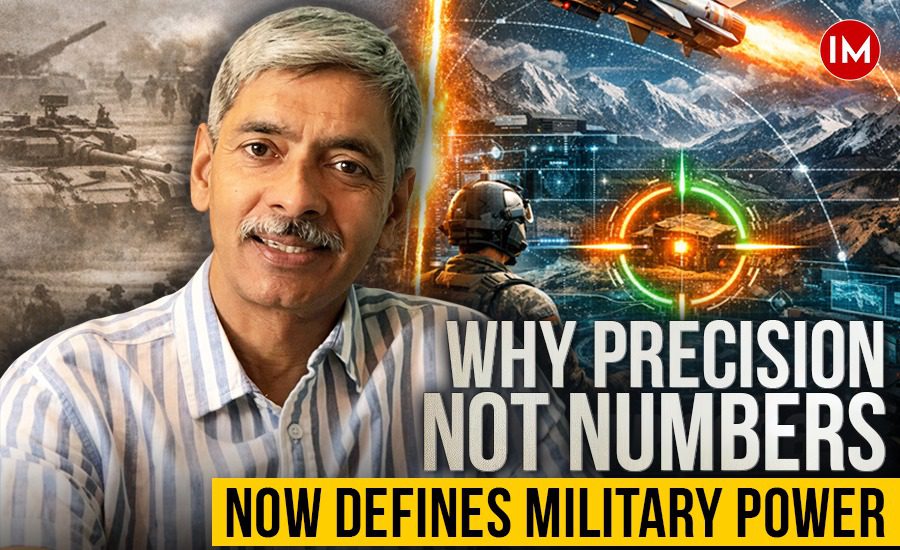
For much of my service, military strength was judged by scale. More guns deployed meant reassurance. Longer fire plans and degradation meant certainty. Commanders slept easier when the guns and gunners were available and targets softened up and degraded before the main assault went in.
That comfort has vanished.
Modern battlefields have stripped away that illusion where quantity guarantees control. Precision in intelligence, targeting, and execution have now emerged as the real determinant of power. This is not a cosmetic evolution. It marks a structural shift in how wars are fought (will be fought), escalation managed and credibility is assessed.
In modern warfare, ACCURACY now intimidates more than MASS AND VOLUME ever did.
Lethality now has finally detached itself from numbers and volume.
In Ukraine, an unforgiving lesson was learnt. Armoured formations once seen as symbols of dominance now struggle to survive in an environment saturated with sensors, precision-guided weapons, and drone warfare. Tanks are no longer neutralised by superior numbers of tanks. They are taken out by accurate intelligence, a drone feed and a missile costing a fraction of the platform it destroys.
Nagorno-Karabakh (Armenia- Azerbaijan conflict) delivered an even starker message. Three decades of fortifications and massed artillery positions collapsed under persistent, precise drone strikes. The defenders were not overwhelmed by firepower. They were dismantled systematically, sensors blinded, command nodes eliminated and morale eroded before traditional battlelines were even engaged.
Precision lethality attacks confidence, before it actually attacks capability, and that is what the modern warfare is all about.
This shift is now very much visible how the world’s most formidable militaries now choose to strike. When the United States conducted precision strikes against Iranian-linked nuclear and strategic facilities, it deliberately avoided prolonged campaigns or saturation bombing. The strikes were intelligence-driven, highly calibrated, and politically controlled. Capability was degraded and escalation managed.
Precision in this context, became deterrence by design.
The Ukraine–Russia conflict reinforces the same logic daily. Russia’s reliance on massed artillery barrages had produced destruction but not decisive advantage. Ukrainian forces, operating with superior fused- intelligence and precision weapons have repeatedly targeted ammunition depots, logistics hubs, bridges, and command centres much in depth. There was no headline-grabbing fire assaults or airstrikes but they were instead system-decapitating strikes.
Remove logistics, command- communication coherence numerical strength becomes redundant.
India’s own experience in Operation Sindoor reflects this strategic maturity as the operation was defined by clarity of intent and accuracy of execution. Targets were carefully selected. Intelligence drove decisions. Escalation was consciously managed and any sort of spectacle avoided.
India demonstrated that it could strike decisively without destabilising the wider strategic environment.
Restraint displayed was not weakness but showcased our confidence.
This is why precision has replaced volume as the new measure of power. Modern battlefields are transparent. Satellites, drones, electronic surveillance, cyber intelligence, and open-source data ensure that nothing significant can remain not visible for long. Concentration and massing of forces attracts attention and which will in turn invite precision targeting.
Time has also become critical and decisive. With collapsing of decision cycles wars are now fought at Formula 1 speed. The side that can detect first, decide faster, and strike accurately can gain an advantage disproportionate to its size. Precision lethality compresses conflict and eliminating the right things early.
There is also a geopolitical reality at play.
In a nuclearized and economically interdependent world, escalation control matters as much as battlefield success. Conventional warfare carries unacceptable political, economic, and diplomatic costs. Precision offers flexibility. It allows force to be applied selectively, proportionately, and credibly allowing space for diplomatic mediation even while demonstrating resolve.
This is where India’s global relevance becomes evident.
As an emerging world power and a leading voice of the Global South, India today matters in every serious strategic conversation involving the United States, Russia, and China. It stems from our demonstrated capability combined with restraint.
Precision strikes like Operation Sindoor are read internationally as evidence of a state that understands when to read the riot- act and when to stop against an adversary.
Incidentally precision warfare is not just about technology but more about leadership.
As precision exposes judgment every strike made becomes an unmistakable responsibility as every decision is visible and every error amplified. For there is no hiding in ambiguity.
Many forces acquire precision weapons without decisive thinking. Platforms are inducted, but processes remain unchanged. True precision lethality demands jointness and integration. Sensors, shooters, cyber, space, and command structures must function as a single military eco- system. Execution decentralised but with clarity of purpose and intent.
From Indian context precision lethality is simply not about acquiring more platforms instead it is integrating what already exists faster, smarter, and jointly and swiftly. Precision lethality is that application of intelligence modern day weaponry and systems and the leadership that authorises their use.
Future conflicts will not reward those who mobilise the most. They will instead reward those who think clearly under pressure, discern and detect patterns early and act decisively with restraint.
Volume once symbolised strength. Today, it appears to display your vulnerability.
Precision lethality is not about doing less damage. It is about achieving a swift, selective, decisive, and strategic effect. That is the new grammar of power and those who fail to learn it today will discover that volumes and numbers alone will never be able to protect them.