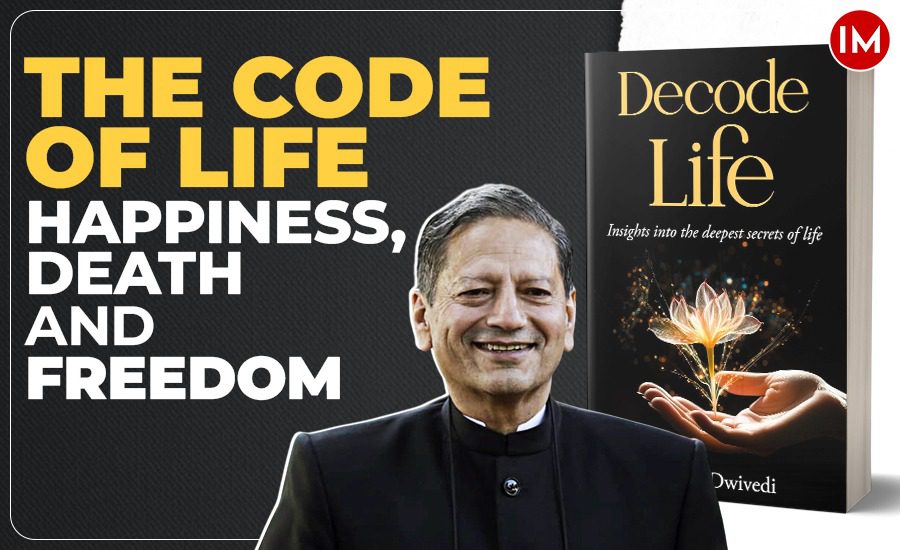
Let’s set the context before we get to the ‘code’. The author is an alumni of IIT Delhi, IIM Bangalore and Cambridge and a serving member of the IAS. In the conventional sense, he should have written a book on project management skills or the mainstreaming of AI in governance, or of his field experiences of three decades in J&K and the Union government. However, what he has chosen to write is a deep philosophical tract on understanding life with a capital L.
The questions he asks are not new–they have been asked from time immemorial–Nachiketa raised these issues, and Arjuna did the same in the battlefield of Kurukshetra, it was the in the search of these answers that Gautama, the Buddha left his palace. This is the reason for Alexander Pope’s famous lines: “Know then thyself, presume not God to scan, the proper study of mankind is man”. This is the question which Iqbal asked in Shiqwa–what is life? What are its deepest secrets? How does one achieve happiness? or is it equanimity that one should be looking for?
In the introduction itself, Dwivedi says that this is not a fast-paced book to be read in one sitting. It has to be absorbed at its own pace. But the book captivates, and each section leaves you wanting to know what follows in the next. For those who have practiced Vipassana, and spent some time in solitude observing their own breath, and/or have also had some reading of the Bhagwad Geeta, it is perhaps easier to comprehend the underlying philosophy which is spelt out in eleven sections: the six attributes of life, understanding happiness, knowing death, the circle of life, the search for freedom, knowing without judging, a journey of discovery into ‘who am I’, the concept of free will, the paradoxes of modern life and finally, the transmission and the meaning of Life. Of these the second, third, fourth, fifth,sixth and seventh chapters are supplemented with short parables which carry a profound meaning and significance.
What then is the essence, or the big takeaway from this pithy offering. First and foremost is the fact that we all seek happiness and immortality, knowing fully well that this is an impossibility paradigm. We seek to be free and assert our individual identity in a world of perceptions in which everything is contextual-for nothing in this universe (or should we say, multiverse) is absolutely good, or absolutely bad. Dwivedi tells us that as our existence is bound to the realms of time, space and energy: these three are the limiting factors in the process of experiencing happiness, which comes as a package deal with unpleasantness in tow. In the follow–up story, we learn of the interplay of trigunatmaka prakriti–the three fold attributes of the sat,rajas and tamas, all of which are present in varying shades in each one of us.
In the section on death, we gain insight about the three reasons on account of which we fear death. These include the fear of losing all we have, because in life our conduct has often been selfish and violent in thought and deed. To conquer the fear of death, Dwivedi prescribes five principles: understanding the limited value of material possessions, performing our actions with a sense of duty, abjuring
That everything in this universe is in the realm of time, space and energy is again reiterated in the section of the circle of life. Because energy is neither created, nor destroyed, it can only get converted from one form to another. This conversion is reflected as cause and effect–a continuous cycle that does not, rather, cannot be stopped even with the rite of passage that we call ‘death’. For ‘you and I have existed for ages, and will continue to exist–for death simply changes the coordinates of the triad of time, space and energy’. We have the option of either hyperbolizing ourselves into infinite circles, moving away from the center, or reducing the size of the circle to a ‘point’-the Bindu–where we become our true selves, beyond the pale of causation.
Let me now quote a remarkable passage from the section ‘The search for Freedom’: “Love directed towards material things with a desire to possess and accumulate is greed. Love directed towards a person with sexual desires for pleasure is lust. Love directed towards a person with a desire to nurture is care. Love directed towards the thought of losing something is fear. Love directed towards a thought of unfulfilled desires is anger. Love directed towards a thought of unpleasantness is disgust. Love directed towards a thought of uncertainty is anxiety. Love directed towards a thought of comparison is envy, jealousy and pride. Love directed towards the thought of losing control is stress. There are hundreds of such emotions. But the root of all is love.”
In ‘Knowing without Judging’, the key message is that nothing is good or bad in itself–the key is perspective and context. An adversity of today has the potential of being the real source of salvation in the future, as illustrated in the tale of the man with the missing thumb.
The seventh section ‘Who Am I’ asks: am I the ego, or beyond? For it is the ego, which separates us from the rest, causes us to believe in ‘doership’, which then leads to all the attachment, and the attendant pros and cons. The search for the true self begins only when the ego is eliminated.
But it is possible to do so? Yes. For human beings have Free Will, which enables us to realize our true potential. Once a person realizes that the source within is infinite and limitless, transcendence is an imminent possibility. And yet, the paradox of modern life is that human beings are so affected by externalities over which they have little control, whereas the only thing they can control is their reaction to any given situation. The more equanimous one is, lesser is the stress. As life will have its ups and downs, it is better to understand it as a passing phase, and focus more on the internal, core elements which define our real self.
The penultimate section is on Transmission of the life force–which is beyond the five elements–Panch Mahabhutas: air, water, fire, earth and ether. And finally, in the last section -Meaning of Life, Dwivedi leaves with the profound insight that rather than looking for a meaning in life as it is, life expects us to add meaning to it from the myriad patterns that it weaves around us.
Doing this requires us to understand the code of life. Here is an invite to join the select club of those who have cracked it, and are happy to share it with those who want to tread the path!