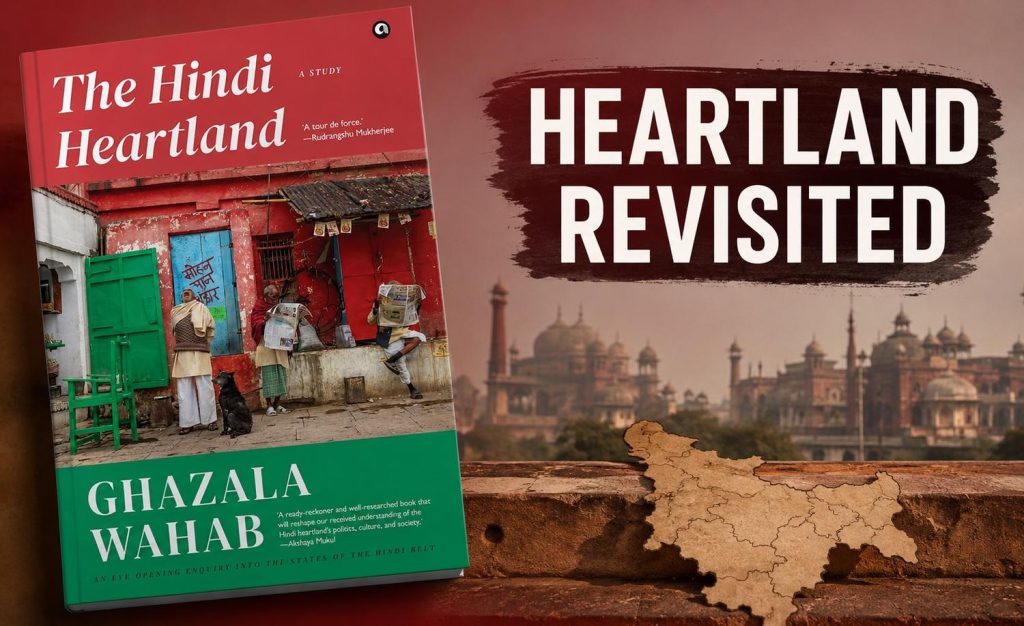
First things first. The Hindi Heartland is an excellent book, and while we may draw our own interpretations from the minefield of data which Ghazala Wahab (a true Hindi heartlander from Agra and Delhi) brings to the table, the uncomfortable questions she raises—about caste, religion, Hindutva, reservations and growing polarization—must engage every Indian, especially non-Hindi heartlanders (like me). For what, if I may ask, gives Hindi-speaking states the prerogative to assume that they constitute the heart of the nation in the anthropomorphic sense of the term? India’s national anthem begins with Punjab, Sindh, Gujarat, Maratha, Dravida, Utkal and Banga, before Vindhya, Himachal, and the Yamuna and Ganga.
The book’s geographical expanse of the Heartland stretches from Rajasthan to Jharkhand with Madhya Pradesh, Chhattisgarh, Bihar, Uttarakhand, and Uttar Pradesh in between. To my mind, Himachal could have been included as well, since it was carved out of Punjab on the basis of its lingua franca being Hindi amongst highlanders. 13 out of 16 Mahajanapadas in the kingdom of Emperor Ashoka were from the Hindi heartland; a few centuries prior, in the Kurukshetra war of the Mahabharat, the bulk of the 18 Akshauhini military formations between the Kauravas and the Pandavas also came from the Kuru kingdom (spanning modern Haryana, Delhi, and western Uttar Pradesh around Hastinapura and Indraprastha), the neighboring Panchala kingdom (central/western UP) as well as Matsya (Rajasthan/Jaipur region), Surasena (Mathura region), Chedi (Bundelkhand region), Vatsa (Prayagraj/Kaushambi region) Anga and Magadh (Bihar).
While Magadh continued to be an important epicenter right up to the time of the Mauryan Empire, the Surasena Janapada in the Delhi-Mathura-Agra belt also punched well above its weight. Akbar’s kingdom had sixteen subahs, and its two most important cities of Agra and Delhi were part of the Heartland. The Mughals expanded agriculture, manufacturing and commerce by providing a pan-India market as well as a stable regime for trade beyond the borders. Wahab believes that if Aurangzeb had not moved out of the HH to extend the regime to the Deccan, the Mughal empire would not have ended the way it did. Be that as it may, the decline of the Mughals saw the rise of the East India Company, which used Indian money and Indian troops to achieve their decisive victory at Plassey. The de jure power of India vested with the Mughal Emperor at the Red Fort in Delhi till the defeat and exile of Bahadur Shah Zafar to Burma in 1857. Even as the EIC made Calcutta the capital city, the Queen’s proclamation of 1858 was made at Allahabad in the Heartland, and over the next six decades Delhi would again be resurrected as the capital of India.
Read Also: ‘My Last Autobiography’: A Moving Meditation on Ageing, Memory and the Will to Live
Wahab argues that the rule of the EIC was more rapacious than anything that India had seen before. Other rulers—except for invaders—had a vested interest in ensuring that prosperity was a leitmotif both for the urban settlements (the Ganj) and rural habitations (the Kasba), since the bulk of revenue came from agriculture. Benefactors lived, worked and spent their resources within the subcontinent, and despite glaring inequality there were no known cases of starvation deaths or serial famines because public works were put into motion at the hint of any such occurrences. But the shareholders of the EIC had no fidelity to Indian soil, and every decision aimed to extract as much profit as could be squeezed.
The British diverted agricultural land from traditional peasant economy staples like paddy, millets and wheat in forcing farmers to grow cash crops like indigo, opium, jute, sugarcane – besides diverting thousands of hectares for tea and coffee plantations which led to a series of famines. Their narrative of India as a jewel in the dazzling British Empire was a successful one; it took Dadabhai Naoroji and RC Dutt to document the drain of the Indian economy and the ruthless exploitation of peasantry for it to crack. Slavery had officially been abolished, but indentured labour had not; hundreds of thousands of Indians were uprooted from their land for generations. The British were then successful in building myths around “martial” and “non-martial” races while recruiting soldiers for their army from regions which had been loyal to them in 1857. They had realised that the best way to govern was by dividing India’s communities on everything from language to participation in education.
Caste is more salient than religion, Wahab avers, as is also narrated through Ambedkar’s lived experience in ‘Waiting for a Visa’. She delves into the growing marginalization of tribes who have been shelved as a category under Fifth and Sixth schedule. Even as Birsa Munda is appropriated by both the Left and the Right, his tribal kinsmen are systematically deprived of their rights in the forest. But religion was the faultline which the British government systematically exploited towards Partition in India. Her take on the freedom struggle delves into a counter-narrative on Chauri Chaura – while Gandhi and the Congress mobilised funds for the 22 policemen who had died, she questions whether there was adequate inquiry into the circumstances which provoked the protestors into storming into the police station.
Finally, Wahab covers one of the most contentious debates of Independent India — the demolition of the Babri Masjid in 1992. A Constitution had been formally adopted by the Indian government, but its tenets had not become commonplace within the still-new country’s administration. The genesis of the Babri Masjid contention lay in the complicity of then-DM of Faizabad (as Ayodha was called) installing a statue of Ram Lalla in the mandir, and the failure of Prime Minister Nehru to get his own CM to act against the responsible duty-holders. Indira Gandhi and Rajiv Gandhi also appeased the RSS on the issue of the Babri Masjid, and this makes it clear that while the rhetoric and grand narratives of the Congress may have been different, political parties calibrate their public statements to complement the public mood.
In Wahab’s view, the Hindi Heartland sets the template for India. My prognosis is different. India is changing, and the change is faster than what political leadership across parties can understand. Defining characteristics today are unprecedented urbanisation and migration on account of an all-India labour market, along with greater enrolment of women in institutions of higher education and feminisation of the workforce across sectors. The two major protests of this decade — the farmers’ agitation in 2020 and the 2026 Gen Z movement against exam discrepancies — were driven by neither caste nor religion, but instead issues of perceived loss around assured income and potential livelihoods. The next census will confirm that India no longer lives in villages. In the delimitation that will follow, the number of India’s legislators and parliamentarians will register a four-fold increase — from 8% at present to at least 35% — thereby changing our country’s political dynamics forever. The New India will be defined by the New Voter, and hopefully that is a fact to celebrate!
Also Read: Rani Gaidinliu: The Untold Saga of the Naga Queen Who Defied the British