Let me, at the very outset, disclose four clear connections with the author Som Kamei. These include JNU, our common alma mater, and then LBSNAA where he did his foundation course in 1998 when I was the Deputy Director of this apex civil services training institution. The third link emerged at the VoW–Auroville Literature Festival, where Som’s book on Rani Gaidinliu provided the base material for Aashisha Chakraborty’s featured historical fiction novel The 13-Year-Old Queen and Her Inherited Destiny. Last, but not the least, the North Eastern Council (NEC) Secretariat, where Som is Planning Advisor, is taking care of logistics for my research on Bob Khathing, who like him is a Manipuri Naga. But while Khathing was a Tangkhul Naga, Kamei, like the eponymous protagonist of this book, is a Zeliangrong Naga – an amalgamation of the Zeme, Liangmei, and Rongmei Naga sub-tribes in the contiguous hill areas of Manipur, Nagaland, and Assam. The Zeliangrong have been asking for an autonomous region/council within India’s constitutional framework. However, as their numbers are scattered across three states, a realistic framework in which their cultural, social and indigenous faith traditions can be protected and preserved has not (yet) seen the light of the day.
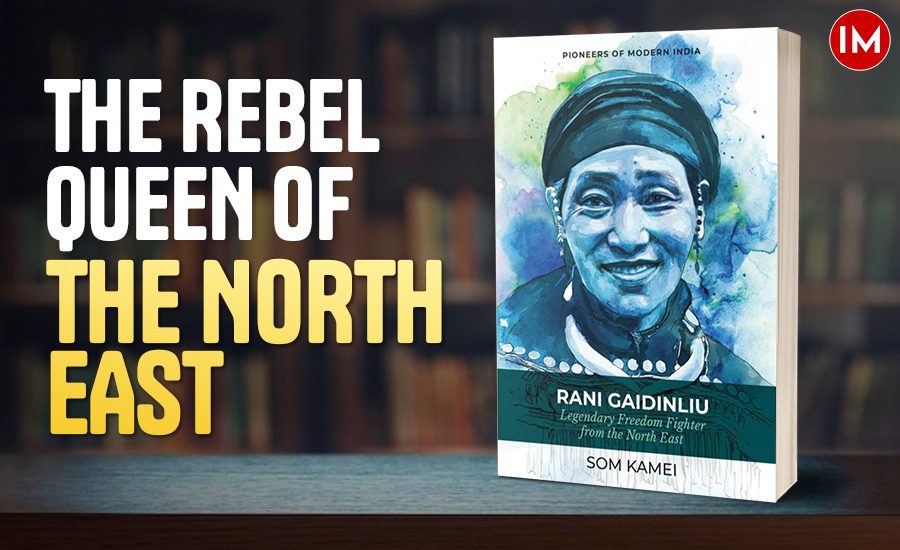
This review is about Som’s well-researched monograph Rani Gaidinliu: Legendary Freedom Fighter from the North East published by Niyogi Books, as part of their Pioneers of Modern India series. It offers a balanced perspective on of the most remarkable yet frequently misconstrued figures of the Indian freedom struggle. Unfortunately, the resurrection of her memory is often juxtaposed against the majoritarian Naga narrative which considers Heraka – the back to the roots, socio-religious reform and indigenous faith movement of the 1920s – as anti-missionary and anti-Christian. Thus, the portrayal of Rani Gaidinliu (1915-1993) as a valiant anti-Imperialist freedom fighter who deserves national recognition is opposed by elements which owe their affiliation to one or the other underground factions of the Nationalist Socialist Council of Nagaland (NSCN).
Trained as a sociologist and an administrator, Kamei approaches his subject not merely through the lens of a standard chronological history of India’s freedom movement, but also within the structural context of tribal identity, colonial policy, and internal community dynamics. He traces her trajectory from being a young girl in a remote village to becoming a formidable leader of the Zeliangrong Naga community.
Also Read- From AI to Gram Panchayats: India Celebrates 17 Digital Governance Breakthroughs at NAeG 2026
The book begins with her cousin brother, Haipou Jadonang, who in 1926 established a religious reform movement aimed at consolidating the Zeliangrong identity to resist British colonial exactions of pothang bekari and pothang senkhai. The former was the enforced house tax of Rs. 3 per month, even if one was unemployed; the latter mandated villagers to provide visiting officials with food and lodging and transport logistics.
Following her brother-mentor’s execution by the British in 1931, the teenage Gaindinilu assumed both the spiritual and military mantle of Haipou Jadonang’s Makam Gwangdi (Naga Raj) movement. Kamei captures the intensity of her guerrilla resistance against the British, her eventual capture in 1932, and her subsequent fourteen-year incarceration. A significant highlight is her intersection with mainstream nationalist politics, specifically when Jawaharlal Nehru met her in Shillong jail in 1937. It was he who first addressed her as the ‘Rani’ of her people, and attempted to secure her release.
During his visit to Sylhet in December 1937, he wrote: “… six years ago, when the civil disobedience movement blazed over the length and breadth of the country, news of Gandhi and the Congress reached her in her hill abode, and found an echo in her heart. She dreamt of freedom for her people and the ending of all restrictions they suffer from, she raised the banner of independence, and called her people to rally around it… and now she lies in some prison in Assam, wasting her bright young womanhood in dark cells and solitude… and India does not even know of this brave child of her hills, with pride. A day will come when India will remember her and cherish her, and bring her out of her prison cell.”
Although by 1938, Assam had a Congress government under Gopinath Bordoloi, the Excluded Areas (to which Giandinliu belonged) were not under the jurisdiction of the provincial government. Nehru therefore wrote to an influential member of the British parliament, Lady Nancy Astor, to secure Rani’s release. The Manipur Mahasabha (a Congress affiliate) also petitioned their Maharaja for the same – Rani had been born in Manipur – but to no avail.
Her jail term made her a polyglot: she could speak Manipuri, Assamese, Khasi, Hindustani, Kachari (Bodo), Mizo and of course her own Naga language. Nehru was finally able to secure her release from the Tura jail in Assam in 1947, but as Manipur would not agree to have her back in the state for the next five years, she settled in Mokokchung (then part of the Naga Hills district) with several restrictions on her movement. She did, however, start receiving recognition as a freedom fighter, a monthly pension of Rs 15 and security from Nagaland Police. Finally, when restrictions on her movement were lifted, she settled in Tamenglong in Manipur, which had a substantial Zeliangrong population, and then began her quest for a homeland movement.
According to Prof. Gangmumei Kamei, the decade from mid-fifties to mid-sixties marked three distinct, interrelated and to some extent, conflicting political pathways for the Rani and her followers. First, unlike the extreme radical Naga groups, the Rani participated in the national political process as it was necessary for the social and economic development of her people. She was also actively engaged in seeking a Zeliangrong homeland for strengthening the Zeliang identity (which was resisting the overarching trend of missionary proselytization), and she also identified herself as a proud Naga who supported a pan-Naga movement (with the caveat that the Zeliangrong would retain its distinct identity within the larger Naga spectrum). However, differences surfaced between the Zeliangrong supporters and members of the NNC when her Heraka movement was criticised as anti-Christian.
After Nagaland achieved statehood, in 1963, CM Shilu Ao sought to bring her out of hiding. This task was entrusted to a young IAS officer Subodh Chandra Dev, then posted as the ADC in the Zohenoboto subdivision. Rani wanted to meet Dev without his security contingent: he agreed, and thus began a relationship of trust and affection in which he addressed her as mother. She told him, ‘For my people, I want no state, no country, but only a Zeliangrong district within any state of the Indian Union.’ She also clarified that she was not against Christianity, or for that matter any other faith, but as she said, ‘We are Nagas, and should live like Nagas. We have beautiful folklore and folk songs, colourful dresses and culture.
When we see these new converts copying western ways in a cheap manner, it pains me.’ Dev also recalls her meeting with Prime Minister Indira Gandhi: ‘The PM stood draped all over with the colourful Zeliang(rong) attire and jewelry presented to her by the Rani’ and ‘assured her that she would do everything possible to develop the Zeliangrong area as quickly as possible’. However, even though the Rani was given the Tamra Patra Freedom Fighter Award in 1972, the Padma Bhushan in 1982 and the Vivekananda Seva Award in 1983 for her role in community service and the revival of indigenous tribal culture, alongside several assurances by Prime Ministers India Gandhi, Rajiv Gandhi, VP Singh and Narasimha Rao, her quest for the Zeliangrong homeland remains unfulfilled. In her centenary year, Prime Minister Modi and Home Minister Rajnath Singh launched a one-hundred-rupee commemorative and a five-rupee circulation coin in honour of Rani Gaidinliu. Her legend grows, but the hope for a Zeliangrong Council continues to be a quest in the present continuous.
Also Read – IFS Gitanjali Janarthanan: The Woman Behind Vindhya Herbals’ 42 Crore Growth Story