Temples in India witness massive and often unpredictable crowds, turning faith into one of the largest movements of people in the country. From the scale of the Kumbh Mela to daily footfall at Tirumala Venkateswara Temple and surges at Khatu Shyam Ji Temple, managing devotees has become a critical governance challenge. Traditional methods have often struggled, leading to tragic incidents such as the Ratangarh Temple Stampede (2013) in Madhya Pradesh and recurring concerns at Jagannath Temple in Puri. The article highlights a gradual shift towards better planning and structured systems, where real-time monitoring, improved communication, and coordinated administration are helping manage crowds more effectively.
Weight of Faith and the Challenge of Managing It
In India, devotion goes beyond belief, bringing together millions in constant motion across pilgrimage routes. Every day, millions of devotees travel across temple towns and pilgrimage routes, often covering long distances for darshan. At its peak, this movement becomes staggering. The Kumbh Mela has seen over 200 million visitors during its cycle, with the 2019 Prayagraj Kumbh alone recording around 50 million footfall on a single auspicious bathing day. Similarly, shrines such as Tirumala Venkateswara Temple receive between 50,000 to 1 lakh devotees, while seasonal peaks at Khatu Shyam Ji Temple can push numbers into lakhs within hours.
This sheer scale turns faith into one of the largest forms of human mobility in the country. But unlike planned public events, pilgrimages unfold organically. Devotees arrive driven by belief, word-of-mouth, and auspicious timings rather than fixed schedules. This makes crowd patterns highly unpredictable. For decades, crowd management depended largely on barricading, manual supervision, and police deployment. While these methods helped maintain basic order, they often struggled during sudden surges, extreme weather, or panic situations.
The consequences of this gap have been visible time and again. The 2013 Ratangarh Temple Stampede claimed over 100 lives after panic spread due to rumours of a bridge collapse. Also, concerns have been raised during peak days at Jagannath Temple, where overcrowding and lack of clear movement systems have led to distress among devotees. These incidents are reminders that managing faith at scale requires more than just physical control, it demands foresight and coordination.
In recent years, however, a visible shift has begun. Across several major temples, new systems are being introduced to better understand and manage crowd movement. The evolving model at Khatu Shyam Ji Temple exhibit this change, where real-time monitoring, better coordination, and structured planning are helping create a safer and more orderly darshan experience. As religious tourism continues to expand, with pilgrimage forming a major share, the focus is gradually moving towards systems that ensure both safety and dignity for every devotee.
Also Read – How A Single-Minded Devotion of Divyanshu Patel Transformed Moradabad
Technology at the Core: A Step Ahead to Predictive Management
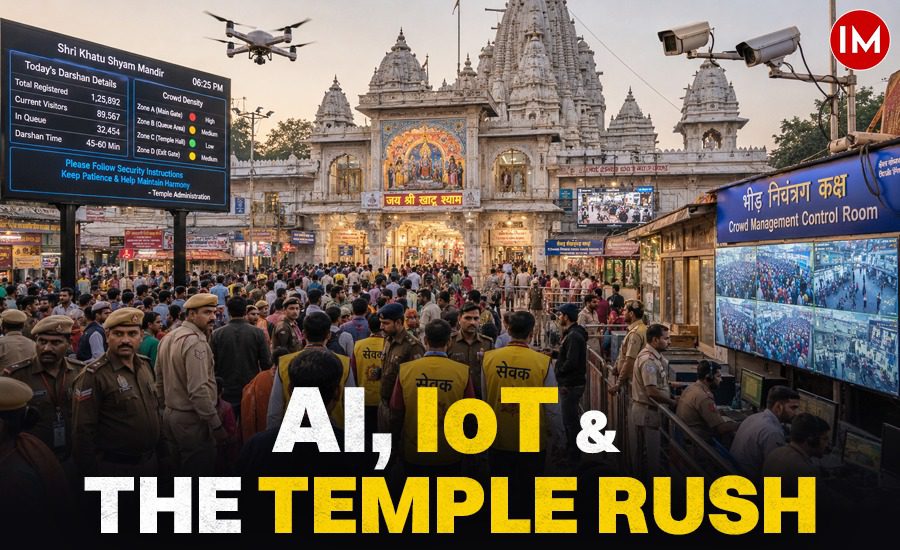
At Khatu Shyam Ji Temple, sensors have been installed at key locations to track crowd density in real time. These systems help authorities understand how many people are present in a particular zone and how movement is evolving across the premise. The information is fed into a central control room, where officials monitor patterns and take timely decisions. If a particular stretch begins to see heavy crowding, entry can be slowed down or redirected to prevent bottlenecks.
One of the most significant changes in temple management has been the shift from reacting to crowds to anticipating them. Earlier, action was taken only when congestion became visible. Today, efforts are being made to identify pressure points before they turn into risks.
Surveillance systems have also become more responsive. Cameras now do more than record, they help identify unusual crowd movement, sudden surges, or signs of distress. At Shirdi Sai Baba Temple, such systems have been combined with digital queue management, helping regulate entry and reduce waiting time. The temple has also introduced online booking for darshan, which has eased pressure during peak days.
Looking at past patterns has also become an important part of planning. Authorities now analyse previous years’ data, such as footfall during festivals, weather conditions, and local events, to prepare for expected surges, termed as Predictive Management. During the 2021 and 2025 editions of the Kumbh, crowd simulations and mapping were used to plan routes, deploy personnel, and avoid congestion at critical points. This marks an important change in approach. Instead of waiting for a situation to escalate, efforts are now being made to stay a step ahead. While no system can fully predict human behaviour, these tools are helping reduce uncertainty and improve response time, which can make all the difference in crowded environments.
Digital Communication: Empowering Devotees as Stakeholders
In crowded spaces, information often becomes the difference between calm and chaos. Many past incidents have shown how rumours or lack of clarity can trigger panic within minutes. Recognising this, temple administrations are now focusing on keeping devotees informed at every stage.
At Khatu Shyam Ji Temple, LED screens have been installed across prone areas, displaying real-time updates on waiting time, crowd levels, and safety instructions. QR-based signages allow visitors to access the same information on their phones, reducing dependence on announcements. This has helped many devotees plan their movement better and avoid peak congestion. A similar approach has been followed at Tirumala Venkateswara Temple, where time-based darshan slots have brought a sense of order to what was once a long and uncertain waiting process. Devotees receive updates through SMS and mobile platforms, allowing them to arrive closer to their allotted time.
Communication also plays a critical role during emergencies. In the 2013 Ratangarh incident, the absence of clear information worsened panic. Learning from such experiences, authorities now prioritise timely announcements and clear instructions. Even small measures, like guiding people towards alternative routes or informing them about delays, can prevent anxiety from spreading. More importantly, this shift is changing the role of devotees themselves. Instead of being passive participants, they are becoming more aware and involved in managing their own movement. In a country where the scale of gatherings is vast, this shared responsibility can go a long way in ensuring smoother and safer experiences.
Learning from Failures: The Cost of Mismanagement
In India, experience with crowd mismanagement carries difficult lessons. Each incident has revealed gaps that go beyond infrastructure and point towards deeper issues of planning and coordination.
The 2013 Ratangarh Temple stampede remains one of the most painful reminders. A rumour about a bridge collapse led to panic among thousands gathered for a festival, resulting in over 100 deaths. Investigations later pointed to lack of crowd control measures, poor communication, and absence of emergency preparedness. Similarly, at Vaishno Devi Temple, the New Year rush in 2022 led to a tragic stampede that claimed 12 lives. Despite improved infrastructure, the incident highlighted how sudden surges and inadequate crowd segregation can still pose risks.
Concerns have also been raised at Jagannath Temple, especially during the Rath Yatra. Devotees have often spoken about overcrowding, lack of clear queues, and instances of misbehaviour by some functionaries. These issues reflect the challenges of managing tradition and modern expectations together. Such examples show that crowd management is not just about handling numbers. It is about systems, accountability, and coordination. Without these, even the best arrangements can fall short.
Mahakal Temple’s ‘Trinetra’ Model Emerges as National Template for Crowd Management
A notable example of technology-led crowd and security management in temples comes from Mahakaleshwar Temple, where the ‘Trinetra’ surveillance system has been implemented as part of the larger Mahakal corridor development. This AI-enabled video monitoring system, deployed across the Mahakal Rudrasagar Integrated Development Area, uses a network of hundreds of smart cameras to track crowd movement, detect unusual patterns, and assist authorities in real-time decision-making. Recently, the initiative received the prestigious gold award at the National e-Governance Awards, recognising its role in improving public service delivery through innovation.
What makes Trinetra significant is not just surveillance, but its ability to support proactive crowd management. The system helps identify congestion points, monitor entry and exit flows, and alert officials to potential risks before they escalate, especially during peak hours and festivals when footfall rises sharply. With Mahakaleshwar Temple witnessing lakhs of devotees, particularly after the development of the Mahakal Lok corridor, such real-time monitoring has strengthened both safety and coordination on the ground.
Importantly, the model is now being seen as replicable beyond Ujjain. With the government exploring its expansion to other high-footfall religious sites across the country, Trinetra show how integrated surveillance, data analysis, and administrative coordination can come together to manage large gatherings more effectively. In many ways, it signals a shift towards more organised and responsive systems in pilgrimage management, where the aim is not just security, but ensuring a smoother and safer experience for every devotee.
Infrastructure and Corridor Development: Expanding the Physical Canvas
Alongside better management practices, physical infrastructure has also seen significant changes. Projects like the Kashi Vishwanath Corridor and Mahakal Lok Corridor have redefined how temple spaces are organised. These developments have widened access routes, created open spaces, and improved overall movement within temple premises. Earlier, narrow lanes and congested surroundings often made it difficult to handle large crowds. With these corridors, movement has become more structured and less stressful for devotees.
However, experience shows that infrastructure alone cannot solve the problem. Larger spaces often attract larger crowds. Without proper monitoring and regulated entry, even well-designed spaces can become congested. This is why the focus is gradually shifting towards combining physical expansion with better planning. Managing parking, accommodation, transport, and entry points together is becoming an essential part of the larger system.
Governance, Collaboration, and the Road Ahead
Unlike many global examples, where a single authority oversees operations, Indian temples often involve multiple stakeholders. Temple trusts, local administration, police, and state agencies all play a role, which can sometimes lead to gaps in coordination. The experience at Khatu Shyam Ji Temple highlights the importance of working together under a unified system. When different agencies share information and operate through a common control structure, responses become quicker and more effective.
Partnerships have also started playing a role, especially in bringing in better systems and improving coordination. But beyond systems, what matters is consistency, ensuring that practices are followed regularly, not just during major events. As religious tourism continues to grow, the need for proactive planning will only increase. According to Ministry of Tourism data, pilgrimage circuits account for a significant share of domestic travel, and this number is expected to rise steadily in the coming years.
Conclusion: Towards Safer and More Thoughtful Pilgrimages
The story of crowd management in India’s temples is still evolving. There is a shift in how public spaces are being understood and managed. From manual control to more organised systems, the journey has been shaped by both necessity and experience. The example of Khatu Shyam Ji Temple shows that change is possible when planning, coordination, and awareness come together. It is not about removing the spontaneity of faith, but about ensuring that devotion does not come at the cost of safety.
At its core, the goal remains simple, to allow every devotee a peaceful and dignified experience. As lessons from the past continue to shape future practices, the hope is that India’s pilgrimage spaces become not just larger, but safer and more humane for everyone who visits them.
Also Read – A Complaint, A Land Dispute, A Business Dream: How IAS Manjunath Bhajantari is Solving It All in Ranchi