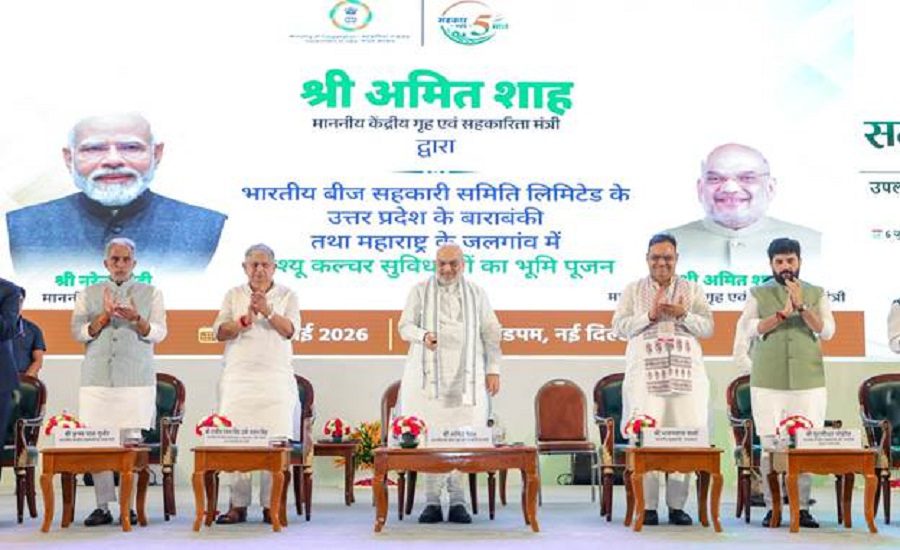
New Delhi: Marking the fifth Foundation Day of the Ministry of Cooperation, Union Home and Cooperation Minister Amit Shah on Sunday unveiled a series of landmark initiatives aimed at transforming India’s cooperative ecosystem into a modern, technology-driven and globally competitive sector. Addressing a large gathering at Bharat Mandapam in New Delhi, Shah said the Ministry has infused new energy into the lives of nearly 32 crore cooperative members and over 8.5 lakh cooperative institutions over the past five years.
He asserted that when India celebrates the centenary of its Independence in 2047, the cooperative movement would emerge as one of the strongest pillars of a “Viksit Bharat” (Developed India).
The event was attended by Union Minister Rajiv Ranjan Singh (Lalan Singh), Rajasthan Chief Minister Bhajan Lal Sharma, Ministers of State for Cooperation Krishan Pal Gurjar and Murlidhar Mohol, Cooperation Secretary Dr Ashish Kumar Bhutani, Agriculture Secretary Atish Chandra, senior officials, representatives of cooperative institutions and stakeholders from across the country.
Ministry of Cooperation Completes Five Years
Recalling the creation of the Ministry on July 6, 2021, Amit Shah said the decision by Prime Minister Narendra Modi ended nearly 75 years of neglect of the cooperative sector.
He noted that while cooperation is a State subject, the Ministry has worked in close coordination with all State governments without interfering in their constitutional powers. Instead, it has focused on policy support, institutional reforms and technological modernisation.
According to Shah, the Ministry has prepared a comprehensive roadmap by identifying long-standing structural challenges and transforming the cooperative ecosystem into one that is transparent, competitive and digitally empowered.
Read also: What Is the Vinimay Platform? Amit Shah Unveils Smart Digital System for India’s Land Ports
32 Crore Cooperative Members Brought Under One Digital Database
Highlighting one of the Ministry’s biggest achievements, Shah said a unified digital database covering 8.58 lakh cooperative societies across 30 sectors and 32 crore members has now been created.
The database includes information on:
- Audit status of cooperative societies
- Financial turnover
- ABC grading
- Areas lacking PACS or dairy cooperatives
- Village-wise cooperative infrastructure
The digital repository, he said, would help States identify gaps and plan expansion of cooperative institutions more effectively.
50,000 PACS Become e-PACS
One of the biggest announcements during the ceremony was the digital transformation of 50,000 Primary Agricultural Credit Societies (PACS) into e-PACS.
According to Shah, computerisation of PACS has been undertaken through an investment of nearly ₹3,000 crore.
Today:
- 55,000 PACS provide over 300 Common Service Centre (CSC) services.
- 39,000 PACS function as Kisan Samriddhi Kendras.
- More than 600 PACS operate Jan Aushadhi Kendras.
- 75 PACS manage petrol and diesel retail outlets.
- 118 PACS operate rural drinking water supply systems.
He said digitisation has introduced electronic auditing, improved transparency and significantly reduced opportunities for corruption.
Nine National Cooperative Institutions to Become Global Organisations
The Union Minister said the government has established nine national-level cooperative societies, integrating sectors including:
- Agriculture
- Dairy
- Banking
- Logistics
- Exports
- Organic farming
- Seed production
- Mobility
- Green energy
He expressed confidence that these institutions would eventually become among the world’s largest cooperative organisations, similar to IFFCO, KRIBHCO, Amul and NDDB.
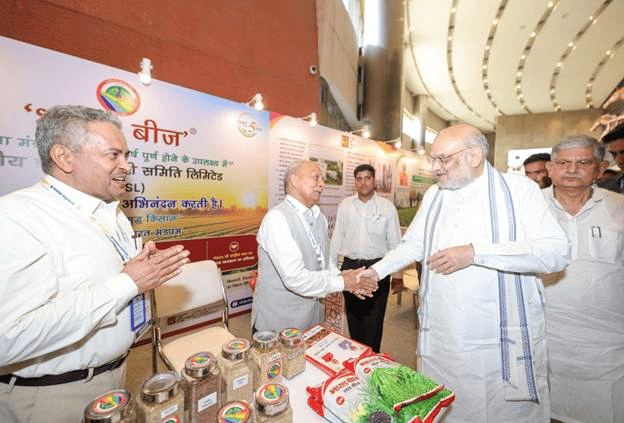
Bharat Beej Sahakari Samiti to Become India’s Largest Seed Company
Shah announced that the Bharat Beej Sahakari Samiti Limited (BBSSL) is expected to emerge as India’s largest seed production company within the next three years.
The initiative will establish seed production units across all States to ensure farmers receive:
- High-quality certified seeds
- Tissue culture planting material
- Improved banana and potato varieties
- Better productivity through advanced technology
An MoU was also signed between BBSSL and ICAR to strengthen India’s seed ecosystem.
Organic Farming and Circular Economy to Drive Rural Growth
A significant focus of the Ministry’s future roadmap revolves around promoting:
- Organic farming
- Bio-fertilisers
- Cattle waste management
- Renewable energy
- Circular economy models
Shah urged farmers to gradually reduce dependence on chemical fertilisers such as DAP, stating that organic alternatives developed through cooperative institutions would improve both soil health and crop productivity.
The newly launched Gomay Cooperative Society Multi-State Limited will work towards converting cattle waste into organic manure, renewable energy and other value-added products.
Cooperative Credit Sector Registers Strong Financial Improvement
The Minister highlighted significant improvements in cooperative banking.
According to him:
- Business of District Cooperative Banks has increased from ₹19.6 lakh crore to over ₹25 lakh crore.
- Gross NPAs of Urban Cooperative Banks have reduced from 12.8% to 6.2%.
- Net NPAs have declined from 5.1% to just 0.7%.
Digital banking, cyber security, e-KYC and digital lending have helped restore public confidence in cooperative financial institutions, he added.
Tribhuvan Cooperative University to Produce Professional Workforce
To professionalise the cooperative movement, Shah said the newly established Tribhuvan Cooperative University will prepare skilled professionals in:
- Cooperative banking
- Dairy management
- Agricultural marketing
- Fertiliser management
- Cooperative administration
He said professional management would improve governance, transparency and institutional efficiency while reducing corruption.
Major Projects Inaugurated
During the event, Amit Shah inaugurated and laid the foundation stone for several important projects, including:
- Transfer of 135 grain storage godowns
- Inauguration of 85 grain storage godowns
- Foundation stone for 47 new grain storage facilities
- Bhoomi Pujan of Sahakar Van, a 64-acre cooperative afforestation project by Amul and NCCF
- Bhoomi Pujan of BBSSL tissue culture facilities in Barabanki (Uttar Pradesh) and Jalgaon (Maharashtra)
- Launch of NCD 3.0 and Geo-tag Mobile Application
- Launch of NDDB’s Milk Supply Review Dashboard
- Launch of Cooperative Milk Producers Organisation Multi-State Limited
- Launch of Gomay Cooperative Society Multi-State Limited
- Introduction of Sahakar CBS and Sahakar Sahyogi, two digital platforms for Urban Cooperative Banks
Vision for Viksit Bharat 2047
Concluding his address, Amit Shah said the Ministry’s objective is to ensure that every benefit generated through the cooperative sector reaches farmers, dairy producers and rural communities with dignity.
He stressed that cooperation would become one of the strongest pillars of India’s journey towards becoming a developed nation by 2047.
“The cooperative movement will serve as the foundation of a prosperous India when the country celebrates 100 years of Independence,” he said.