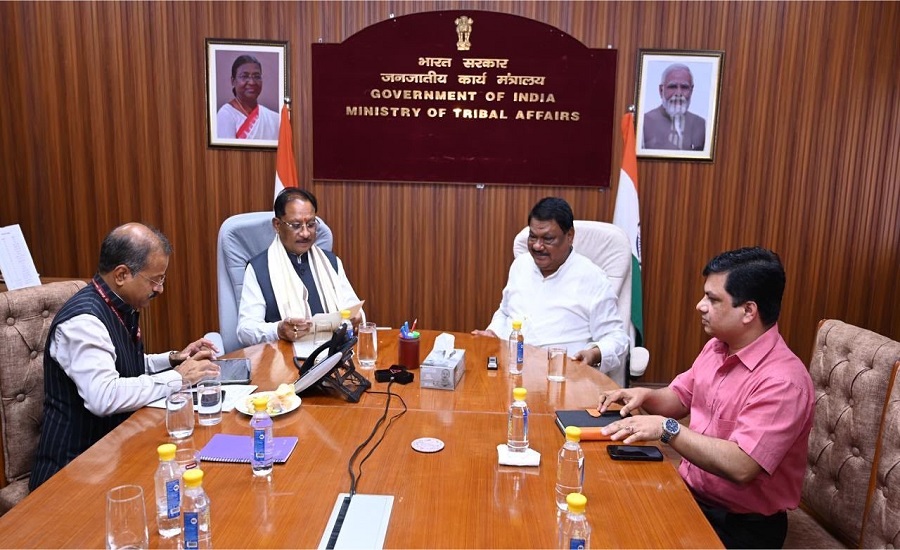
New Delhi/Raipur: Chhattisgarh Chief Minister Vishnu Deo Sai has sought ₹435 crore in special financial assistance from the Centre to provide grid electricity to 461 remote and erstwhile Maoist-affected villages in the Bastar division.
During a meeting with Union Tribal Affairs Minister Jual Oram in New Delhi on Friday, the Chief Minister submitted a detailed proposal under the Dharti Aaba Gram Utkarsh Yojana, highlighting that extending electricity to remote villages is among the state government’s highest development priorities.
Chhattisgarh Seeks ₹435 Crore for Bastar Electrification Project
The proposed electrification project aims to connect 461 villages in Bastar with the power grid, bringing essential infrastructure to areas that remained underdeveloped for years due to Maoist violence.
The key highlights of the proposal include:
- Total project cost: ₹973 crore
- Central assistance sought: ₹435 crore
- Scheme: Dharti Aaba Gram Utkarsh Yojana
- Target area: 461 remote and erstwhile Maoist-affected villages in Bastar division
The remaining project cost will be borne by the Chhattisgarh government.
Read also: CM Vishnu Deo Sai Meets PM Modi, Seeks Centre’s Support for Bastar Vision, ₹10,500 Crore Urea Plant
Funding Planned Over Three Financial Years
The state government has proposed that the Centre provide financial assistance over three financial years.
The proposed funding pattern is:
- 2026-27: ₹85 crore
- 2027-28: ₹250 crore
- 2028-29: ₹100 crore
The Chief Minister requested the Union Government to approve the proposal as a special case under Article 275(1) of the Constitution, which provides grants for the welfare and development of Scheduled Areas and Scheduled Tribes.
Electricity to Improve Education, Healthcare and Livelihoods
According to Chief Minister Vishnu Deo Sai, electrification of these villages will significantly improve the quality of life for tribal communities.
The project is expected to:
- Improve access to quality education.
- Strengthen healthcare services.
- Create employment opportunities.
- Promote small-scale industries and local businesses.
- Accelerate overall socio-economic development.
- Improve living standards in remote tribal areas.
The Chief Minister said that providing basic infrastructure like electricity is essential for integrating remote villages into the mainstream of development.
Centre Assures Support for the Proposal
During the meeting, Union Tribal Affairs Minister Jual Oram assured the Chief Minister that the proposal would be processed immediately after its formal submission under the Dharti Aaba Gram Utkarsh Yojana.
The Union Minister also assured that:
- The Centre would extend full support to the project.
- There would be no shortage of funds for the electrification initiative.
- The proposal would receive priority consideration.
The assurance is expected to facilitate faster implementation of the project once approvals are granted.
Bastar Emerging as a Symbol of Development
Chief Minister Sai said that Bastar, which comprises seven districts, has been witnessing significant progress and is emerging as a symbol of development, trust and new opportunities.
He noted that extending grid electricity to 461 villages would be another important milestone in the region’s transformation and would help accelerate development in areas that had remained affected by Maoist violence for decades.
The Chief Minister also highlighted that Chhattisgarh was declared free from Maoism on March 31, 2026, making it possible to focus on infrastructure development and improving public services in previously affected regions.
Electrification Project Aims to Transform Remote Tribal Villages
The proposed electrification project is expected to play a crucial role in improving infrastructure across Bastar by bringing reliable electricity to hundreds of remote villages.
Once implemented, the initiative is expected to strengthen education, healthcare, livelihood opportunities and overall socio-economic development while supporting the long-term integration of tribal communities into the state’s growth and development agenda.