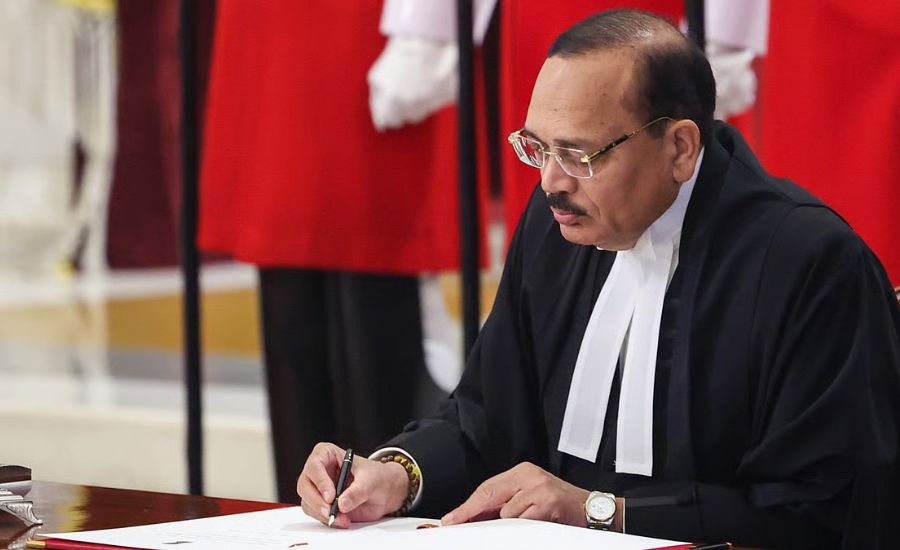
New Delhi: The legal challenge to the law governing the appointment of the Chief Election Commissioner (CEC) and Election Commissioners has taken a significant turn, with Surya Kant, Chief Justice of India, expressing reluctance to continue hearing the matter and transferring it to another bench.
The petitions challenge the Chief Election Commissioner and other Election Commissioners (Appointment, Conditions of Service, and Term of Office) Act, 2023, a law enacted by the Union government that replaced the Chief Justice of India with a Union Minister in the selection panel responsible for appointing the CEC and Election Commissioners.
The matter has now been listed for hearing on April 7 before an appropriate bench of the Supreme Court of India.
CJI Surya Kant Steps Aside from Hearing
During the hearing, Surya Kant observed that since the petitions directly concern the constitutional position of the office of the Chief Justice of India, it would be appropriate for another bench to hear the matter.
His decision followed a suggestion made by senior advocate Prashant Bhushan, who appeared on behalf of Association for Democratic Reforms.
Bhushan argued that the matter should ideally be heard by a bench where neither the presiding nor the accompanying judge is a prospective future Chief Justice of India, given the institutional implications involved.
Accepting the concern, the CJI remarked that the matter should be assigned to a bench where the judge may not be in line to become the Chief Justice of India.
Read also: Digital India Under Attack: CJI Surya Kant Reveals Shocking Scam Targeting His Own Family
Case Listed for April 7 Before Fresh Bench
The bench formally directed that the matter be listed on April 7 before an appropriate bench.
This means the substantive constitutional challenge to the 2023 law will now proceed before a different combination of judges.
The transfer itself is significant because the petitions deal directly with institutional balance between the judiciary and executive in the process of election commissioner appointments.
What the 2023 Law Changed
The controversy centres on the Chief Election Commissioner and other Election Commissioners (Appointment, Conditions of Service, and Term of Office) Act, 2023.
Before this law came into force, the selection committee for appointing the Chief Election Commissioner and Election Commissioners consisted of:
• The Prime Minister
• The Leader of Opposition in Lok Sabha
• The Chief Justice of India
Under the new law, the composition was altered to include:
• The Prime Minister
• The Leader of Opposition
• A Union Minister nominated by the Prime Minister
This effectively removed the Chief Justice of India from the appointment panel.
Petitioners Say Law Dilutes Supreme Court Judgment
The petitioners argue that the 2023 legislation was enacted to dilute the constitutional principles laid down by the Supreme Court in the landmark Anoop Baranwal v. Union of India judgment delivered in March 2023.
In that ruling, a Constitution Bench had directed that until Parliament enacted a law, appointments of the CEC and Election Commissioners should be made by a high-powered committee consisting of:
• Prime Minister
• Leader of Opposition
• Chief Justice of India
The judgment was intended to insulate the election appointment process from unilateral executive control.
Core Constitutional Question Before Supreme Court
The central legal issue now is whether Parliament can enact a law that effectively alters the balance created by a Constitution Bench judgment.
On an earlier date, Surya Kant had made an important constitutional observation that the validity of the 2023 Act would depend on whether Parliament can dilute or circumvent binding judicial declarations made under Article 141 of the Constitution.
Article 141 at the Centre of Debate
Article 141 of the Constitution of India provides that the law declared by the Supreme Court is binding across India.
Therefore, the Court may now examine:
• Whether Parliament merely exercised legislative competence
• Or whether it attempted to override a constitutional safeguard crafted by judicial interpretation
This question could have implications beyond election appointments, affecting broader executive-judiciary boundaries.
Why This Case Matters for Electoral Independence
The appointment mechanism of Election Commissioners is considered central to institutional independence of the Election Commission of India.
Critics of the new law argue that replacing the Chief Justice of India with a Union Minister increases executive dominance in appointments.
Supporters of the law argue that Parliament retains authority to legislate institutional appointment processes.
Institutional Sensitivity Behind CJI’s Recusal
The Chief Justice’s decision to step aside is also being viewed as an effort to avoid any perception of conflict, since the office of the CJI itself is directly implicated in the constitutional design being debated.
Such recusal reflects judicial caution in cases involving institutional self-reference.
What Happens Next
When the matter comes up on April 7, the new bench is expected to examine:
• Whether interim protection is required
• Whether appointments made under the 2023 law need scrutiny
• Whether the Act conflicts with constitutional principles laid down in Anoop Baranwal
The outcome may shape future appointments to the Election Commission and define the constitutional limits of Parliament’s power in altering institutional safeguards.