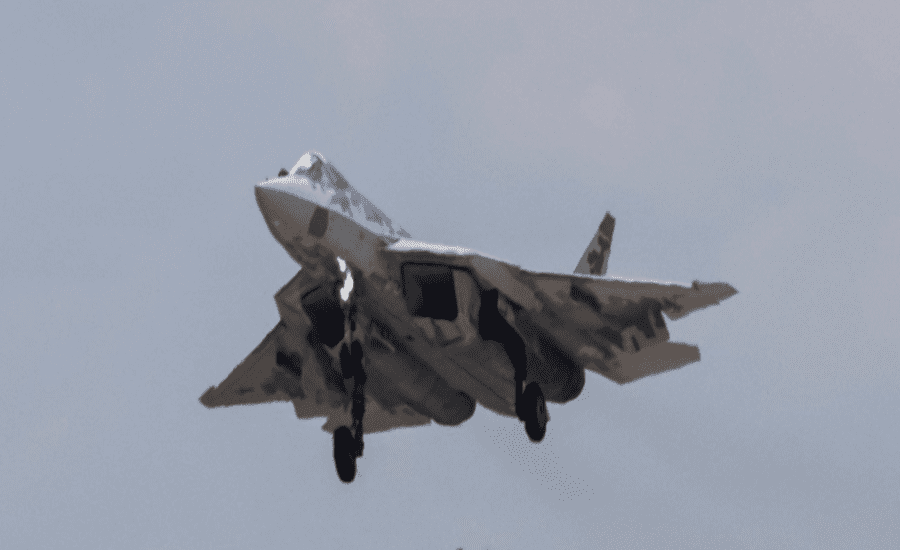
In a detailed evaluation that may influence India’s next big defence acquisition, the Indian Air Force (IAF) has raised significant technical concerns over the stealth capabilities of Russia’s Su-57E fighter jet. According to sources, the IAF’s assessment focused on the aircraft’s radar signature reduction performance, particularly in the rear-aspect domain, where vulnerabilities have been found to compromise its low observability.
IAF evaluators noted that the exposed engine sections of the Su-57E substantially increase its radar cross-section (RCS), offsetting gains achieved through frontal shaping and radar-absorbent coatings.
Engine Design and Radar Signature: The Core Issue
Experts familiar with the IAF’s evaluation pointed out that the Su-57E’s nozzle configuration and engine layout appear similar to older Soviet-era designs like the Su-27. This design choice reportedly enlarges the radar signature, making the aircraft more visible to enemy radar systems. Preliminary findings indicate that while the Su-57E’s frontal RCS ranges between 0.1 and 1 square metre, the US-made F-35 records a far lower RCS of approximately 0.001 square metre.
The report also noted that Russia’s design philosophy for the Su-57E favours high thrust through its Saturn AL-41F1 engines over stealth perfection. This trade-off enhances performance but raises radar and infrared detectability.
Indian Feedback Spurs Russian Response
Indian officials have formally communicated these concerns to Russian counterparts, making it clear that procurement discussions cannot proceed unless key stealth deficiencies are rectified. The Su-57E remains a contender in India’s Rs. 20 billion USD plan to acquire 114 next-generation fighters, a programme that seeks to bolster the nation’s air superiority capabilities.
In response, Russia’s defence industry has begun testing new composite panels and heat-shield assemblies at the Gromov Flight Research Institute, aiming to cut infrared emissions by nearly 50 percent. However, India has sought firm timelines for these upgrades and clarity on integration with the next-generation AL-51 (Izdeliye 30) engine.
Durability and Local Conditions: A Major Concern
IAF officials have also requested long-term data on the radar-absorbent material (RAM) coatings used in the Su-57E. The performance of these coatings under India’s tropical and desert climates is a crucial factor in determining operational sustainability. Previous Russian systems have reportedly faced challenges with coating longevity, leading to higher maintenance costs.
Additionally, inconsistencies in panel alignment and sensor shaping have raised questions about manufacturing precision — a vital parameter for maintaining true stealth characteristics.
Sanctions and Strategic Autonomy: India’s Balancing Act
With ongoing Western sanctions affecting Russia’s access to high-end avionics and semiconductors, the IAF has expressed concerns over long-term sustainment and upgrade pathways for the Su-57E fleet. These issues come at a time when India is simultaneously advancing its indigenous Advanced Medium Combat Aircraft (AMCA) programme and pursuing the Multi-Role Fighter Aircraft (MRFA) initiative.
IAF leadership has underscored that any acquisition must align with India’s long-term goals of technological self-reliance, maintainability, and strategic autonomy.
The Road Ahead
While Moscow continues to position the Su-57E as a cost-effective fifth-generation solution, New Delhi’s evaluation reflects a more pragmatic stance — balancing stealth performance, lifecycle costs, and self-reliance. The final verdict on the Su-57E will depend on whether Russia can deliver measurable improvements and verifiable stealth data in the next round of technical assessments.
Also Read: India’s Bold Sky Revolution: 100 IAF ASPJ Pods to Turn Su-30MKI into an Undetectable Super Sukhoi