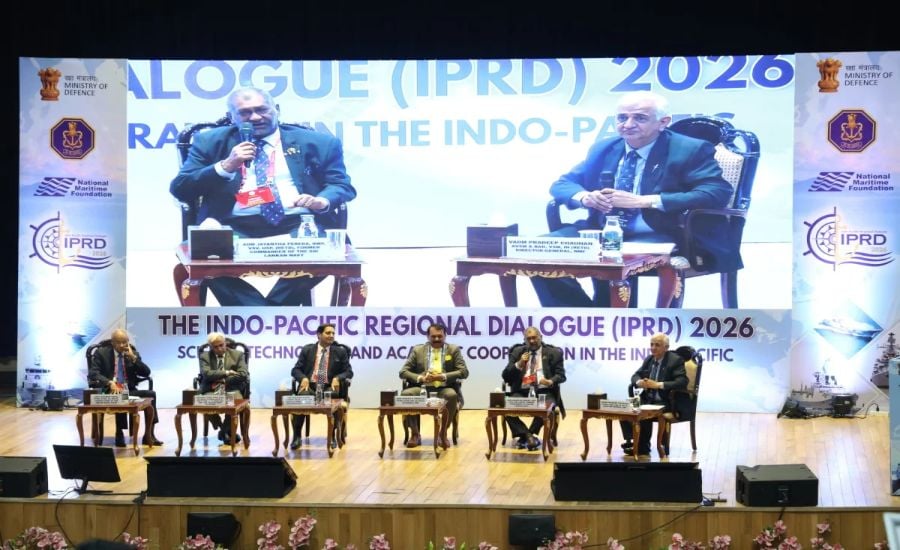
New Delhi: India has highlighted the importance of regional navies in strengthening Indo-Pacific maritime security during the Indo-Pacific Regional Dialogue 2026 (IPRD-2026). A special session brought together four former Indian Navy Chiefs and a former Commander of the Sri Lanka Navy to discuss maritime security, regional cooperation and stronger naval partnerships.
The discussions focused on how regional navies can work together to address emerging maritime challenges and improve security across the Indo-Pacific region.
IPRD 2026: Former Naval Chiefs Discuss Maritime Security
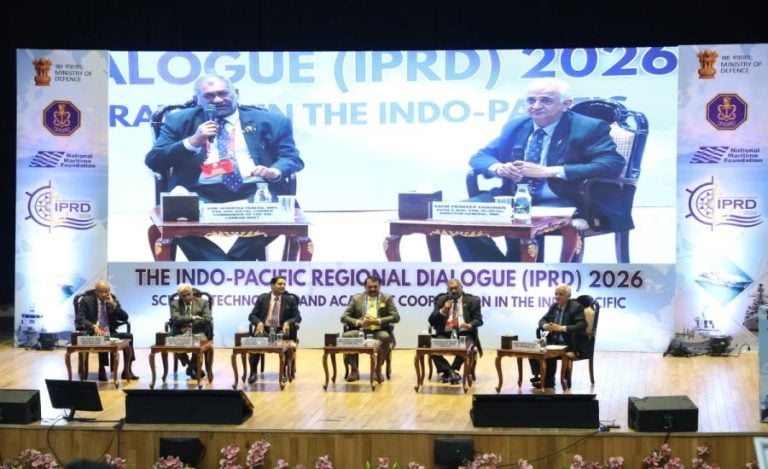
The special session, titled ‘Perspectives From The Flag Bridge’, was one of the key events of IPRD-2026. It brought together four former Chiefs of the Indian Navy and former Sri Lankan Navy Commander Admiral Jayantha Perera.
Read also: Operation Sindoor: IAF Chief Reveals How India Delivered Strikes Deep Inside Pakistan
The session provided important views on the role of regional navies in maintaining maritime security and strengthening maritime resilience.
The discussions also highlighted the importance of cooperation between neighbouring countries to address common security challenges in the Indo-Pacific.
Regional navies play an important role in protecting sea routes, supporting maritime operations and responding to threats at sea.
India Hosts IPRD 2026
The Indo-Pacific Regional Dialogue 2026 began on November 3 and continued until November 5 in New Delhi.
The Indian Navy organised the three-day conference in association with the National Maritime Foundation (NMF), which serves as its knowledge partner.
The central theme of this year’s conference was ‘Science, Technology And Academic Cooperation In The Indo-Pacific’.
The main objective was to explore how scientific research, technological development and academic partnerships can improve regional cooperation.
The conference also focused on converting scientific knowledge into practical solutions for maritime security and regional stability.
Jitendra Singh Highlights India’s Deep-Ocean Research Capabilities
During the second day of the conference, Union Minister of State for Science and Technology and Earth Sciences Jitendra Singh highlighted India’s growing capabilities in ocean research and exploration.
He said India is working towards achieving global competitiveness through indigenous technology, international cooperation and joint scientific development.
He also explained that India’s scientific missions are increasingly bringing different departments and research institutions together.
This approach helps connect several important fields, including ocean science, space technology, nuclear science, geology, electronics and robotics.
The minister also highlighted the achievements of the National Institute of Ocean Technology (NIOT), Chennai.
According to him, NIOT has developed the capability to conduct trials at depths of 5,000 to 6,000 metres in the Central Indian Ocean Basin.
This capability is important for India’s future deep-ocean exploration and marine research programmes.
IPRD 2026: International Cooperation Remains A Key Priority
The opening day of IPRD-2026 focused on academic networks, research and human capital development. The session was moderated by Vice-Admiral Sanjay Mahindru (Retd), former Deputy Chief of the Naval Staff.
Representatives from France, Indonesia, Japan and the Maldives shared their perspectives on research, education and regional cooperation.
The discussions highlighted the importance of building strong partnerships between universities, research institutions and maritime organisations.
Such partnerships can help countries share scientific knowledge, develop new technologies and improve their ability to respond to common challenges.
Why Indo-Pacific Maritime Security Is Important
The Indo-Pacific region is one of the world’s most important maritime areas. It connects major international trade routes and supports the movement of energy supplies, commercial goods and essential resources.
Any major disruption in these sea routes can affect international trade and the economies of several countries.
Maritime security is also facing new challenges, including illegal activities at sea, threats to important maritime infrastructure, environmental changes and growing competition in strategic waters. Therefore, cooperation between regional navies is important for maintaining safe sea routes and protecting shared maritime interests.
Countries can improve their response capabilities through information sharing, joint research, naval cooperation and better maritime awareness.
Read also: Inside The India-Japan Defence Talks Shaping The Future Of Indo-Pacific Security
FAQs
The session brought together four former Chiefs of the Indian Navy and a former Commander of the Sri Lanka Navy. They discussed the importance of regional navies in strengthening maritime security and resilience across the Indo-Pacific.
IPRD 2026 is the Indo-Pacific Regional Dialogue organised by the Indian Navy in association with the National Maritime Foundation. It was held in New Delhi from November 3 to 5, 2026, focusing on science, technology and academic cooperation in the Indo-Pacific.
Regional navies help protect important sea routes, improve maritime awareness, address security threats and support international trade. Cooperation between these navies also helps countries respond more effectively to shared maritime challenges.