New Delhi: The Delhi government, under Chief Minister Rekha Gupta, has launched a major initiative to make the capital’s road network safer, more durable, environmentally friendly, and future-ready. The move aims to transform Delhi’s roads into a smart and data-driven urban infrastructure system.
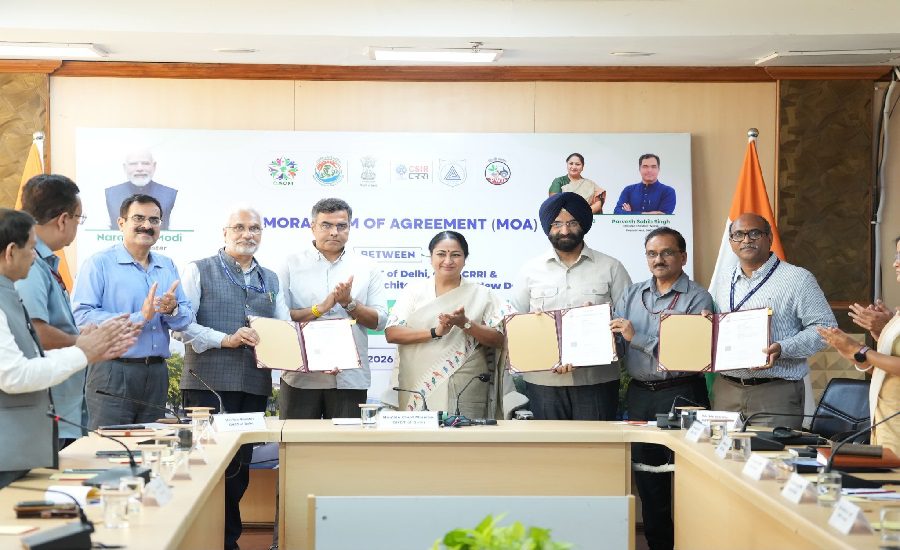
As part of this initiative, a historic tripartite Memorandum of Agreement (MoA) was signed between the Public Works Department (PWD), the Council of Scientific and Industrial Research–Central Road Research Institute (CSIR-CRRI), and the School of Planning and Architecture (SPA).
The collaboration will implement a “Standard Framework for Paving and Greening of Urban Roads” to promote scientific road redesign, aesthetic development, and green urban infrastructure.
Focus on Smart, Scientific and Data-Based Road Management
Chief Minister Rekha Gupta said the government is no longer limited to constructing roads but is developing an entire urban road ecosystem that is safe, sustainable, and aligned with future needs.
She emphasized that increasing traffic, air pollution, and waterlogging challenges require a shift from traditional maintenance to a scientific and data-driven system.
A key component of the initiative is the development of a Road Asset Management System (RAMS), which will be introduced in Delhi for the first time.
Digital Road Mapping and Asset Management System (RAMS)
The RAMS framework will provide a detailed scientific assessment of:
- Current road conditions
- Traffic load and pressure
- Structural strength of roads
- Maintenance requirements
- Expected lifespan of road assets
Under this system, all roads will be digitally mapped and regularly monitored. Maintenance will be planned based on priority, ensuring better use of public resources and improved infrastructure quality.
The system will also help identify potential road issues in advance, enabling timely repairs and maintenance.
Strong Focus on Dust-Free and Green Roads
A major objective of the agreement is to move Delhi towards a dust-free urban road model. This will be achieved through:
- Development of scientifically designed green belts along roads
- Plantation of native tree species
- Strengthening rainwater harvesting systems
- Improved drainage infrastructure
- Sustainable urban landscaping
The initiative also aims to reduce dust pollution through better roadside greenery and mechanized cleaning systems.
Improved Drainage System to Address Waterlogging
To tackle monsoon waterlogging, the road slope design and stormwater drainage systems will be restructured.
The new pavement design will incorporate technology that supports groundwater recharge, helping provide a long-term solution to recurring waterlogging issues in the city.
Role of CSIR-CRRI and SPA in the Project
Under the agreement:
- CSIR-CRRI will provide technical expertise in road engineering, pavement technology, road safety, and asset management
- School of Planning and Architecture (SPA) will offer guidance in urban design, street planning, public space development, and green infrastructure
Together, these institutions will help develop an integrated urban road development model for Delhi.
Government’s Vision for Smart and Climate-Resilient Delhi
Chief Minister Rekha Gupta said the initiative builds on existing efforts such as:
- Wall-to-wall road carpeting
- Dust pollution control measures
- Mechanised road sweeping
- Water sprinkling systems
- Green corridor development
She said the new framework will make these efforts more systematic, scientific, and long-term in nature.
The government’s broader vision is to create smart, sustainable, and climate-resilient urban corridors that improve mobility, reduce pollution, and enhance city aesthetics.
Focus on Cleaner Air, Safer Roads and Better Urban Living
PWD Minister Pravesh Sahib Singh said the MoA is a significant step toward modernizing Delhi’s road infrastructure using technology and data-based planning.
Environment Minister Manjinder Singh Sirsa highlighted that extensive plantation drives, mechanised sweeping, and scientific greenery development are being undertaken to reduce dust pollution and improve air quality.
Delhi Aims for World-Class Urban Road Model
The initiative marks a major shift in how urban roads will be planned and maintained in Delhi. By combining technology, environmental planning, and scientific research, the government aims to develop a world-class, sustainable road infrastructure model that enhances safety, reduces pollution, and improves the overall quality of life for citizens.