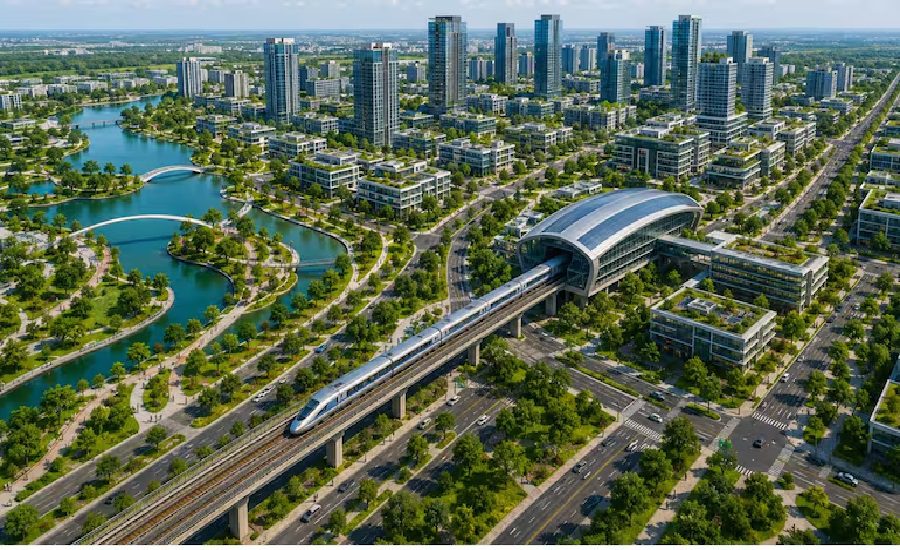
New Delhi: In a major step toward managing rapid urbanisation in the National Capital Region (NCR), the government has approved the development of four new greenfield cities, named ‘Namo Cities’. These cities will be developed around the Regional Rapid Transit System (RRTS) corridors to promote planned urban growth and improved regional connectivity.
The decision was taken during a meeting of the NCR Planning Board chaired by Union Urban Development Minister Manohar Lal.
Cities to Be Developed Across Four States
The proposed ‘Namo Cities’ will be developed in NCR regions of:
- Delhi
- Uttar Pradesh
- Haryana
- Rajasthan
State governments have been asked to submit proposals for city locations. The selection will be done through a competitive process, ensuring strategic planning and balanced regional development.
Each city is expected to be developed with a modern urban framework, focusing on sustainability and infrastructure efficiency.
Read also: Delhi Approves ₹12,000 Crore Elevated Ring Road Project to Ease Traffic and Improve Connectivity
₹5,000 Crore Investment per City Over Five Years
The government has proposed an investment of ₹5,000 crore for each city over the next five years. The funds will be used for:
- Urban infrastructure development
- Transport and connectivity systems
- Environment-friendly city planning
- Public utilities and smart city features
Officials confirmed that environmental standards will be strictly followed during the planning and execution of these cities.
Integration with RRTS Network for Better Connectivity
A key feature of the project is its integration with the Regional Rapid Transit System corridors.
The new cities will be developed around these high-speed transport corridors to ensure seamless regional mobility, reduce congestion in existing NCR cities, and promote transit-oriented development.
Focus on Sustainable and Environment-Friendly Urban Planning
During the NCR Planning Board meeting, emphasis was placed on:
- Expanding eco-friendly transport systems
- Improving inter-city connectivity within NCR
- Developing new RRTS routes
- Reducing pollution and traffic congestion
The initiative aims to create sustainable urban centres with reduced environmental impact.
NCR Vision 2041 and Policy Framework
The meeting also discussed the NCR Regional Vision 2041. A sub-committee has been formed to prepare a detailed report by August 15.
The next NCR Planning Board meeting is scheduled for December, where further decisions on implementation will be reviewed.
NCR to Be Divided into Three Zones
To address concerns related to regulatory restrictions, the board decided to divide NCR into three zones:
- Core Zone
- Two additional development zones
Officials clarified that pollution-related restrictions will primarily apply only to the core zone, while the other zones will have relaxed or partial regulations.
A proposal from Haryana to reduce the NCR boundary was also discussed but rejected by the board.
High-Level Participation in the Meeting
The meeting was attended by senior leaders, including Delhi Chief Minister Rekha Gupta, Haryana Chief Minister Nayab Singh Saini, and urban development ministers from Uttar Pradesh and Rajasthan, along with senior officials from all NCR states.
The approval of four new ‘Namo Cities’ marks a major shift in NCR’s urban development strategy. With planned integration of RRTS corridors, significant investment, and a focus on sustainability, the initiative aims to decongest existing cities and build future-ready urban centres.