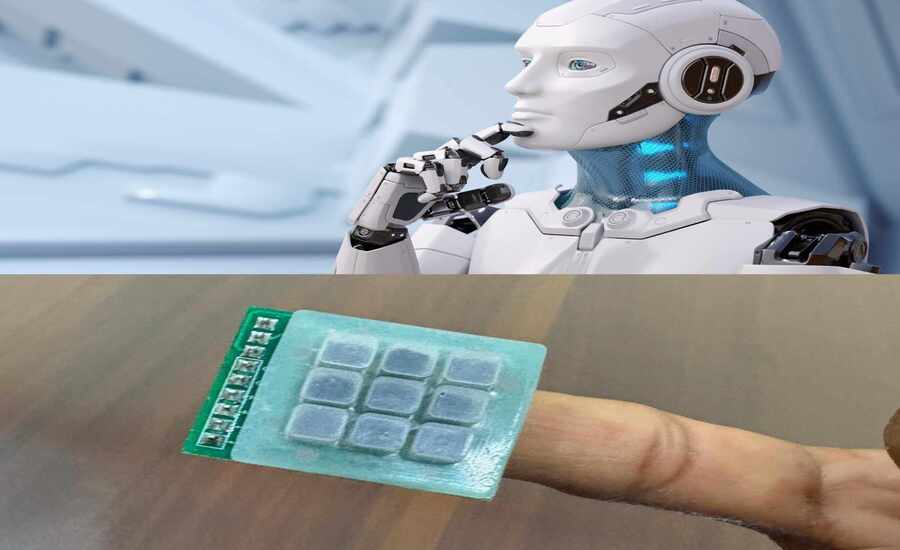
New Delhi: India has taken a major step forward in defence robotics with the development of tactile sensor technology by the Defence Research and Development Organisation (DRDO) and the Defence Institute of Advanced Technology (DIAT). These tactile sensors for robotic skin allow machines to sense touch, pressure, and texture similar to human skin.
This breakthrough strengthens India’s push for indigenous defence technology and aligns with the government’s larger goal of building a self-reliant defence ecosystem. The new system can help advanced robots operate safely and intelligently in complex environments such as defence operations, disaster response, and medical prosthetics.
The innovation also highlights India’s growing capabilities in robotics, artificial intelligence, and bionics research.
Details of Indigenous Tactile Sensors for Robotic Skin
The Research and Development Establishment (Engineers) under DRDO collaborated with DIAT to create indigenous tactile sensor arrays.
These sensors mimic the sensory capabilities of human skin and enable machines to detect subtle interactions with objects and surroundings.
Traditional robotic systems often rely on basic sensors that can only detect simple contact. In contrast, these new tactile sensors allow robots to perceive pressure, texture, and spatial contact, making them far more capable in real-world tasks.
This research represents an important milestone in India’s effort to develop advanced robotics technologies domestically.
How the Indigenous Tactile Sensors for Robotic Skin Work
The new technology uses a matrix of flexible sensors arranged in an array.
Key features include:
- Sensors that detect pressure and touch intensity
- Ability to recognize surface texture and contact points
- Flexible structure that can adapt to curved or irregular surfaces
- Durable performance under mechanical stress
Because of this flexible design, the sensor arrays can be integrated into robotic arms, prosthetic limbs, and other intelligent machines.
This flexibility allows robots to interact with their environment in a more natural and safe way.
Why Robotic Skin Technology Matters
Human skin is one of the most sophisticated sensory systems in nature. Replicating it in machines has been a major challenge for robotics engineers worldwide.
The newly developed tactile sensors bring several advantages:
1. Better Human–Robot Interaction
Robots equipped with tactile skin can safely interact with humans without causing injury.
2. Precision Handling
Machines can pick up delicate objects and adjust grip strength automatically.
3. Improved Situational Awareness
Robots can sense environmental changes and respond intelligently.
4. Advanced Prosthetics
The technology can help create prosthetic limbs that provide realistic touch feedback to users.
What are Applications of the Indigenous Tactile Sensors for Robotic Skin
The innovation has several potential uses in the defence sector.
Military Robotics
Robots equipped with tactile sensors can perform dangerous tasks such as bomb disposal, surveillance, and reconnaissance.
Autonomous Systems
Tactile feedback can help autonomous vehicles and drones interact safely with their surroundings.
Battlefield Assistance
Robots with enhanced sensory capabilities can support soldiers during complex missions.
By enabling machines to “feel” their environment, these sensors improve both safety and operational efficiency.
Boosting India’s Self-Reliant Defence Ecosystem
India has been actively promoting indigenous defence technology under the Atmanirbhar Bharat initiative.
Defence indigenisation helps the country:
- Reduce dependence on foreign technology
- Strengthen national security
- Boost domestic manufacturing and innovation
India’s defence production has already grown significantly, with thousands of companies and MSMEs contributing to the ecosystem.
Policies like the Defence Acquisition Procedure (DAP) 2026 aim to further increase indigenous content and encourage domestic technology development.
The DRDO-DIAT tactile sensor project fits perfectly within this broader strategy.
Future Prospects for India’s Robotics Research
The development of tactile sensor arrays opens the door to several future innovations.
Possible areas of growth include:
- Artificial intelligence-driven robotics
- Advanced prosthetics and medical devices
- Autonomous defence systems
- Industrial automation and manufacturing robots
With continuous investment in research institutions and defence laboratories, India aims to become a global leader in robotics, AI, and defence technologies.