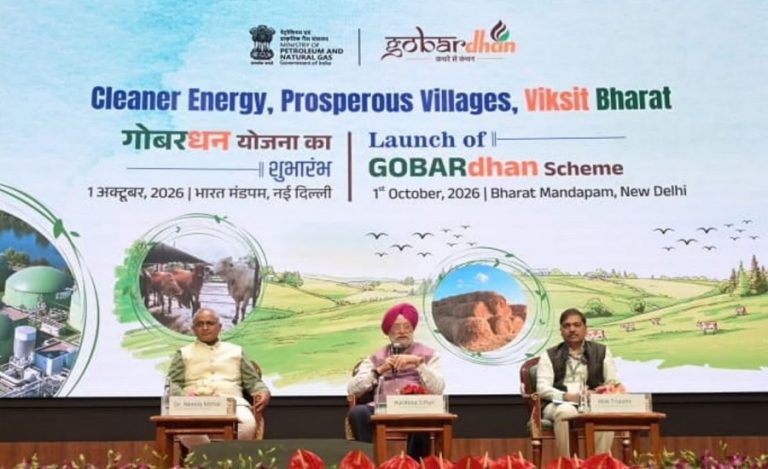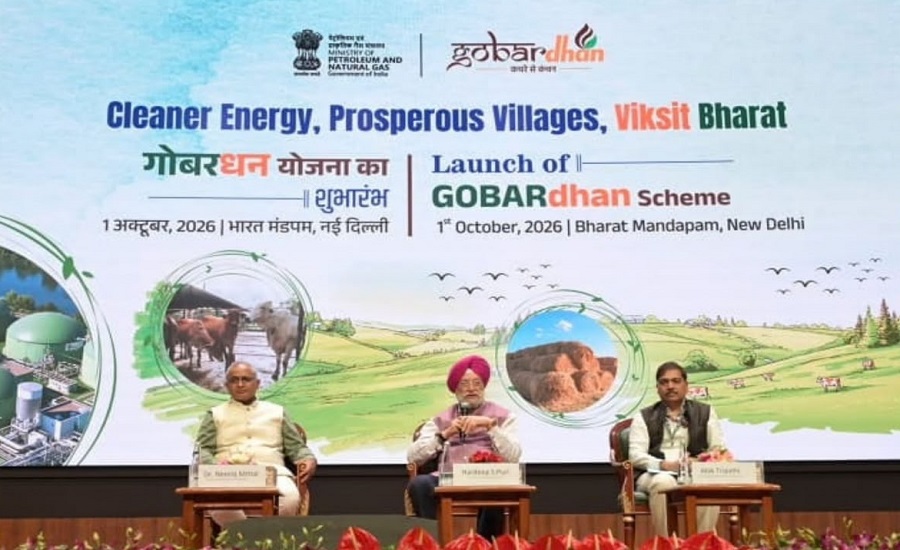
New Delhi: Union Minister for Petroleum and Natural Gas Hardeep Singh Puri has launched the GOBARdhan National Circular Bioenergy Scheme, a ₹23,731 crore Central Sector Scheme aimed at developing a robust Compressed Bio-Gas (CBG) ecosystem across India.
The scheme will be implemented over 10 years, from FY 2026-27 to FY 2035-36, and seeks to accelerate domestic CBG production by creating an integrated framework covering assured offtake, stable pricing, capital assistance, pipeline connectivity and access to finance.
The Union Cabinet approved the scheme on August 6, 2026.
During the launch, the Minister also unveiled the GOBARdhan Handbook and inaugurated the Unified GOBARdhan Portal for streamlined and transparent implementation of the scheme.
GOBARdhan Scheme Has Six Key Interventions
The ₹23,731 crore scheme has been designed to address major challenges faced by the CBG industry, including demand visibility, pricing uncertainty, financing and connectivity.
The six key interventions under the scheme are:
- CBG Offtake Assurance
- CBG Pricing Framework
- Capital Assistance for CBG Projects
- Development of Pipeline Infrastructure
- Credit Guarantee Support
- CBG Ecosystem Challenge Fund
Together, these measures are aimed at creating a stronger commercial, financial and infrastructure ecosystem for CBG projects.
Read also: GOBARdhan Scheme a ‘Gamechanger’ for Clean Energy Transition, Says Petronet LNG CEO A.K. Singh
Scheme Targets Nearly Ten-Fold Increase in Domestic CBG Production
GOBARdhan aims to increase India’s domestic CBG production nearly ten-fold by supporting the development and expansion of CBG plants.
A key component is the procurement framework linked to the government’s CBG blending obligation.
Under the framework, City Gas Distribution entities will support CBG blending targets of:
- 3% in FY 2026-27
- 4% in FY 2027-28
- 5% from FY 2028-29 onwards
The targets apply to CNG transport and domestic PNG segments.
The assured procurement mechanism is intended to provide CBG producers with greater visibility on future demand and improve the commercial viability of new projects.
GOBARdhan to Convert Agricultural Waste into Clean Energy
The scheme will promote the conversion of various types of organic waste into compressed biogas and organic manure.
These include:
- Cattle dung
- Agricultural residue
- Sugar-industry press mud
- Municipal organic waste
- Other forms of biomass
The initiative aims to create commercial value from waste while supporting cleaner waste management and reducing the environmental impact associated with the disposal or burning of agricultural residues.
CBG production can also generate organic manure, creating an additional output for farmers and rural enterprises.
GOBARdhan to Support Farmers and Rural Economy
The scheme is expected to create opportunities for farmers, cooperatives, gaushalas and local enterprises across the CBG value chain.
Participants can be involved in activities such as:
- Feedstock collection
- Biomass aggregation
- Transportation
- Waste processing
- CBG production
- Organic fertiliser distribution
CBG plants can also generate employment in transportation, plant operations, waste processing and related activities.
By creating economic value from locally available organic waste, the scheme aims to support rural incomes while promoting a circular economy.
Major Push for India’s Oil and Gas Sector
The GOBARdhan scheme represents a broader policy push to expand India’s emerging bioenergy industry and reduce dependence on imported natural gas.
The Ministry of Petroleum and Natural Gas will play a central role in implementing the unified scheme.
Oil marketing companies and City Gas Distribution companies will have an important role in the implementation of procurement and blending arrangements and in integrating CBG into existing fuel distribution systems.
For public sector energy companies, the expanding CBG ecosystem could also create opportunities in:
- Renewable energy investment
- Biofuel procurement
- Technology partnerships
- Waste-to-energy projects
However, achieving the scheme’s production ambitions will depend on factors such as timely commissioning of plants, reliable feedstock availability, affordable financing and last-mile connectivity with gas networks.
GOBARdhan Builds on SATAT Experience
The new scheme builds on the experience of the earlier SATAT initiative and seeks to strengthen the commercial and infrastructure ecosystem needed for CBG projects to operate sustainably at scale.
By bringing various support mechanisms under a unified national framework, GOBARdhan aims to provide greater certainty to investors and CBG producers.
The programme also connects organic waste management with renewable fuel production, supporting India’s broader clean-energy transition.
GOBARdhan to Support Energy Security and Circular Economy
The decade-long programme is designed to establish CBG as a more significant component of India’s energy mix while encouraging private investment and rural economic activity.
The government expects the scheme to contribute to:
- Greater domestic availability of gaseous fuel
- Reduced dependence on imported fossil fuels
- Improved organic waste management
- Rural employment generation
- Development of a circular bioeconomy
- Increased private investment in bioenergy
The long-term impact will depend on how effectively financial assistance, procurement commitments and infrastructure support translate into operational CBG capacity and sustained production.
GAIL Reaffirms Support for GOBARdhan
GAIL (India) Limited has reaffirmed its commitment to supporting India’s energy security, rural prosperity and improved waste management through the development of the CBG ecosystem.
The company said the initiative supports the broader vision of “Waste to Wealth” and “Annadata to Urjadata”, while promoting a circular economy.
The scheme also reflects the concept of “Kachre Se Kanchan”, aimed at transforming waste into economic and energy value.
About GOBARdhan Scheme
The GOBARdhan National Circular Bioenergy Scheme is a ₹23,731 crore Central Sector Scheme approved by the Union Cabinet in August 2026. It will run from FY 2026-27 to FY 2035-36 and focuses on developing India’s CBG ecosystem through assured offtake, pricing support, capital assistance, pipeline infrastructure, credit guarantees and technology development. The scheme aims to promote waste-to-energy conversion, rural economic activity and India’s clean-energy and energy-security goals.