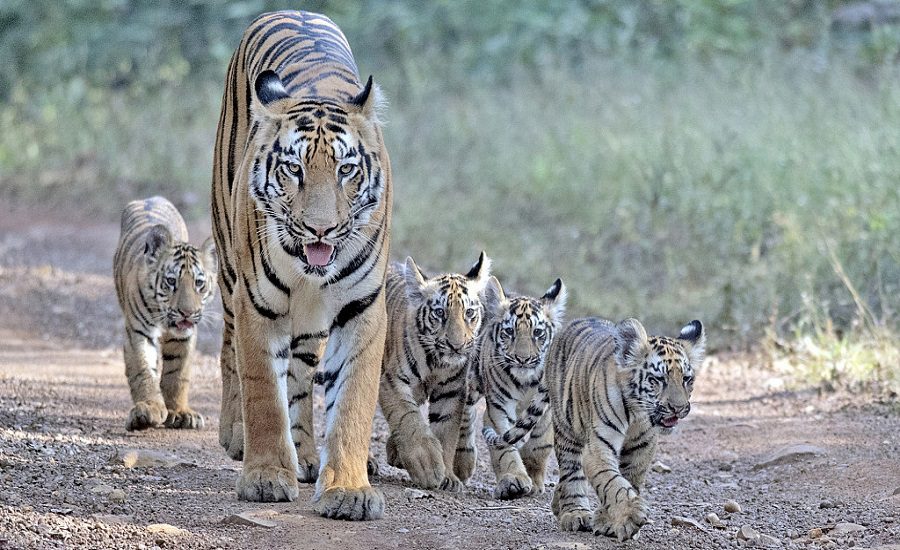
New Delhi: Tiger conservation in India has become one of the world’s greatest wildlife success stories. India is now home to 3,682 wild tigers, nearly 70% of the global wild tiger population, according to the latest official estimates. This remarkable achievement reflects decades of scientific planning, strong government policies, habitat protection and community participation.
Ahead of International Tiger Day (July 29), the Government of India highlighted how initiatives such as Project Tiger, the National Tiger Conservation Authority (NTCA) and the use of advanced technologies have transformed the country’s tiger conservation programme into a global model. From increasing tiger numbers to protecting forests and biodiversity, India’s conservation journey is now inspiring wildlife protection efforts around the world.
Background of Tiger Conservation In India
India’s tiger conservation programme has evolved from a crisis response into one of the most successful wildlife conservation models in the world.
In the early 1970s, tiger populations were declining rapidly because of habitat destruction, hunting and poaching. Recognising the urgent need to protect the national animal, the Government of India launched Project Tiger in 1973.
More than five decades later, the results are clearly visible. According to the All India Tiger Estimation (AITE) 2022, India now has 3,682 wild tigers, the highest number recorded in the country’s history.
This achievement is not the result of a single programme. It reflects continuous investment in forest protection, scientific monitoring, better wildlife laws, improved habitat management and cooperation between the Central Government, state governments, conservation experts and local communities.
Today, tiger conservation In India model is widely recognised as an example of how long-term planning can successfully protect endangered wildlife.
Tiger Conservation In India: How India’s Tiger Population Has Grown Over The Years
One of the strongest indicators of India’s conservation success is the steady increase in tiger numbers over the last two decades.

According to official tiger estimation reports, the country’s wild tiger population has grown consistently through scientific conservation efforts.
| Year | Estimated Tiger Population |
| 2006 | 1,411 |
| 2010 | 1,706 |
| 2014 | 2,226 |
| 2018 | 2,967 |
| 2022 | 3,682 |
The latest estimate shows that India’s tiger population has more than doubled since 2006. Unlike many wildlife estimates in the past, these numbers are based on scientific surveys carried out across the country using camera traps, field observations, habitat assessments and modern data analysis. This consistent growth also indicates that India’s forests are becoming healthier and better protected.
Why Tiger Conservation Matters Beyond Saving One Species
Protecting tigers is about much more than saving a single animal. Tigers sit at the top of the food chain and play a critical role in maintaining ecological balance. A healthy tiger population usually indicates healthy forests, abundant prey animals and a well-functioning ecosystem.
When forests are protected for tigers, many other species also benefit. Elephants, leopards, deer, birds, reptiles and countless plant species depend on the same habitats.
Healthy forests also help store carbon, protect rivers, improve groundwater recharge and reduce the impact of climate change. In this way, tiger conservation directly supports environmental sustainability and human well-being.
What Is Project Tiger And Why Has It Been So Successful
Project Tiger was launched by the Government of India in 1973 to stop the rapid decline in tiger populations.

Initially covering only a few protected areas, the programme has expanded significantly over the years and now forms the backbone of India’s tiger conservation efforts.
The programme focuses on protecting tiger habitats, preventing poaching, improving forest management, strengthening scientific research and involving local communities in conservation. Financial and technical support is provided to state governments to improve wildlife protection, habitat restoration and conservation planning.
Instead of focusing only on increasing tiger numbers, Project Tiger follows an ecosystem-based approach. This means protecting forests, prey animals, water resources and biodiversity together, ensuring that tigers have a healthy environment in which they can survive and reproduce. This long-term approach has played a major role in India’s remarkable conservation success.
Tiger Conservation In India: How Tiger Reserves Have Strengthened Wildlife Protection
One of the biggest strengths of Project Tiger is the creation and expansion of tiger reserves. According to the Government of India, the country currently has 58 Tiger Reserves spread across 18 tiger-range states.
Together, these reserves cover nearly 84,500 square kilometres, representing around 2.56% of India’s geographical area. These protected landscapes provide safe breeding grounds for tigers while conserving forests, rivers and biodiversity.
Tiger reserves also help reduce habitat fragmentation by maintaining wildlife corridors that allow animals to move safely between forests. Many reserves have also improved eco-tourism opportunities, creating livelihoods for local communities while encouraging people to support wildlife conservation.
National Tiger Conservation Authority Plays A Central Role
The National Tiger Conservation Authority (NTCA) is the apex body responsible for guiding tiger conservation across India. The authority prepares scientific conservation guidelines, approves Tiger Conservation Plans, supports state governments and regularly evaluates the management of tiger reserves.
NTCA also promotes better wildlife monitoring, anti-poaching measures, habitat improvement and capacity building for forest staff. By combining science, technology and policy, the authority ensures that conservation decisions are based on reliable data rather than assumptions. Its work has helped improve the effectiveness of India’s tiger reserves and strengthen wildlife protection across the country.
Tiger Conservation In India Model Is Winning Global Recognition
India’s success is no longer viewed as a national achievement alone. With nearly 70% of the world’s wild tigers living within its borders, the country has become a global leader in tiger conservation.
Many countries are now studying India’s scientific monitoring systems, reserve management practices and technology-driven conservation model to improve their own wildlife protection programmes.
The Government believes this achievement demonstrates that strong political commitment, scientific planning and community participation can together reverse the decline of endangered species.
How India Uses Technology To Protect Tigers
One of the biggest reasons behind Tiger Conservation In India is the country’s use of advanced technology. Earlier, forest officials depended mainly on manual surveys and field observations. Today, Artificial Intelligence (AI), camera traps, satellite mapping and GPS-based monitoring have made tiger conservation more accurate and scientific.
These technologies help authorities monitor tiger movements, identify individual animals, detect threats and improve habitat management. They also reduce errors in estimating tiger populations and allow faster action against poaching and illegal activities. The Government says technology has become an important pillar of India’s modern conservation strategy.
Tiger Conservation In India: M-STrIPES Improves Protection On The Ground
The Monitoring System For Tigers – Intensive Protection And Ecological Status (M-STrIPES) is one of India’s most important conservation tools.

It allows forest officials to record patrolling routes using GPS-enabled devices. Rangers can collect real-time information on tiger sightings, animal movements, habitat conditions and signs of illegal activities during their patrols.
The system combines GPS, Geographic Information Systems (GIS) and remote sensing to improve wildlife monitoring. It also helps forest departments identify vulnerable areas and strengthen anti-poaching efforts.
Tiger Conservation In India: Artificial Intelligence Makes Tiger Identification Easier
India has also introduced Artificial Intelligence to improve wildlife conservation. AI-powered software analyses thousands of camera trap images and helps identify individual tigers based on their unique stripe patterns.
The CaTRAT system speeds up image analysis, while ExtractCompare matches stripe patterns with high accuracy. This reduces manual work and improves the reliability of tiger population estimates.
These technologies allow conservation teams to monitor tiger movements over long periods and understand changes in population and habitat use.
How India Counts Tigers
India conducts the All India Tiger Estimation (AITE) every four years. It is considered the world’s largest scientific survey of wild tigers. The 2022 survey covered 20 states and more than 6.41 lakh kilometres of forest areas.
The exercise used multiple scientific methods, including:
- Camera trap photography
- Foot surveys
- Habitat assessment
- Prey population studies
- GIS mapping
- Statistical data analysis
The survey also included India’s first large-scale assessment of ungulates such as deer and antelope, which are the main prey species for tigers. Studying prey availability helps scientists understand whether forests can support healthy tiger populations.
This scientific approach has made India’s tiger estimates among the most trusted in the world.
How Tiger Reserves Are Evaluated
Protecting tiger habitats is only one part of conservation. The Government also regularly checks how effectively tiger reserves are managed. This is done through the Management Effectiveness Evaluation (MEE) programme.
The evaluation measures habitat quality, wildlife protection, anti-poaching systems, staff capacity, tourism management and community participation.

According to the Government, 51 tiger reserves had been evaluated by 2022. Among them, 12 reserves received an “Excellent” rating, while the overall average management score reached 78%.
Regular assessments help identify strengths and improve areas where additional conservation measures are needed.
India Is Expanding Global Cooperation For Tiger Conservation
Tiger conservation is not limited by national borders. Wild animals often move across neighbouring countries, making international cooperation essential. India has signed agreements and strengthened partnerships with countries including Nepal, Bhutan, Myanmar, Russia, China, Botswana, South Africa, Kenya, Cambodia, Guatemala and Namibia. These partnerships support:
- Wildlife research
- Anti-poaching operations
- Habitat conservation
- Capacity building
- Knowledge sharing
- Biodiversity protection
By working together, countries can better protect wildlife corridors and reduce illegal wildlife trade.
International Big Cat Alliance Strengthens Global Wildlife Protection
India is also leading international conservation through the International Big Cat Alliance (IBCA). Approved by the Union Cabinet in March 2024, the alliance brings together 95 big cat range and partner countries, along with conservation organisations and scientific institutions. The alliance works to protect seven iconic big cat species:
- Tiger
- Lion
- Leopard
- Snow Leopard
- Cheetah
- Jaguar
- Puma
Its main objectives include promoting scientific research, sharing conservation knowledge, strengthening wildlife protection and improving international cooperation. The Government believes the alliance will help create a stronger global framework for conserving endangered big cats.
Global Tiger Forum Promotes Regional Cooperation
India also hosts the Global Tiger Forum (GTF), the world’s only intergovernmental organisation dedicated entirely to tiger conservation. Headquartered in New Delhi, the forum includes 13 tiger-range countries.
It supports conservation by encouraging knowledge sharing, policy coordination, scientific research and capacity building among member countries. The forum also promotes collaborative efforts to protect tiger habitats across Asia.
Integrated Tiger Habitat Conservation Programme Supports Long-Term Conservation
India is also a partner in the Integrated Tiger Habitat Conservation Programme (ITHCP). Supported by the German Government through KfW Development Bank, the programme funds conservation projects across important tiger landscapes in Asia.
Its main focus areas include habitat restoration, biodiversity conservation, sustainable landscape management and strengthening cooperation between countries.
The Road Ahead For Tiger Conservation In India
While India’s achievements are remarkable, conservation remains an ongoing responsibility. The Government plans to strengthen climate-resilient habitats, improve wildlife corridors, expand scientific monitoring and increase the use of Artificial Intelligence and satellite technology.
Future conservation efforts will also focus on training frontline forest staff, involving local communities and encouraging young people to participate in wildlife protection. These measures aim to ensure that India’s forests remain safe for tigers and countless other species for generations to come.
Tiger Conservation In India: Key Highlights
- India has 3,682 wild tigers, the largest population in the world.
- Nearly 70% of the world’s wild tigers live in India.
- India has 58 Tiger Reserves across 18 tiger-range states.
- Tiger reserves cover around 84,500 square kilometres.
- Project Tiger has been protecting tigers since 1973.
- NTCA leads scientific tiger conservation across the country.
- India uses AI, camera traps, M-STrIPES, GPS and GIS for wildlife monitoring.
- 51 tiger reserves have undergone Management Effectiveness Evaluation.
- India leads global conservation through the International Big Cat Alliance and the Global Tiger Forum.
Read also: Big Cat Conservation Events 2026: India’s Mega Plan to Protect Tigers, Lions & Cheetahs