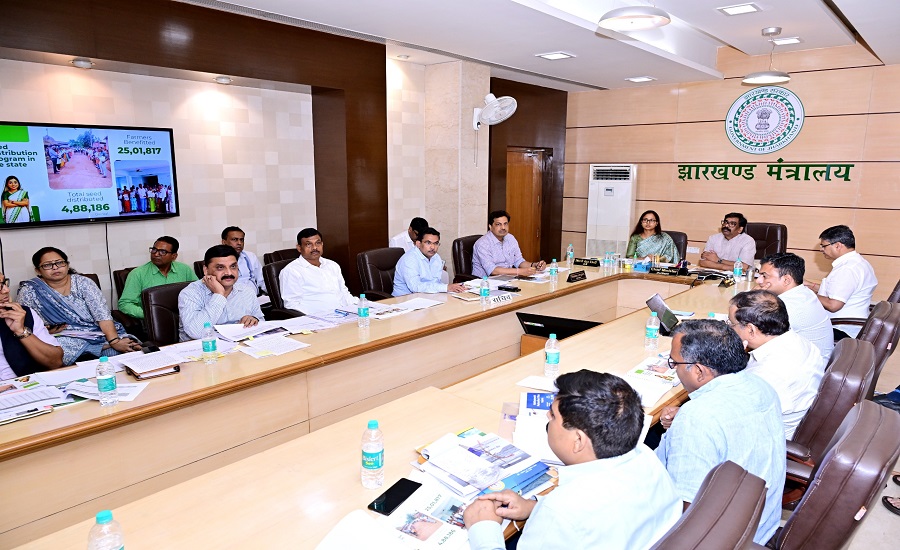
Ranchi: Jharkhand Chief Minister Hemant Soren chaired a high-level review meeting of the Agriculture, Animal Husbandry and Cooperation Department at the Jharkhand Ministry on Friday, outlining a comprehensive strategy to strengthen agriculture, improve farmer welfare, and promote climate-resilient farming across the state.
Reviewing the department’s achievements for FY 2025-26 and action plan for FY 2026-27, the Chief Minister directed officials to ensure that all farmer welfare schemes reach eligible beneficiaries transparently and within stipulated timelines. Agriculture Minister Shilpi Neha Tirkey and senior departmental officials also attended the meeting.
Model Farmer Schools to Be Established in Every District
To modernize agriculture, CM Soren instructed officials to develop at least one Model Farmer School in every district. These centres will provide farmers with training on modern farming techniques, advanced agricultural technologies, and best practices in collaboration with agricultural universities and research institutions.
He also directed the department to strengthen the functioning of existing Farmer Schools to make them more effective and result-oriented.
Focus on Pulses and Millets in Low-Rainfall Regions
Considering below-normal rainfall in several parts of the state, the Chief Minister directed officials to prepare a strategy to promote the cultivation of pulses and millets, particularly in districts where these crops have high potential.
He also asked the department to identify barren and fallow agricultural land and prepare an action plan to bring such land under cultivation.
Solar Irrigation Pumps Under Kisan Samriddhi Yojana
CM Soren emphasized expanding the Kisan Samriddhi Yojana by providing more farmers with solar-powered irrigation pumps.
According to him, solar irrigation will reduce farming costs, lower dependence on conventional electricity, and improve farmers’ incomes. He instructed officials to strengthen coordination with JREDA for effective implementation of the scheme.
Special Strategy for Drought-Prone Areas
In view of lower-than-normal rainfall, the Chief Minister directed the department to prepare a dedicated action plan for drought-prone regions, especially the Palamu Division and other low-rainfall districts.
The strategy will focus on:
- Promoting low-water-consuming crops
- Expanding water conservation initiatives
- Encouraging organic farming
- Supporting commercial agriculture
- Strengthening agricultural procurement systems
Agriculture Trade Fairs to Expand Across Divisions
Following the success of the state-level Agriculture Trade Fair in Ranchi, CM Soren directed officials to organize Agriculture Trade Fairs in every divisional headquarters at different times throughout the year.
The initiative aims to help farmers gain exposure to modern agricultural equipment, innovative technologies, and better market opportunities.
Boost for Mushroom Farming, Beekeeping and Women Farmers
The Chief Minister instructed the department to establish mushroom cultivation training centres in every district and promote women-led Farmer Producer Groups (FPOs).
He also stressed expanding beekeeping activities and providing safety kits and technical support to beekeepers to encourage sustainable income generation.
One Agriculture Model Village in Every District
CM Soren announced plans to develop one model agriculture village or panchayat in every district.
These model villages will receive integrated support, including:
- Soil testing
- Irrigation facilities
- Farmer training
- Access to government schemes
- Modern farming practices
He also advised officials to ensure that benefits are distributed among a wider pool of eligible farmers instead of repeatedly benefiting the same individuals.
Animal Husbandry to Become a Major Income Source
Reviewing the Animal Husbandry Department, the Chief Minister directed officials to promote:
- Dairy farming
- Goat farming
- Pig farming
- Poultry farming
He also called for regular livestock vaccination, improved veterinary services, and modernization of breeding farms.
Additionally, he suggested developing livestock-based livelihood models in mining-affected areas and introducing dairy farming in central prisons.
More Focus on Dairy and Fisheries
The Chief Minister instructed the department to increase milk production by preparing a comprehensive database of dairy farmers and connecting them with the state’s Milk Federation.
He also emphasized organizing livestock fairs at the divisional level and strengthening the fisheries sector as a major source of employment for rural youth.
Technology-Driven Agriculture and Better Market Access
CM Soren asked officials to prepare a special roadmap to provide farmers with:
- Weather-based advisory services
- High-quality seeds
- Modern agricultural technologies
- Crop diversification support
- Improved marketing facilities
He also stressed regular monitoring of all agriculture schemes at district and block levels to ensure effective implementation.
Strengthening Cooperative Institutions
During the review of the Cooperation Department, the Chief Minister directed officials to make LAMPS and PACS more active by strengthening:
- Procurement of agricultural produce
- Transparent payment systems
- Seed distribution networks
He also proposed developing apex cooperative societies as Centres of Excellence to improve service delivery.
CM Interacts with Farmers Through Video Conference
During the meeting, CM Soren interacted via video conferencing with:
- Farmer School representatives in Garhwa
- Farmer Suresh Marandi from Dumka
- Agriculture officials from Jamtara
He reviewed the current agricultural situation, implementation of government schemes, opportunities in cashew cultivation, and advised farmers to choose crops suited to low-rainfall conditions.
The Chief Minister reiterated that the government’s priority is to make Jharkhand’s agriculture sector more productive, climate-resilient, technology-driven, and profitable while ensuring sustainable livelihoods for farmers across the state.