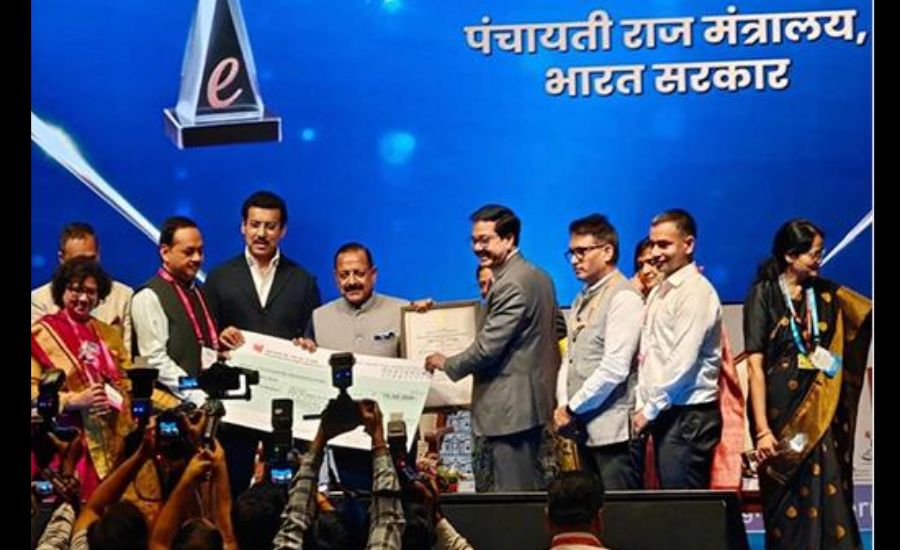
Punjab cadre IAS officer Vipul Ujwal has earned national recognition after playing a leading role in the Panchayat Advancement Index (PAI), India’s largest rural governance assessment platform, which received the Gold Award at the National Awards for e-Governance (NAeG) 2026. The honour celebrates excellence in the use of digital technology and data analytics to improve governance and public service delivery.
The award was presented during the 29th National Conference on e-Governance, held on July 1–2, 2026, at the Rajasthan International Centre in Jaipur. The Ministry of Panchayati Raj’s flagship initiative secured the top honour in Category VII – Digital Transformation through the Use of Data Analytics in Digital Platforms.
Vipul Ujwal’s Contribution to the National Initiative
A 2009-batch IAS officer of the Punjab cadre, Vipul Ujwal is currently serving as Director, Capacity Building Division in the Ministry of Panchayati Raj on deputation. He has been closely associated with the Panchayat Advancement Index since its early stages, contributing to its design, execution and expansion across the country.
According to the Ministry, Ujwal played an important role in developing the assessment framework, strengthening the digital platform, coordinating with States and Union Territories, integrating data from multiple ministries and leading extensive capacity-building programmes that supported nationwide implementation.
PAI 2.0 Achieves Near-Universal Coverage
The second edition of the Panchayat Advancement Index has significantly expanded its reach. PAI 2.0 assessed 2,59,867 Gram Panchayats, covering 97.3 per cent of India’s 2,66,999 Gram Panchayats. This is a notable improvement over the 80.79 per cent participation recorded during the first edition. The exercise included participation from 33 States and Union Territories.
The index measures the performance of Gram Panchayats through 150 indicators and 230 data points spread across nine thematic pillars, all aligned with the Localisation of Sustainable Development Goals (LSDGs).
To reduce manual reporting and improve data quality, the platform automatically draws 59 data points from 11 government schemes managed by six Union Ministries. These include eGramSwaraj, Jal Jeevan Mission, MGNREGS, POSHAN Tracker and UDISE+, enabling a more reliable and evidence-based assessment.
Strengthening Grassroots Governance Across India
Beyond creating a national assessment framework, the initiative has focused heavily on capacity building. More than 4.71 lakh Panchayati Raj Institution functionaries and stakeholders have been trained as part of the programme. Its implementation network spans nearly 37 lakh elected representatives, 7,135 Block Development Officers and 741 District Officers.
The Ministry stated that PAI scores are now being used to support the National Panchayat Awards, preparation of Gram Panchayat Development Plans, and state-level incentive programmes already being implemented in Punjab, Jharkhand and Uttar Pradesh.
Officials said the success of PAI 2.0 reflects coordinated efforts by the Ministry of Panchayati Raj, State Governments, district administrations and Panchayati Raj Institutions to strengthen transparency, accountability and outcome-based governance at the grassroots.
Interestingly, public service is a shared commitment in Vipul Ujwal’s family. His wife, Sonali Giri, also a 2009-batch IAS officer of the Punjab cadre, currently serves as the Administrative Secretary, School Education, Punjab. The officer couple has earned recognition for their contributions in their respective areas of governance.