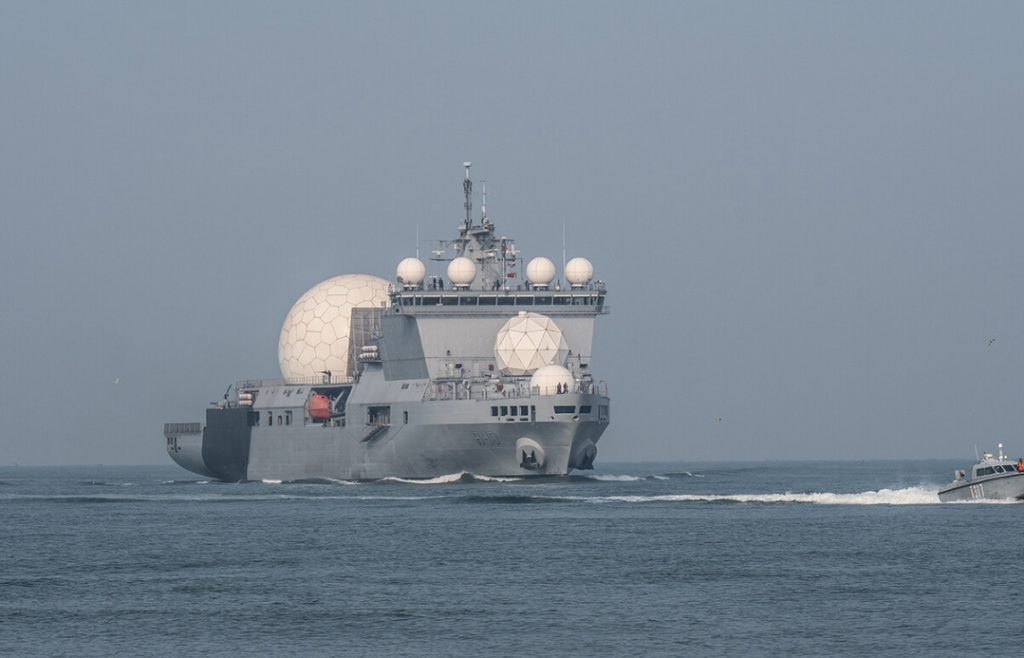
New Delhi: INS Dhruv missile tracking ship deployment in the Arabian Sea has intensified attention across South Asia as Pakistan prepares for a major missile test. The move highlights a growing intelligence rivalry between the two nuclear-armed neighbors.
With Pakistan issuing a large NOTAM (Notice to Airmen), India positioned its advanced surveillance vessel just before the test window, signaling a shift from routine military drills to real-time intelligence monitoring.
What Triggered the Latest India-Pakistan Tension?
Pakistan recently issued a NOTAM restricting a large area of the northern Arabian Sea between 14–15 April 2026 for a suspected missile launch.
- The restricted zone stretches around 415–450 km
- Covers key regions near Karachi, Gwadar, Ormara, and Sonmiani
- Applies from sea level to unlimited altitude
This unusually large exclusion zone suggests a high-value or long-range missile test, not a routine exercise.
Background of INS Dhruv Missile Tracking Ship Deployment
India deployed INS Dhruv, a highly specialized missile-tracking and surveillance ship, into the Arabian Sea just before Pakistan’s test window.
- Entered the region less than 24 hours before the test
- Designed to track missile launches and collect telemetry data
- Operates with advanced radar and electronic intelligence systems
This indicates a planned intelligence mission aimed at observing Pakistan’s missile capabilities in real time.
What Makes INS Dhruv So Important?
INS Dhruv is one of India’s most sensitive strategic assets.
- Built by Hindustan Shipyard Limited
- Supports India’s ballistic missile defence (BMD) programme
- Equipped with AESA radars and long-range sensors
- Can track missile trajectory, speed, and re-entry behavior
It can collect critical data that helps improve interception systems and early warning networks.
What Missile Could Pakistan Be Testing?
Pakistan has not officially revealed details of the missile. However, analysts suggest possible options:
- Advanced surface-to-surface missile
- Sea-launched cruise missile
- Possibly a submarine-launched system like Babur-III
Such systems are part of Pakistan’s maritime nuclear deterrence strategy, making the test highly sensitive.
Why This Situation Is Strategically Important
This is not a direct military conflict, but a battle of intelligence gathering.
- India aims to capture technical data from the launch
- Pakistan may see it as an attempt to expose its strategic secrets
- Both countries are using the Arabian Sea as an intelligence battlefield
Missile tracking ships like INS Dhruv operate legally in international waters, but their presence often creates political tension.
Arabian Sea Becoming a Strategic Hotspot
The incident shows a larger trend:
- India and Pakistan rivalry is expanding from land to maritime domain
- Both are investing in naval missile systems and surveillance
- The Arabian Sea is now a key zone for deterrence and intelligence operations
Future missile tests may increasingly trigger counter-surveillance deployments like this.