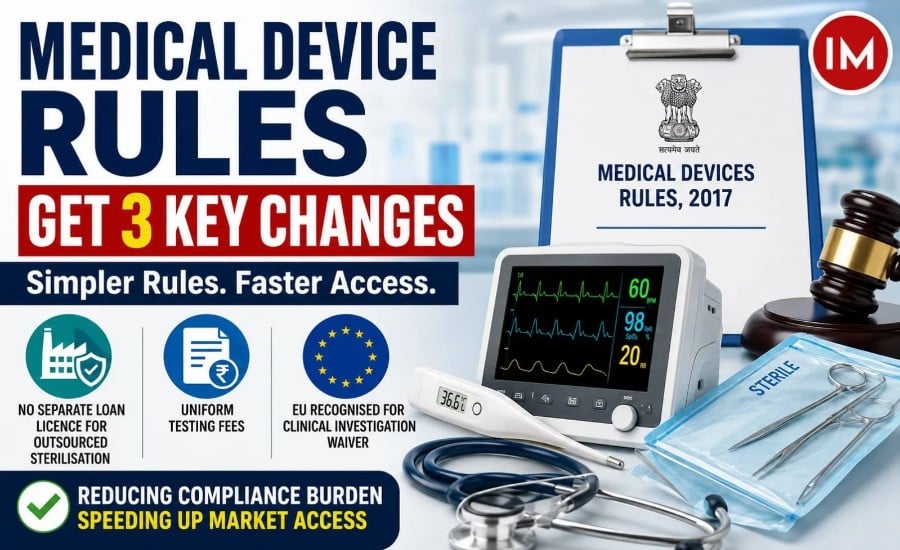
New Delhi: The Union Ministry of Health and Family Welfare has proposed amendments to the Medical Devices Rules, 2017, introducing three regulatory changes aimed at simplifying compliance requirements, improving transparency and facilitating faster access to eligible medical devices in India.
The proposed reforms cover outsourced sterilisation, testing fees and clinical investigation requirements for certain medical devices.
Three Areas Targeted for Regulatory Simplification
The proposed changes focus on:
- Removing a separate loan licence requirement for certain outsourced sterilisation arrangements.
- Introducing uniform testing fees for medical devices.
- Adding the European Union (EU) to the list of recognised stringent regulatory jurisdictions for specified clinical investigation waivers.
Read Also: Madhya Pradesh Expands Local Nutrition Support, Children to Get Daily Hot Meals at Anganwadis
According to the Ministry, the measures are intended to reduce regulatory burden while maintaining quality, safety and performance standards.
Separate Loan Licence Proposed to Be Removed for Outsourced Sterilisation
One of the changes concerns Rule 44 of the Medical Devices Rules, 2017.
Under the proposed amended provision, manufacturers using an outsourced sterilisation facility would not need to obtain a separate loan licence under Rule 25 if the sterilisation facility already holds a valid licence under the Medical Devices Rules, 2017.
Previously, manufacturers without an in-house sterilisation facility were required to obtain a separate loan licence for sterilisation activities.
The proposed change is expected to reduce:
- Documentation requirements
- Regulatory approvals
- Compliance-related costs
- Approval timelines
It would allow manufacturers to use specialised sterilisation facilities without the additional licensing requirement, subject to the applicable regulatory conditions.
Uniform Testing Fees Proposed Across Laboratories
The proposed amendments also introduce a Ninth Schedule to the Medical Devices Rules, prescribing uniform fees for testing medical devices by recognised Medical Device Testing Laboratories.
The standardised fee structure is intended to bring greater predictability to testing costs for manufacturers and importers.
The Ministry said the measure would help:
- Standardise testing charges
- Reduce ambiguity over fees
- Minimise disputes
- Improve transparency
- Promote equitable treatment of stakeholders
European Union Added to Recognised Regulatory Jurisdictions
Another proposed change relates to Rule 63, which governs waiver of clinical investigation requirements for certain medical devices without predicate devices.
The EU would be added to the existing list of recognised stringent regulatory jurisdictions, which currently includes:
- United States
- United Kingdom
- Australia
- Canada
- Japan
The change would allow eligible medical devices already approved in the European Union to qualify for the applicable waiver of clinical investigation requirements in India.
What This Could Mean for Medical Device Access
The proposed EU recognition is intended to reduce regulatory duplication for eligible devices and facilitate their faster availability in India, while lowering associated regulatory timelines and burdens for manufacturers and importers.
The waiver, however, applies to eligible medical devices covered by the relevant provisions and does not mean that all EU-approved medical devices would automatically bypass India’s regulatory requirements.
Government Links Reforms to Ease of Doing Business
The Ministry said the proposed amendments are part of efforts to strengthen India’s medical device regulatory framework through greater transparency, predictability and international regulatory convergence.
Taken together, the three measures are aimed at:
- Simplifying regulatory procedures
- Reducing compliance costs
- Making testing charges more predictable
- Facilitating timely market access for eligible devices
- Strengthening regulatory transparency
- Supporting access to advanced medical technologies
The reforms are intended to improve ease of doing business in the medical device sector while retaining requirements related to the quality, safety and performance of medical devices.
Read Also: Govt Plans Faster Local Production of MRI Other High-End Medical Device