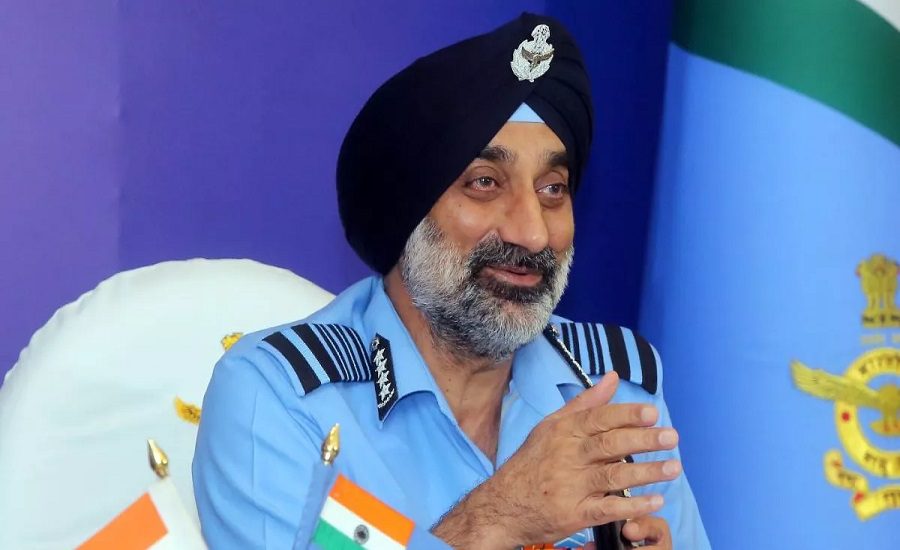
New Delhi: In a major revelation that underscores the scale and success of India’s recent military operations, Air Chief Marshal Amar Preet Singh confirmed that 10 Pakistani fighter jets, including advanced F-16s and JF-17s, were shot down during Operation Sindoor, a four-day high-intensity air offensive executed earlier this year.
The disclosure came during a press conference held to commemorate the 93rd anniversary of the Indian Air Force (IAF), where the Air Chief said the operation delivered “speed, precision, and strategic impact” that will be remembered in military history.
The Blow to Pakistan: Major Losses in Air Power and Infrastructure
The IAF chief detailed the devastating losses suffered by Pakistan, both in the air and on the ground:
Fighter Aircraft Destroyed:
At least 9–10 fighter jets, including 4–5 F-16s and multiple JF-17s, were neutralized. This included five aircraft shot down mid-air, 300 km inside enemy territory.
AWACS and Transport Aircraft Hit:
One AWACS (Airborne Warning and Control System) and a C-130 transport aircraft were also destroyed in precision air strikes.
Long-range Strike Success:
Singh confirmed a record-breaking kill at 300 km distance using newly operational long-range Surface-to-Air Missiles (SAMs). This capability significantly crippled Pakistan’s ability to operate within its own airspace.
#WATCH | Delhi: On Operation Sindoor, Indian Air Force chief Air Chief Marshal Amar Preet Singh says, "…A clear directive, clear mandate was given to the Indian Armed Forces… It stands as a lesson which will go down in history that this is one war that was started with a… pic.twitter.com/FJuEpFdVQi
— ANI (@ANI) October 3, 2025
Ground Targets: Command Structures, Radars, and Runways Wiped Out
The operation struck deep into Pakistan’s air defense infrastructure:
Radar Systems:
Radars at four key locations were destroyed, significantly weakening enemy surveillance and tracking.
Command & Control Centers:
Two vital command centers were neutralized, disrupting Pakistan’s military coordination and response capability.
Runway Damage:
Two airbase runways were severely damaged, preventing take-offs and landings of fighter aircraft during critical phases.
Aircraft Hangars and Tarmac:
Three hangars, including those housing F-16s under maintenance, were hit, destroying both aircraft and support infrastructure.
SAM System Neutralized:
A full Surface-to-Air Missile system was taken out, exposing Pakistan’s airspace further to Indian precision strikes.
“Objectives Achieved Swiftly, War Ended on Our Terms”
The IAF Chief hailed Operation Sindoor as a model of modern warfare:
“This was a war started with a very clear objective and terminated quickly. We achieved what we set out to do. It will go down in history,” said Air Chief Marshal Singh.
He emphasized that India called for an end to hostilities only after it had achieved all mission goals, rejecting Pakistan’s denial and misinformation about the scale of the conflict.
SAMs & Surveillance: India’s Technological Edge
The success of Operation Sindoor was significantly aided by India’s newly inducted long-range SAMs and surveillance systems. The Air Chief noted that these systems:
- Allowed deep strikes inside enemy territory
- Prevented Pakistan from operating effectively, even within its own airbases
- Achieved the longest known air kill in Indian defense history
Media Role & Disinformation Warfare
Singh praised the Indian media’s responsible coverage during the fog of war, stating:
“Our media handled the fog of war very well, cut down disinformation. They stood shoulder-to-shoulder with the Armed Forces.”
This, he noted, was crucial in neutralizing Pakistan’s narrative warfare and maintaining public morale during the operation.
Why Operation Sindoor Was Launched
The operation was a retaliatory strike in response to the Pahalgam terror attack in May 2025. Indian forces targeted terror infrastructure in Pakistan and Pakistan-occupied Jammu and Kashmir (PoJK), including airbases and strategic installations.
Following initial strikes, Pakistan attempted escalation—but was firmly repelled and outmatched by the IAF’s swift and decisive response.
Conclusion: A New Chapter in Indian Military Strategy
Air Chief Marshal Singh’s revelations make it clear that Operation Sindoor was not just a tactical mission, but a strategic show of force. It demonstrated India’s evolving air dominance, cutting-edge defense technology, and its resolve to strike back decisively.
“This is something the world needs to learn from us,” Singh concluded.
Read also: Indian Navy Signs Deal for Multi-Spectral Camouflage Cloak Under iDEX to Boost Stealth Capabilities