New Delhi: Prime Minister Narendra Modi on Monday urged young civil servants to place citizens at the heart of governance, stressing that every administrative decision should reflect empathy, responsiveness and a commitment to public service.
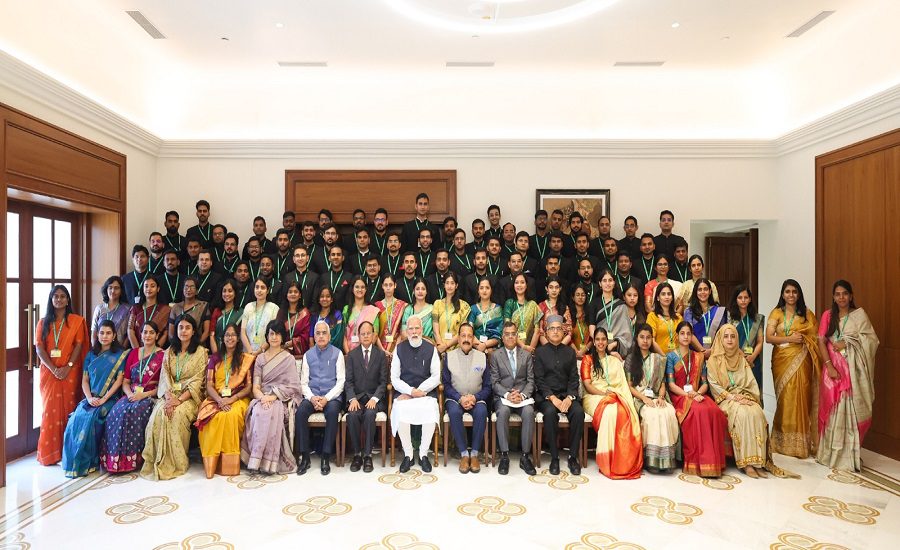
Interacting with 183 Officer Trainees of the IAS 2024 batch at Seva Teerth in New Delhi, the Prime Minister highlighted the importance of citizen-centric governance, technological innovation and collaborative administration as India advances towards the vision of Viksit Bharat 2047.
The officer trainees are currently serving as Assistant Secretaries across various Ministries and Departments of the Government of India as part of their administrative training.
Public Service Begins with Real-Life Responsibility
Addressing the young officers, the Prime Minister noted that after two years of field exposure and administrative learning, they had reached a crucial stage in their careers.
He said that the decisions they make in the coming years would shape not only their professional journeys but also the lives of millions of citizens across the country.
Emphasising the responsibilities of public service, he remarked that the true test of an administrator begins when handling real-life situations with integrity, sensitivity and dedication.
According to the Prime Minister, governance is not merely about managing systems and procedures but about making a meaningful difference in people’s lives.
Read also: Centre Extends Tenure of IAS J.V. Naga Subramanyam as Joint Secretary, MNRE Till Feb 2027 | Know Him
‘Nagrik Devo Bhava’ Should Guide Every Decision
One of the key messages delivered during the interaction was the importance of maintaining a citizen-first approach in governance.
The Prime Minister urged officers to always remember the human impact behind every government file and administrative decision.
He observed that every file represents the aspirations, concerns and expectations of countless citizens who depend on government institutions for support and services.
Invoking the mantra of “Nagrik Devo Bhava”, he encouraged the officers to place citizens at the centre of governance and ensure that public administration remains compassionate, inclusive and responsive.
According to him, empathy and sensitivity must remain integral to decision-making processes at every level of government.
Need for a Whole-of-Government Approach
The Prime Minister also highlighted the growing need for collaboration across government departments.
He noted that many contemporary development challenges cut across sectors and therefore cannot be effectively addressed through isolated departmental efforts.
Calling for a “whole-of-government approach”, he stressed that coordination between ministries, departments and agencies is essential for achieving sustainable and meaningful development outcomes.
The Prime Minister said that eliminating administrative silos would improve policy implementation and strengthen governance delivery mechanisms.
Civil Servants Key to Viksit Bharat 2047
Highlighting India’s long-term development vision, the Prime Minister called upon the young officers to play an active role in the country’s journey towards becoming a developed nation by 2047.
He said every policy, programme and administrative intervention undertaken over the coming decades should contribute to the larger goal of building a prosperous and developed India.
The Prime Minister identified several national priorities that require focused administrative attention, including:
- Aatmanirbhar Bharat
- Make in India
- Manufacturing growth
- Energy security
- Employment generation
- Youth empowerment
- Infrastructure development
He emphasised that civil servants would play a critical role in translating these national priorities into tangible outcomes at the grassroots level.
Technology and AI Transforming Governance
Reflecting on the evolution of governance in India over the past decade, the Prime Minister noted that administration has increasingly shifted from a process-centric framework to a result-oriented model.
He highlighted the expanding role of technology in governance and pointed to digital platforms, artificial intelligence and innovation as powerful tools for improving public service delivery.
According to him, technology has enabled citizens to access government services more efficiently while increasing transparency and accountability within administrative systems.
The Prime Minister encouraged young officers to embrace technological advancements and leverage digital solutions to improve governance outcomes.
Data Must Reflect People’s Lives
The Prime Minister also underlined the importance of data-driven governance.
He said that data should not be viewed merely as statistical information or numerical indicators. Instead, administrators should understand that behind every dataset are the lives, challenges and aspirations of millions of citizens.
He urged officers to regularly assess whether government schemes and policies are producing the intended outcomes on the ground.
Monitoring implementation and measuring impact, he said, are essential for ensuring that public resources generate meaningful benefits for citizens.
Growing Role of Women in Administration
During the interaction, the Prime Minister highlighted the increasing participation of women in public administration.
He noted that women constitute more than 40 percent of the current IAS 2024 batch, reflecting a positive shift towards greater gender representation in the civil services.
The Prime Minister described this trend as an important development for nation-building and inclusive governance.
Focus on Outcomes Rather Than Positions
In his concluding remarks, the Prime Minister encouraged the officer trainees to continuously evaluate their contribution to national development.
He advised them to derive satisfaction not from the positions they occupy but from the measurable outcomes they achieve for society.
According to him, the true success of a civil servant lies in the positive impact created through effective governance, public service and citizen welfare.
Expressing confidence in the capabilities of the young officers, he said their energy, commitment and talent would play a significant role in shaping India’s future.
Senior Officials Present During the Interaction
The interaction was attended by several senior government functionaries, including:
- Jitendra Singh, Minister of State (Personnel)
- P. K. Mishra
- Shaktikanta Das
- T. V. Somanathan
- Rachna Shah
- Sriram Taranikanti
The interaction served as an opportunity for the future administrators of the country to engage directly with the Prime Minister and gain insights into the government’s vision for governance, public service and nation-building.
As India moves towards Viksit Bharat 2047, the message delivered to the young IAS officers was clear: governance must remain citizen-centric, technology-enabled, collaborative and outcome-oriented.