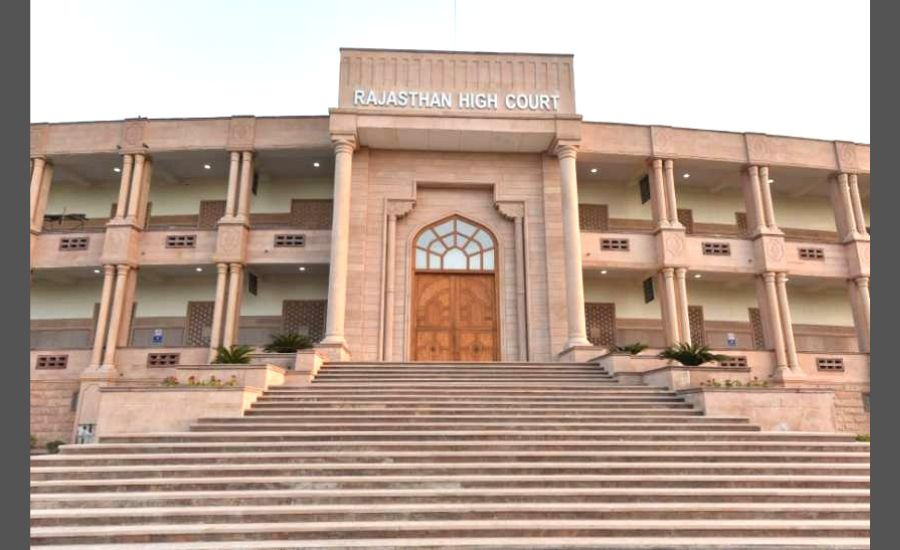
Jodhpur: In a significant judgment on administrative fairness and misuse of disciplinary powers, the Rajasthan High Court has quashed the extension of suspension orders against Manmeet Singh Ahluwalia (IRS:2012), holding that the action was arbitrary, malicious and driven by personal vendetta. The Court also directed the Union Government and the Central Board of Indirect Taxes and Customs (CBIC) to pay ₹5 lakh as exemplary costs, restore the officer’s promotional benefits and grant him full salary for the period of illegal suspension.
The verdict was delivered on July 30, 2026, by a Division Bench comprising Justice Munnuri Laxman and Justice Anuroop Singhi in Manmeet Singh Ahluwalia vs. Union of India & Others, allowing the writ petition and setting aside an earlier order of the Central Administrative Tribunal (CAT), Jodhpur Bench.
Court Sets Aside CAT Order and Suspension Extensions
The High Court quashed:
- The CAT, Jodhpur Bench’s order dated April 16, 2025.
- Suspension extension orders dated July 16, 2021 and January 13, 2022.
The Bench held that both extension orders were “vitiated by malice in law” and reflected an abuse of administrative authority.
Read also: Rajasthan High Court Suspends RCA Ad Hoc Committee; IAS Bhaskar A. Sawant Appointed In-Charge
Dispute Originated From Residential Colony Incident
The controversy dates back to September 2019, when a late-night altercation took place at a government residential colony in Mayapuri, New Delhi.
The dispute involved Ahluwalia’s mother and sister on one side and a GST Council official along with another colleague on the other.
An inquiry committee examined the incident and reportedly found fault with the petitioner’s family members—not Ahluwalia himself.
Following the incident:
- Ahluwalia was transferred to Jodhpur.
- Eviction proceedings were initiated against him.
- He later secured relief from the appellate court in the eviction matter.
Suspension Extended Without Chargesheet
The Court noted that several complaints were subsequently made against the officer, including allegations relating to:
- Unauthorised leave during the COVID-19 pandemic.
- Alleged rude behaviour towards senior officers.
Based on these complaints, Ahluwalia was suspended in May 2021.
While the initial suspension was for 90 days, the department extended it twice:
- First for 180 days.
- Again in January 2022.
However, the chargesheet was issued only in August 2022, months after both extension orders had already expired.
The Bench observed that the disciplinary authority already possessed all relevant materials, including inquiry reports, complaints and statements, at the time of the original suspension. Therefore, there was no legal justification for repeatedly extending the suspension.
Promotion Kept in Sealed Cover
The judgment also highlighted that a Departmental Promotion Committee (DPC) met in March 2022 while the officer remained under the second suspension extension.
As a consequence:
- Ahluwalia’s promotion was placed in a sealed cover.
- His juniors were promoted ahead of him.
The Court held that the illegal continuation of suspension directly affected his career progression.
High Court Finds Evidence of Personal Vendetta
Making strong observations against the department, the Bench noted that the allegations primarily arose from a private family dispute unrelated to the officer’s official responsibilities.
The Court also observed that Ahluwalia had maintained an otherwise unblemished seven-year service record and had represented India at international trade forums.
In one of the strongest observations in the judgment, the Bench remarked, “The manner in which these allegations were brought forth prima facie demonstrates personal vendetta on the part of certain high-ranking officials against the petitioner.”
The judges further noted that while a counter-FIR lodged by the petitioner’s family existed, it was ignored during departmental proceedings, with the officer alone being targeted.
Administrative Harassment Cannot Be Tolerated
Relying on the Supreme Court’s landmark judgment in Lucknow Development Authority v. M.K. Gupta, the High Court reiterated that arbitrary and capricious actions by public authorities amount to harassment that transcends individual grievances and becomes a matter of public concern.
The Bench held that the extension of suspension amounted to malice in law and constituted an abuse of administrative power that unjustifiably damaged the officer’s career prospects.
Reliefs Granted by the High Court
Allowing the writ petition, the High Court directed:
- Quashing of both suspension extension orders.
- Treating Ahluwalia as reinstated immediately after expiry of the original 90-day suspension.
- Payment of full salary for the extended suspension period after adjustment of amounts already paid.
- Opening of the sealed cover maintained by the DPC.
- Grant of notional promotion, subject to eligibility, from the date his juniors were promoted.
- Extension of all consequential service benefits.
- Completion of the promotion exercise within two months.
- Payment of ₹5 lakh as exemplary compensation by the Union of India and CBIC within three months.
Significant Judgment on Administrative Accountability
The ruling is expected to have wider implications for disciplinary proceedings within the civil services, reinforcing that suspension cannot be extended mechanically or without adequate justification. It also underscores the judiciary’s willingness to intervene where disciplinary powers are found to have been exercised arbitrarily or for extraneous considerations, particularly when they adversely affect an officer’s career progression.