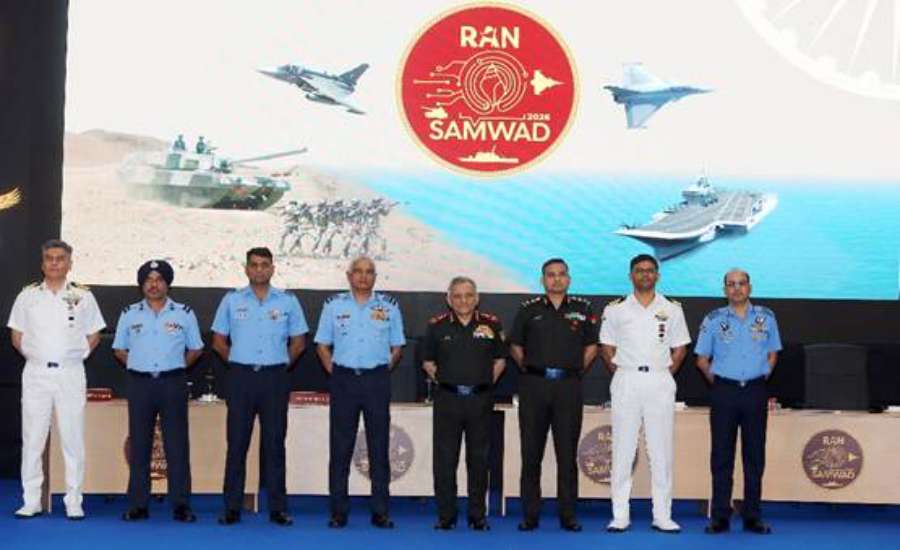
New Delhi: The role of humans in AI dictated war decisions became a major focus at the second joint Indian defence leaders summit, Ran Samvad 2026, held in Bengaluru. Top military leaders stressed that while Artificial Intelligence (AI) is transforming warfare, human judgment must remain central.
The discussions also reflected on lessons from the West Asia conflict and India’s Operation Sindoor. Experts highlighted that modern wars are becoming faster and more complex, but decisions involving life and death cannot be left entirely to machines. The summit underlined the importance of balancing advanced technology with human control in defence strategy.
Ran Samvad 2026: Human Judgment Must Remain Central in AI Warfare
Senior Indian defence officials clearly stated that AI can support decision-making, but it cannot replace human thinking.
Read also: How Indian Army Plans to Turn Tank Smoke Launchers into Deadly Drone Systems for Future Warfare
Army Chief General Upendra Dwivedi emphasized that technology should be “technology-enabled, not technology-led.” This means AI should assist commanders, not control them.
Naval Chief Admiral Dinesh Tripathi also highlighted that no algorithm can match the instinct, experience, and resilience of trained military personnel. He stressed that final decisions must always be taken by humans.
Ran Samvad 2026: The “Kill Chain” Debate in AI-Based Warfare
One of the key topics discussed was the “kill chain”, which refers to the process of identifying and attacking targets.
With AI speeding up this process, a major question arises: Should machines decide when to strike?
Military leaders agreed that:
- AI can suggest options
- AI can process data quickly
- But humans must remain “in the loop” for final approval
This ensures accountability and reduces the risk of wrong decisions in high-pressure situations.
What are the Lessons from West Asia Conflict for India
The ongoing West Asia conflict provided real-world lessons for Indian defence planners.
Air Marshal Ashutosh Dixit warned that:
- Conflicts far away can still impact India
- Disruptions in sea routes and energy supply can affect national security
- Regional instability spreads quickly in today’s interconnected world
He also pointed out how modern warfare involves:
- Long-range air strikes
- Drone attacks
- Missile coordination across countries
This shows that no single domain (land, sea, air) is enough anymore.
Ran Samvad 2026: Rise of Multi-Domain Warfare
Ran Samvad 2026 focused heavily on multi-domain operations (MDO).
This includes coordination across:
- Land
- Air
- Sea
- Cyber space
- Space and cognitive domains
According to the Ministry of Defence, future wars will require seamless integration across all these domains for faster and smarter decision-making.
Operation Sindoor and Modern War Lessons
Discussions also included India’s Operation Sindoor, which highlighted:
- The role of information warfare
- Importance of coordination between forces
- Need to counter misinformation
Military leaders said modern conflicts are not just fought on battlefields, but also in:
- Media
- Digital platforms
- Psychological spaces
Why AI Alone Is Not Enough
Experts warned that AI has limitations:
- It cannot understand cultural or human behavior fully
- It may miss unexpected patterns
- It lacks moral judgment
One senior officer noted that even advanced AI systems in global conflicts failed to detect certain human factors.
This reinforces the idea that human intuition is still irreplaceable.
India’s Strategy: Balance AI with Human Control
India’s defence strategy is clear:
- Use AI for speed and efficiency
- Keep humans responsible for final decisions
Officials also stressed the need for:
- Ethical use of AI in warfare
- Proper testing of AI systems
- Clear rules on human control
This approach ensures both technological strength and responsible use of power.
Conclusion
Ran Samvad 2026 made one thing very clear — the future of warfare will be driven by Artificial Intelligence, but controlled by humans. As technology advances, the challenge is not just adopting AI, but using it wisely. India is focusing on a balanced approach where machines assist, but humans decide.
This strategy aims to ensure faster operations without losing human responsibility, ethics, and judgment in modern warfare.
Read also: Why Operation Sindoor Ended in Just 4 Days: Air Chief Marshal AP Singh Explains