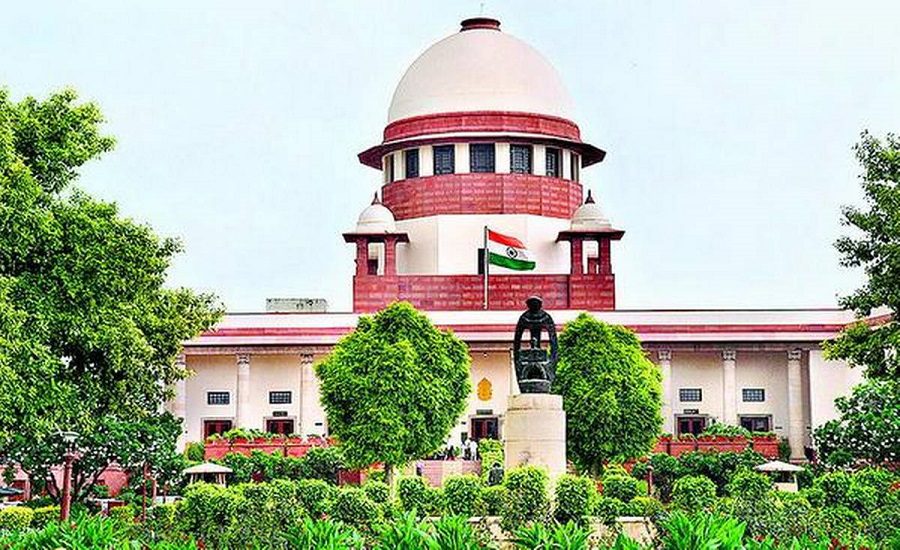
New Delhi: In a significant observation concerning the professional status and service conditions of the country’s judicial officers, the Supreme Court has said that judicial officers are not government employees and cannot be treated on the same footing as regular executive-service personnel.
The apex court observed that judicial service is fundamentally different from executive service and that judicial officers, although appointed by states under the constitutional framework, constitute a separate class.
The observations came while the court was considering a proposal to increase the retirement age of district judges from 60 to 62 years.
Supreme Court Gives States Two Weeks to Reconsider Retirement Age
A bench comprising Chief Justice of India Surya Kant, Justice Joymalya Bagchi and Justice V Mohana granted states and Union Territories two weeks to reconsider their positions on the proposal to enhance the retirement age of judicial officers.
The court also rejected the argument that raising the retirement age would impose an additional financial burden on states and Union Territories.
Instead, the bench pointed out that retaining experienced judicial officers could potentially prove more economical for governments than paying pensions to retiring officers and incurring expenditure on recruiting and training replacements.
Experience of Judicial Officers Should Not Be Lost Prematurely
The Supreme Court emphasised the importance of experience in the legal and judicial profession.
It noted that expertise acquired by judicial officers over several decades is valuable and should not necessarily be lost through premature retirement.
According to the court’s reasoning, retaining experienced judges could contribute to the efficiency and continuity of the judicial system while also reducing the need to replace experienced officers immediately upon their retirement.
The court therefore questioned the assumption that an increase in the retirement age would necessarily result in a greater financial burden for the states.
Judicial Officers Cannot Be Equated With Regular Government Employees
A key aspect of the proceedings was the argument that increasing the retirement age of judicial officers could create an imbalance between them and regular state government employees.
The Supreme Court rejected this contention.
The bench observed that although judicial officers are appointed by state governments, their service operates under a constitutional scheme and is fundamentally distinct from ordinary government service.
The court consequently held that judicial officers should be treated as a separate class rather than being automatically equated with employees working in the executive branch of government.
Different Retirement Ages Already Exist Across Professions
The apex court also pointed out that different professions already have different superannuation ages.
The bench referred to professions such as doctors and professors, where retirement conditions may differ from those applicable to other categories of government employees.
The observation reinforces the court’s view that there is no inherent requirement for judicial officers to have the same retirement age as every other category of state government employee.
Earlier July 22 Order Had Set Interim Framework
The latest observations follow an earlier order passed by the Supreme Court on July 22 concerning the retirement age of judicial officers.
In that order, the court had directed the concerned High Courts to take time-bound decisions on the issue.
As an interim arrangement, the apex court permitted judicial officers to continue in service where the jurisdictional High Court and the respective state government agree to an increase in their retirement age.
This interim arrangement is intended to prevent disruption while different jurisdictions consider the proposal.
Retirement Age Decision to Have Retrospective Effect From April 1, 2026
The Supreme Court has also clarified the temporal scope of any final decision on the retirement age issue.
According to the court’s direction, any final decision regarding enhancement of the retirement age will apply retrospectively to superannuation occurring on or after April 1, 2026.
The provision is aimed at ensuring a smooth transition for judicial officers who may have reached or are due to reach the existing retirement age while the legal and administrative framework is being finalised.
Why the Retirement Age Issue Matters
The proposed increase from 60 to 62 years could have implications for the functioning of the district judiciary, where experienced judicial officers play a critical role in handling a large volume of cases.
The Supreme Court’s observations put emphasis on the value of retaining experienced judicial personnel and avoiding the premature loss of institutional knowledge.
At the same time, the court has left room for states and High Courts to reconsider their positions before a final framework is settled.
Key Points
- The Supreme Court said judicial officers are not government employees and constitute a separate class.
- The court stressed that judicial service is fundamentally different from executive service.
- The proposal under consideration seeks to increase the retirement age of district judges from 60 to 62 years.
- States and Union Territories have been given two weeks to reconsider their views.
- The court rejected the argument that the retirement-age increase would necessarily create a greater financial burden.
- Retaining experienced judicial officers could reduce costs associated with pensions and recruitment of replacements.
- The court noted that different retirement ages already exist for professions such as doctors and professors.
- An earlier July 22 order directed High Courts to take time-bound decisions on the issue.
- As an interim measure, judicial officers may continue if the jurisdictional High Court and respective state government agree to raise the retirement age.
- Any final retirement-age decision will apply retrospectively to superannuation occurring on or after April 1, 2026.
Read Also: SC/ST Reservation: Centre Says Creamy Layer Rule Has No Constitutional Basis