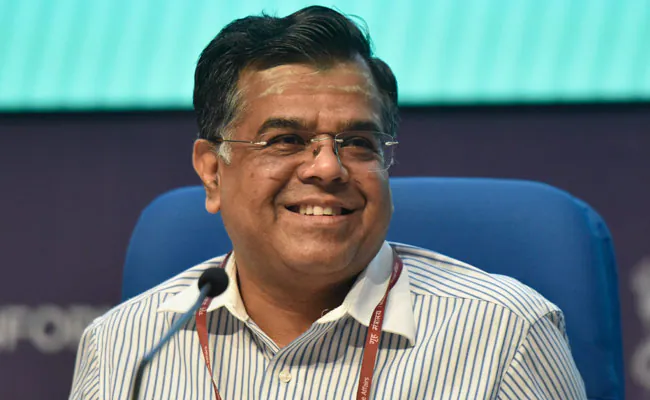
New Delhi: As Cabinet Secretary Dr T.V. Somanathan (IAS:1987:TN) approaches the end of his two-year tenure on August 30, 2026, speculation has intensified within bureaucratic and policy circles over whether the Centre will extend the tenure of India’s highest-ranking civil servant.
Although the government has made no official announcement, the record of successive governments—particularly under Prime Minister Narendra Modi—shows a clear preference for continuity in the country’s top bureaucratic post. Every Cabinet Secretary over the past 15 years has received one or more extensions beyond the initial tenure, making the possibility of another extension a subject of keen interest.
However, reports in some sections of the media suggesting that Somanathan himself may not be inclined to continue beyond his present tenure have added another dimension to the discussion, leaving the final decision closely watched.
Somanathan Took Charge in August 2024
Dr T.V. Somanathan assumed office as the Cabinet Secretary of India on August 30, 2024, succeeding Rajiv Gauba, after serving briefly as Officer on Special Duty in the Cabinet Secretariat.
A 1987-batch IAS officer of the Tamil Nadu cadre, he was appointed for the standard two-year fixed tenure that is typically given to Cabinet Secretaries.
Before becoming Cabinet Secretary, Somanathan had built a reputation as one of the country’s foremost experts in public finance and governance, serving as Finance Secretary (Department of Expenditure), Additional Secretary and Joint Secretary in the Prime Minister’s Office (PMO), and holding senior positions in both the Government of Tamil Nadu and the World Bank.
Past Cabinet Secretaries Received Multiple Extensions
A look at the tenure history of previous Cabinet Secretaries indicates that continuity has become the norm rather than the exception.
Ajit Seth assumed office on June 14, 2011, under the UPA government for an initial two-year tenure. After completing two years, he received a one-year extension in 2013. Following the change of government in 2014, the Modi government granted him an additional six-month extension before he demitted office on December 13, 2014.
His successor, P.K. Sinha, took over on June 13, 2015. He remained in office for over four years after receiving three successive extensions—a one-year extension in 2017, another one-year extension in 2018, and a final three-month extension in 2019. He retired on August 30, 2019.
The longest-serving Cabinet Secretary in India’s history was Rajiv Gauba, who assumed office on August 30, 2019. Initially appointed for two years, he received three consecutive one-year extensions in 2021, 2022 and 2023, completing a full five-year tenure before handing over charge to Somanathan in August 2024.
The succession pattern demonstrates a consistent administrative approach where experienced Cabinet Secretaries have been retained to ensure continuity in governance, especially during periods of major policy implementation.
A Different Style of Leadership
During his tenure, Somanathan has adopted a proactive administrative approach that many within the bureaucracy describe as more interventionist than merely coordinative.
Rather than limiting the Cabinet Secretariat’s role to inter-ministerial coordination, he has periodically issued detailed advisories and communications to Secretaries across ministries, urging faster decision-making, timely implementation of projects, improved governance standards, and greater administrative efficiency.
His emphasis has been on strengthening institutional capacity, improving delivery mechanisms, accelerating government programmes and encouraging greater accountability across departments.
These initiatives have made his tenure distinct from the traditionally low-profile functioning associated with the Cabinet Secretary’s office.
Will the Government Continue the Trend?
The approaching end of Somanathan’s tenure has naturally raised questions over whether the Centre will continue its established practice of granting extensions.
Given the precedents set by Ajit Seth, P.K. Sinha and Rajiv Gauba, many observers believe continuity remains a strong possibility.
At the same time, reports indicating that Somanathan may not be interested in seeking an extension have introduced uncertainty. If these reports prove accurate, the government could begin the process of identifying his successor before the end of August.
As of now, however, neither the Cabinet Secretariat nor the Appointments Committee of the Cabinet (ACC) has made any announcement regarding the matter.
About Dr T.V. Somanathan
Dr T.V. Somanathan is among the most academically accomplished officers in the Indian Administrative Service.
Born on May 10, 1965, he secured All India Rank 2 in the 1987 Civil Services Examination and joined the Tamil Nadu cadre.
His academic and professional credentials include:
- Ph.D. in Economics from the University of Calcutta
- Master’s degree in Economics
- Executive Development Programme at Harvard Business School
- Qualified Chartered Accountant (CA)
- Qualified Cost Accountant (CMA)
- Qualified Company Secretary (CS)
His career has included several prestigious assignments:
- Joint Secretary and Additional Secretary in the Prime Minister’s Office
- Finance Secretary (Department of Expenditure)
- Secretary, Ministry of Corporate Affairs
- Additional Chief Secretary (Finance), Government of Tamil Nadu
- Managing Director, Chennai Metro Rail Limited
- Director, World Bank Group, Washington D.C., under its prestigious Young Professionals Programme
An Author and Public Policy Expert
Apart from his administrative career, Somanathan is widely recognised as a scholar of economics and public policy.
He has authored or co-authored several books, including:
- Derivatives
- The Economics of Derivatives
- State Capability in India
He has also published more than 80 research papers and articles and contributed chapters to leading academic publications, including The Oxford Handbook of the Indian Constitution.
Decision Expected Soon
With less than a month remaining before his tenure concludes, the government’s decision regarding Somanathan’s future is expected shortly.
Whether the Centre opts to continue the recent tradition of granting extensions or appoints a new Cabinet Secretary, the decision will shape the leadership of India’s civil services at a crucial time when the government is implementing several major policy and governance initiatives.
For now, the bureaucracy awaits the Centre’s call, with history suggesting continuity—but recent reports leaving the outcome open.