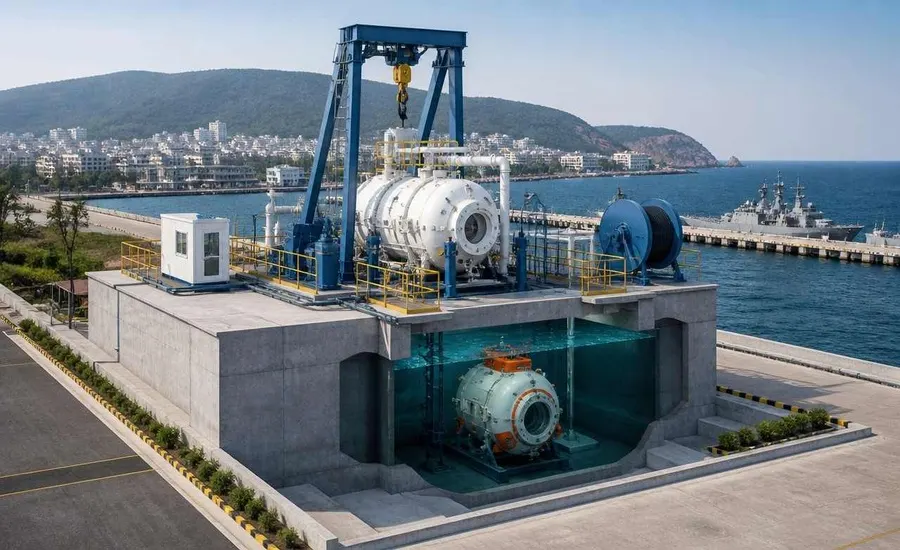
Vishakhapatnam: The Visakhapatnam submarine rescue test Plinth has been inaugurated by the Indian Navy to improve submarine rescue preparedness and maintenance capabilities. The new Launch and Recovery System (LARS) Test Plinth was inaugurated on August 19, 2026, at the Submarine Rescue Unit (East) in Visakhapatnam by Vice Admiral Sanjay Bhalla, Flag Officer Commanding-in-Chief of the Eastern Naval Command. The facility will help the Navy conduct shore-based testing and maintenance of critical submarine rescue equipment.
What Is The New LARS Test Plinth
The Launch and Recovery System (LARS) Test Plinth is a specialized shore-based facility designed for testing, validating, and maintaining submarine rescue equipment.
Read also: How The Indian Navy Plans To Fight Future Naval Battles With A Layered Missile Network
It supports the operation of the Deep Submergence Rescue Vehicle (DSRV), a highly advanced rescue system used to save sailors trapped inside disabled submarines during underwater emergencies.
The new infrastructure allows technicians to inspect and test the launch and recovery mechanism in a controlled environment without depending on ships at sea.
Why Is Submarine Rescue Test Plinth Important?
Improved Rescue Preparedness
The facility enhances the operational readiness of the Indian Navy’s submarine rescue systems. Regular testing ensures that rescue equipment remains fully functional and can be deployed quickly during emergencies.
Faster Maintenance And Repairs
Earlier, extensive testing often required deployment at sea. With the new test plinth, maintenance and validation can be performed on land, reducing costs, saving time, and improving efficiency.
Enhanced Safety For Submarine Operations
Submarine rescue missions demand highly reliable equipment. The new facility helps ensure that every component of the rescue system operates safely before actual deployment.
What is the The Deep Submergence Rescue Vehicle (DSRV)
A Deep Submergence Rescue Vehicle (DSRV) is a specialized underwater rescue craft used to evacuate personnel from stranded submarines. The Indian Navy operates DSRV systems on both the eastern and western coasts to provide rapid rescue support.
How Does It Work?
The DSRV is transported to the emergency location and launched into the sea. It docks with the distressed submarine and safely transfers trapped crew members to the surface. The system can operate at significant underwater depths and is equipped with advanced sensors and rescue technology.
Role Of Visakhapatnam In India’s Submarine Rescue Network
Visakhapatnam is the headquarters of the Eastern Naval Command and serves as a major naval hub on India’s eastern coast. The Submarine Rescue Unit (East) plays a key role in maintaining rescue capabilities for submarines operating in the Bay of Bengal and surrounding waters.
The addition of the LARS Test Plinth further strengthens the city’s strategic importance in India’s maritime security framework.
Submarine Rescue Test Plinth: Indigenous Defence Maintenance Capability Gets A Boost
The newly inaugurated facility represents an important step toward self-reliance in defence maintenance. By enabling in-house testing and maintenance, the Indian Navy can reduce dependence on external support systems while ensuring long-term operational availability of critical rescue equipment.
Strategic Significance For The Indian Navy
Strengthening Underwater Safety
The facility improves India’s ability to respond rapidly to submarine emergencies and safeguard naval personnel.
Supporting Future Naval Operations
As India’s submarine fleet continues to grow, advanced maintenance infrastructure will become increasingly important for operational effectiveness.
Boosting Maritime Security
Reliable submarine rescue capabilities are essential for maintaining a strong naval presence and ensuring crew safety during underwater missions.
Read also: Indian Navy BrahMos Missile Deployment: Key Plans, Benefits and 2030 Roadmap
FAQs
The Visakhapatnam Submarine Rescue Test Plinth is a shore-based facility used to test, maintain, and validate the Launch and Recovery System (LARS) employed in submarine rescue operations.
The DSRV is designed to rescue sailors trapped inside disabled submarines and safely transport them to the surface during emergencies.
The facility improves operational readiness, enables faster maintenance, reduces dependence on sea-based testing, and strengthens submarine rescue preparedness.