Dipak Sarmah, IFS (Retd.)
In recent decades, there has been a considerable increase in the flow of visitors to India’s protected areas (PAs), such as national parks and wildlife sanctuaries. An increased inflow of tourists into the PAs evokes mixed responses from wildlife admirers, conservationists and tourism developers. Heavy and continuous traffic to these natural areas contributes to the destruction of the environment, including loss and deterioration of habitat, pollution from litter, contamination of natural water bodies, disruption of wildlife migrations, loss of biodiversity, loss of tranquillity, etc. On the other hand, tourism itself can become an effective tool for sustainable conservation of the natural resources through promotion of awareness, interest and concern for biodiversity conservation, generation of much-needed resources for further developing the natural areas, and provision of employment/income for the local population.
The negative impacts of tourism on the environment can be reduced considerably by effective planning and devising appropriate strategies for action. It is in this context that the concept of ecotourism gains relevance. Ecotourism is a regulated form of tourism wherein the volume of traffic into natural areas is limited to their carrying capacity and all tourism-related activities are planned and executed so as to contribute to the conservation and development of the natural areas. Evidently, ecotourism is a natural resource-based and nature-oriented travel, and any activity associated with it needs to be subservient to and in harmony with the principles of ecological conservation of natural resources.
Wholesome ecotourism is based on four cardinal principles: (a) it should not adversely affect the environment; (b) it must raise sensitivity and awareness to environmental conservation; (c) it should maximize local benefits; and (d) Revenue generated from ecotourism should be ploughed back for conservation and development of the natural resources.
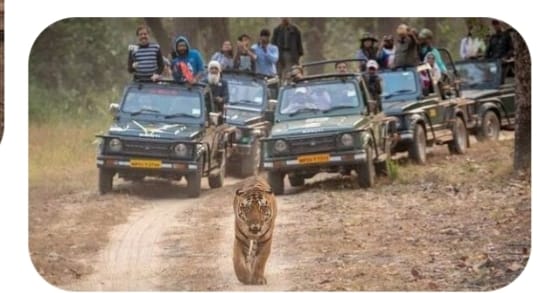
In view of the likely harmful impacts of tourism on the environment, the carrying capacity of each PA needs to be assessed carefully. Steps should also be taken to raise the carrying capacity to its full potential. Tourist traffic and facilities for their comfort should never exceed the PA’s carrying capacity. Each PA should have its own tourism plan providing detailed guidelines for area managers, tour operators and tourists. All tourist movements should be thoroughly planned and restricted to the tourism zone identified and marked clearly on the map and on the ground. No tourism should be allowed in any area outside the designated tourism zone. The conveyance used should be less polluting vehicles (preferably battery operated), boats, riding elephants, etc. There should be a ceiling on the number of vehicles/tourists allowed to enter the PA at any given point in time. Tourists should invariably be accompanied by trained guides to ensure their safety and minimize disturbances to the environment. All accommodations for tourists, including infrastructure such as cafeterias, shops, etc. should be located outside the limits of the PAs or, if that is not possible, in a corner of the buffer zone. All structures, including buildings, in the PAs should be simple and architecturally compatible with the natural surroundings. Use of solar, wind and other forms of non-conventional sources of energy should be maximized for lighting, heating, cooking and other purposes.
For ecotourism to be sustainable, it is important not only to conserve the PA but also to develop it further. This requires additional investment by way of strengthening protective measures, forest development, eco-development activities, human resources development, etc. Additional investment is also required for increasing the carrying capacity of the PAs to their optimum potential. Income from ecotourism should be reinvested in the protected areas.
Creation of national parks, wildlife sanctuaries, tiger reserves, reserved forests, etc. had resulted in forfeiture of rights, concessions and privileges enjoyed by the local inhabitants. It is therefore necessary to ensure that the ecotourism plan for any PA incorporates provisions which, to the extent possible, compensate the local people for the sacrifices they made for the conservation of forest and wildlife. They should be actively associated and given preference for manpower and infrastructure requirements in the ecotourism-related activities. Some of the local educated youths, on proper training, can become excellent guides/naturalists to accompany the tourists inside the protected areas.
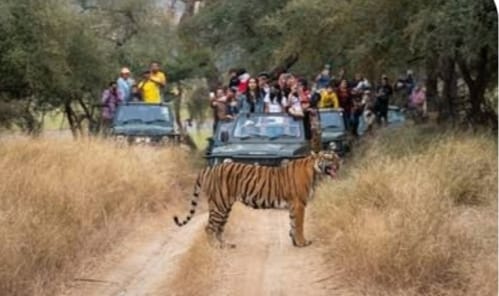
In India, ecotourism is a relatively recent activity, gaining prominence after enactment of the Wildlife (Protection) Act, 1972, that brought about far-reaching changes in the country’s wildlife scenario, providing fillip to wildlife conservation through the launching of flagship programs such as the Project Tiger. With the expansion of the PA network, especially tiger reserves, the craze for seeing the tiger in the wild has become so overwhelming that tourism in wildlife areas has become synonymous with tiger tourism. While the Project Tiger has given tremendous boost to wildlife tourism, the overzealousness among tourists to view the tiger is so intense that the carrying-capacity norms are often flouted by the park authorities. It is necessary for the park managers to be conscious of and careful about the grave dangers from overexposure of the tiger. In their enthusiasm to attract more visitors, the park officials are tempted to walk the extra mile to show the animal by any means. This tendency of overexposing our wildlife needs to be curbed at any cost. Viewing of an animal in the wild should always happen naturally, i.e., by chance and not by design. The attempt of the park manager should be to showcase the forest as a whole so that the visitor has a feel of the forest in its entirety with all its diversity, splendor and magnificence. The naturalist or the guide accompanying the tourists should be adequately trained and equipped with knowledge and information not only about wildlife but also about the entire forest ecosystem so that the tour continues to be interesting and educative even if no wild animal is sighted during the visit. It is also necessary to encourage forest or nature ecotourism to reduce pressure on the PAs from overexposure. The effort of the Forest departments should be to increase awareness of people, especially children and youth, about the benefit and pleasure of simply viewing the forest and enjoying the various facets presented by its diverse flora and fauna in the backdrop of an enchanting landscape of hills, dales, springs, streams, waterfalls, ponds, lakes and rivers.
Many PAs across the country provide flexibility to private tour operators and wildlife resort owners to carry visitors in their own vehicles for viewing wildlife. From photographs and video clips appearing in the social media, it is apparent that some of the famous tiger reserves of the country permit at the same time many vehicles with hundreds of tourists into the parks who virtually surround a lone tiger, who also appears to be quite used to this sort of situation, as it must be happening almost every day. This however does not augur well for the long-term survival of the animal and its habitat. The ultimate aim of the park authorities must be to ensure that ingress into the park is kept within its carrying capacity so as to maintain tranquility of the forest. This principle should be followed scrupulously and any attempt to dilute it in the name of making wildlife viewing more people-friendly ought to be resisted at any cost.