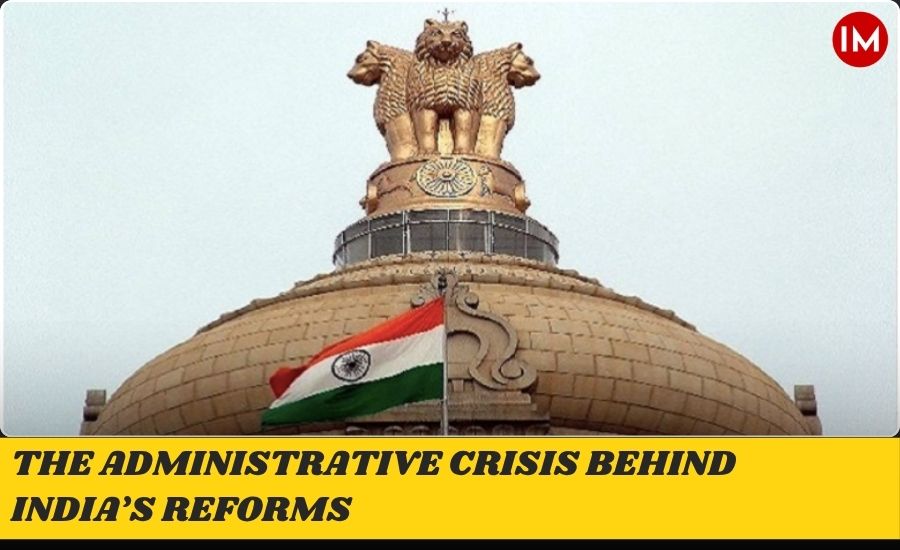
There is a certain energy in governance today that is hard to miss. Policies are being announced faster, reforms are more ambitious, and the State appears more willing than ever to intervene, whether in regulating the digital economy, reshaping electoral representation, or reimagining India’s cities.
Yet, behind this momentum lies a quieter, less visible reality. For every new law passed or reform announced, there is an administrative system struggling to keep pace. The contradiction is not in intent but in capacity. India is legislating like a fast-moving State, but implementing like a constrained one.
This gap between policy imagination and administrative execution is no longer incidental, it is becoming structural.
A system running short of personnel
The numbers tell a sobering story.
Across the higher civil services, there are over 2,800 vacancies, including nearly 1,300 posts in the Indian Administrative Service, about 19% of its sanctioned strength and around 500 in the Indian Police Service. The Indian Forest Service faces an even steeper shortfall of over 30%.
Put simply, nearly one in five senior administrative positions in India remains unfilled.
But statistics alone do not capture the lived reality of governance. In districts and departments across the country, officers often juggle multiple portfolios, moving from revenue administration to disaster management to welfare implementation in the same day. Files move, but attention is fragmented. Decisions are taken, but follow-through weakens.
The shortage extends beyond elite services. Municipal bodies function without adequate planners or engineers. Public health institutions, including premier ones, report over 35% faculty vacancies. What emerges is a pattern: the State is expanding its responsibilities without expanding its human capacity.
When laws outpace institutions
This capacity deficit becomes most visible when ambitious laws encounter limited institutional readiness.
Take India’s push toward digital governance. The legal architecture for data protection signals a strong commitment to citizen rights and regulatory oversight. Yet, the slow pace of building enforcement institutions reveals a familiar pattern, laws are enacted faster than institutions are staffed, trained, and empowered to act.
A similar challenge looms over the coming delimitation exercise. Redrawing electoral boundaries in a country of India’s scale is not merely a technical task; it requires deep administrative bandwidth, reliable data systems, and political neutrality. Without adequate capacity, even well-intentioned exercises risk delay, contestation, or uneven execution.
Urban governance perhaps offers the clearest everyday example. Cities are expected to deliver housing, infrastructure, climate resilience, and digital services. But on the ground, many urban local bodies lack professional staff, technical expertise, and leadership continuity. The result is visible in incomplete projects, delayed services, and planning that rarely keeps pace with urban growth.
Warnings that went unheeded
What makes this paradox more striking is that it has long been anticipated.
The Hota Committee emphasised the need for lateral entry and professionalisation to bridge skill gaps. The Surinder Nath Committee argued for objective, performance-based evaluation systems to improve accountability. The Punchhi Commission warned that without strengthening state-level capacity, reforms would lead to uneven outcomes across the federal structure.
More recently, NITI Aayog has repeatedly stressed the importance of specialisation and domain expertise in governance.
The diagnosis, across decades, has been remarkably consistent:
India’s governance deficit is not due to lack of ideas, but due to lack of capacity.
And yet, reform has remained incremental. Vacancies persist, lateral entry is limited in scale, and the system continues to rely heavily on a generalist framework, ill-suited to increasingly complex policy domains.
The structural mismatch
At the heart of the issue lies a deeper mismatch between what the State is expected to do and how it is designed to function.
On one side, the scope of governance has expanded dramatically into digital regulation, climate policy, urban transformation, and large-scale welfare delivery. On the other, the administrative system remains limited in size with gaps across levels, generalist in orientation even in specialised sectors as well as institutionally unstable, with frequent transfers disrupting continuity.
This mismatch produces a familiar pattern: policies multiply, but execution thins out. Officers become overburdened, decisions become hurried, and governance increasingly shifts toward compliance and reporting rather than problem-solving.
Lessons from elsewhere
Global experience offers a useful contrast. Countries that have successfully navigated large-scale reforms have done so by investing in administrative capacity alongside legislation.
South Korea, before its digital leap, built a strong technocratic bureaucracy capable of managing complex digital transitions. Singapore invested in specialised administrative cadres to handle urbanisation and economic planning. Also, the United Kingdom relies on well-staffed, domain-specific regulatory institutions to enforce laws effectively.
The common thread is clear: capacity precedes complexity.
India, by contrast, often adopts a “legislate first, build later” approach, one that creates ambition at the top but strain at the bottom.
Rebuilding the foundation
Addressing this paradox requires more than incremental adjustments, it demands a structural shift.
Expanding the strength of services like the Indian Administrative Service and Indian Police Service is essential, but numbers alone will not suffice. There is already existing mechanism for capacity building and governance such as that of ‘Mission Karmayogi’ and PRAGATI, that are rebuilding the foundation of the Indian Cicil Services. But, the system must also embrace specialisation, bringing in domain experts in areas such as digital governance, AI regulations, and climate policy.
Equally important is strengthening local governments with professional staffing, greater autonomy, and stable leadership. Without empowered institutions at the last mile, even the best-designed policies will falter.
Reforms in transfer and management are critical to ensure continuity and institutional memory. And perhaps most importantly, governance must shift from measuring outputs to evaluating outcomes, from counting schemes to assessing their real impact on people’s lives.
Conclusion: Capacity as the missing link
India’s current phase of legislative activism hints towards a State that is ambitious and forward-looking. But ambition, by itself, does not translate into governance.
The evidence is clear: Nearly 20% vacancy in top civil services, persistent shortages across sectors and expanding responsibilities without proportional capacity.
The true test of governance lies not in announcing reforms, but in sustaining them institutionally.
As India moves forward, the central challenge is no longer crafting new laws. It is building the administrative capacity to make those laws work consistently, equitably, and at scale.
Until then, governance will remain caught in a familiar space, between promise and performance.