When public policy addresses a social challenge by understanding people’s behaviour instead of merely issuing appeals, the results can be remarkable. That is precisely what happened in Madhya Pradesh‘s Khandwa district, where the administration tackled a persistent shortage of blood by connecting voluntary blood donation with one of India’s most revered pilgrimage centres—the Omkareshwar Jyotirlinga Temple.
Led by IAS Rishav Gupta (2014 batch, Madhya Pradesh cadre), District Collector of Khandwa, the district administration introduced an initiative that offers devotees free VIP entry for Omkareshwar darshan in return for voluntary blood donation. What began as an experiment has now evolved into a successful public health model, collecting nearly 1,800 blood units within four months while also encouraging a more positive attitude towards voluntary blood donation.
The initiative demonstrates how governance can leverage existing public participation and faith-based gatherings to address critical healthcare needs without imposing additional financial burdens on citizens.
Identifying Two Parallel Trends
Every successful policy begins with careful observation. For the Khandwa administration, two distinct developments pointed towards a possible solution.
The first was an increasing demand for blood across the district. According to IAS officer Rishav Gupta, better highways, improved road infrastructure and faster vehicular movement have contributed to a rise in road accidents. As accident cases increased, hospitals and blood banks experienced growing pressure to maintain adequate blood reserves. For nearly a year, blood collection was struggling to keep pace with demand.
At the same time, Omkareshwar was witnessing a steady rise in the number of devotees. Post-pandemic, religious tourism had grown significantly, and donations at the temple had also increased.
Rather than viewing these as unrelated developments, the district administration connected the two.
“Bringing these two observations together led us to this initiative,” Mr Gupta shared in a conversation with Indian Masterminds.
Instead of relying solely on awareness campaigns, the administration decided to create an opportunity where devotees could contribute to a life-saving cause during their pilgrimage.
Bringing Blood Donation to the Temple
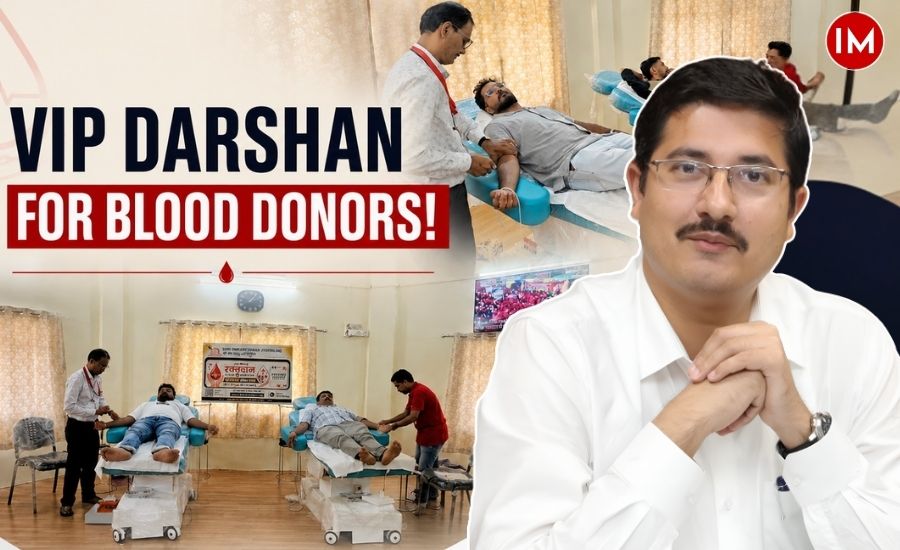
The administration, with support from the State National Health Mission, established a dedicated blood donation centre near the entrance of the Omkareshwar temple.
The objective was not merely to collect blood but to make the donation experience comfortable, accessible and meaningful.
Information, Education and Communication (IEC) activities were carried out through local announcements and public representatives to encourage participation. Volunteers arriving for darshan were informed about the opportunity to donate blood before entering the temple.
To recognise their contribution, donors and their families received VIP passes for temple entry, ensuring priority access for darshan.
“We arranged a blood donation counter near the temple entrance and were pleasantly surprised by the response from devotees who willingly came forward to donate,” the officer said.
Making the Experience Comfortable
The administration realised that encouraging first-time donors required more than a donation desk. The overall experience had to inspire confidence.
The blood donation centre was therefore designed with comfortable reclining donation couches, an aesthetically pleasing environment and a religious ambience that matched the surroundings of the temple.
Temple staff were sensitised to ensure that VIP passes issued to donors were honoured on priority, making the process smooth from donation to darshan.
This attention to detail helped create an environment where blood donation became a positive and memorable part of the pilgrimage rather than an additional obligation.
Coordination Made the Difference
In this case, coordination was essential because the programme involved the district administration, the health department, the National Health Mission and the Omkareshwar Temple Trust.
Initially, there were logistical hurdles. The blood donation centre’s location had to be shifted twice before the most suitable site was identified. Like many new initiatives, the first few weeks involved operational adjustments.
However, regular meetings between stakeholders ensured that issues were addressed quickly.
The Temple Trust also extended financial support to improve facilities at the donation centre, helping make the overall experience more donor-friendly.
“The continuous coordination between the health department and the temple trust helped the system stabilise within a month,” said Mr Gupta.
The active involvement of the district administration played a crucial role in maintaining communication among all stakeholders and ensuring consistent implementation.
Changing Public Perception
One of the most significant outcomes of the initiative extends beyond the number of blood units collected.
Voluntary blood donation often suffers from misconceptions and hesitation. By integrating blood donation with a religious visit, the administration was able to present it as a noble social contribution rather than a medical procedure people tend to avoid.
Public participation increased steadily, suggesting that the initiative was helping change perceptions around voluntary blood donation.
The administration also recognised the importance of leadership by example.
On his birthday, Chief Executive Officer Shri Nagarjun Gowda, IAS, donated blood at the temple premises. Such gestures by public officials reinforced the campaign’s message and encouraged others to participate.
“When public figures voluntarily donate blood, it creates a positive perception and encourages many more people to come forward.“
The Numbers Speak
Within just four months of its launch, the initiative has achieved encouraging results.
Approximately 1,800 blood units have been collected through the Omkareshwar blood donation programme.
Following the initial two months of operational adjustments, the initiative has now reached a steady pace, with an average collection of 120 to 150 blood units every week.
The administration expects these numbers to increase further during the holy month of Saawan, when the temple receives significantly higher footfall.
These figures indicate not only successful implementation but also sustained public participation, which is essential for maintaining blood availability throughout the year.
A Model That Can Be Replicated
Perhaps the biggest strength of the Khandwa initiative is its simplicity.
It does not require large infrastructure investments or complex technological interventions.
According to the administration, the model depends on three basic ingredients:
- A cooperative health department.
- A willing temple trust.
- A positive environment that encourages voluntary participation.
Many temple towns across India witness thousands of visitors every day. With proper planning, awareness campaigns and institutional coordination, similar blood donation centres could be established at several religious destinations.
The initiative also demonstrates that public health campaigns can benefit from understanding local cultural practices instead of functioning independently from them.
Governance Through Community Participation
The Khandwa model illustrates how administrative innovation often lies in connecting existing public behaviour with pressing civic needs.
Rather than asking people to make a separate trip to donate blood, the administration integrated the opportunity into an activity that already attracts thousands of people. By combining convenience, recognition and public service, it transformed voluntary blood donation into a meaningful part of the pilgrimage experience.
As blood requirements continue to rise across districts, especially with increasing road traffic and emergency medical cases, such locally designed solutions can help strengthen healthcare systems without placing additional pressure on existing resources.
For Collector IAS Rishav Gupta and the Khandwa administration, the initiative is not simply about collecting blood units. It is about creating a sustainable culture where acts of faith are accompanied by acts of public service—ensuring that every donation has the potential to save a life while inspiring many others to do the same.