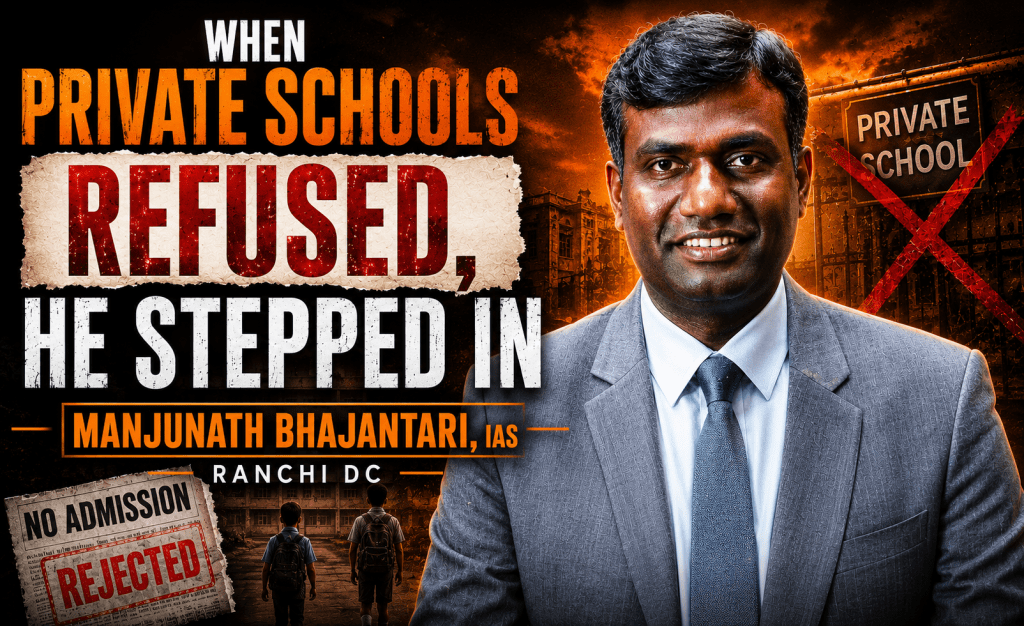
When Manjunath Bhajantari took charge as Deputy Commissioner of Ranchi, one complaint kept surfacing again and again. Children eligible under the Right to Education Act were being denied admission.
Parents were frustrated. Schools were hesitant. And the system, according to Bhajantari, lacked structure.
“It was not a really systematic thing. Most of the schools were not even admitting children,” recalls the officer in an exclusive conversation with Indian Masterminds.
What followed was not a temporary intervention. It became one of Ranchi’s most talked-about education reforms.
Also read: Zooming In To People’s Heart
TURNING RTE ADMISSIONS INTO A TRANSPARENT PROCESS
The problem was simple but serious. Under the RTE Act, 25% seats in private schools are reserved for children from BPL families. But in Ranchi, implementation was weak.
Bhajantari decided to fix the process from the ground up. The first step was creating transparency.
A software portal was developed where private schools were first required to declare their available seats under the BPL quota. This was not easy.
“Last year when we started, they were not willing to cooperate. But with the help of the Act, we asked them to give exact admission numbers,” he says.
The administration collected complete vacancy data. Once that was done, parents could apply online for their children. Verification was digital too.
Birth certificates, residential proofs and other documents were checked online by revenue officers, removing the need for repeated office visits.
Then came the most critical step: selection. Instead of closed-door decisions, Bhajantari introduced an online lottery system. It was conducted publicly, in front of the media and parent representatives.
This single step changed trust in the process. The selected list was then sent directly to schools, and the district administration kept monitoring the admissions.
For the first time, top private schools like DPS Ranchi and JVM Shyamli admitted children under this system. That first year, close to 700 children secured admission through the digital lottery.
When some seats remained vacant after the first round, Bhajantari ordered a second round. By 2026, the system had become stronger, smoother, and repeatable.
Currently, the first round for the new session has already been completed, with the second round planned to fill remaining vacancies.
THE FEE HIKE CRACKDOWN
While working on admissions, another issue emerged. Private schools were increasing fees aggressively, often under different names. Development fees. Annual charges. Miscellaneous costs.
Parents had little clarity. Bhajantari decided to audit this. Jharkhand already has a legal framework: schools can increase fees only once in two years, and only up to 10%, with the approval of the School Fees Management Committee.
But many schools were bypassing it. The district called a large meeting of private school principals and management representatives. They were briefed on the law and asked to submit fee records of the last three years.
The findings were revealing. Several schools had increased fees beyond the legal limit without committee approval. Instead of punitive recovery, Bhajantari ordered fee adjustments in the ongoing academic cycle.
“They have been asked to readjust those fees. We have not gone for recovery,” he says.
The move earned appreciation across Jharkhand and sparked discussions on replication in other districts.
REVIVING DEAD HAND PUMPS, ONE PANCHAYAT AT A TIME
But Bhajantari’s work didn’t stop with schools. Summer in Jharkhand often means water scarcity, especially in villages. The administration launched a district-wide hand pump revival campaign.
The scale was massive. Ranchi has 305 panchayats. Every mukhiya was asked to prepare a list of non-functional hand pumps. That list was compiled district-wide and handed over to the PHED department for repairs.
But Bhajantari introduced something unusual. Verification after repairs would also be done by the mukhiyas themselves. Because, as he points out, engineers may report a repair, but local people know if the water is actually flowing.
“It is more about people participation at the grassroots,” he says.
This added accountability to the process. In urban Ranchi, too, water supply through tankers came under tighter regulation. The administration directed Ranchi Municipal Corporation to monitor tanker operators, checking both water quality and rates.
Citizens were also given a direct grievance route. Through the district’s public grievance system, anyone can report faulty hand pumps or poor-quality water.
Complaints are passed to PHED and usually resolved within 24 hours to one week. For Bhajantari, governance is not just about schemes. It is about fixing what people face every day.
A school seat. A fair fee. A working hand pump. And in Ranchi, those everyday fixes are quietly changing thousands of lives.
Also read: DC Deogarh Captures People’s Hearts With a Simple Gesture!