Water has shaped every great civilisation. It has built cities, sustained cultures and determined the fate of nations. Today, as climate change, depleting groundwater and shrinking rivers threaten that very foundation, Madhya Pradesh has launched an ambitious mission to reconnect people with their water heritage. The Jal Ganga Samvardhan Abhiyan is not just about reviving rivers and ponds. It is about reviving society’s relationship with water.
Speaking to Indian Masterminds, Shriram Tiwari, Cultural Advisor to the Hon’ble Chief Minister of Madhya Pradesh and Trustee Secretary, Veer Bharat Nyas, explained how the campaign has evolved into one of the country’s largest community-driven water conservation movements.
A VISION THAT BEGAN MORE THAN TWO DECADES AGO
According to Tiwari, the roots of the campaign go back nearly 22-23 years, long before Dr Mohan Yadav became the Chief Minister of Madhya Pradesh.
At that time, Dr Yadav was associated with the Ujjain Development Authority. The growing concern over the drying Shipra River prompted discussions on the need to revive traditional water bodies.
The problem was not limited to Ujjain.
Across India, many rivers had gradually disappeared beneath expanding cities. Natural streams were converted into drains or built over in the name of development.
Tiwari cited examples of cities where urbanisation replaced natural water systems. Even Bhopal, once known as a city of rivers, is now largely remembered only for its Upper and Lower Lakes.
The campaign formally gathered momentum after Dr Mohan Yadav became Chief Minister. It was launched on 30 March 2025 from the banks of the Shipra River in Ujjain during the traditional Shivratri Parikrama.
Later, on Ganga Dussehra, ministers, MPs and public representatives across Madhya Pradesh were encouraged to perform worship at rivers and ponds in their respective regions while spreading awareness about water conservation.
“Water is becoming the greatest deity of the future. If we fail to respect and conserve it today, society itself will face an existential crisis,” says Tiwari.
WHY REVIVING OLD WATER BODIES MATTERS
Unlike many Himalayan states, Madhya Pradesh has no glaciers. Most of its rivers depend on groundwater recharge.
This makes traditional water structures—ponds, stepwells, lakes and wells—extremely important. Rather than constructing entirely new structures, the campaign focuses first on restoring existing ones.
Tiwari believes this approach is both practical and sustainable.
He points out that the state government has identified nearly 1,100 rivers across Madhya Pradesh. More than 750 rivers are between 10 and 25 kilometres long, while over 250 rivers extend beyond 25 kilometres. Even major rivers have been affected.
The Narmada, which flows for about 1,310 kilometres through the state, has witnessed shrinking stretches. Similar concerns exist for the Shipra, where several portions of the river have lost their natural flow.
Groundwater depletion, pollution, untreated sewage, industrial waste, medical waste and indiscriminate dumping have all contributed to this decline. According to Tiwari, conserving what nature has already gifted us must be the first priority.
Also Read – The Story of Ritu Goyal and Her Four-Attempt Journey to AIR 223
A MOVEMENT DRIVEN BY PEOPLE
One of the defining features of the Jal Ganga Samvardhan Abhiyan is public participation. Tiwari says no government alone can save rivers. Communities have to take ownership.
Across Madhya Pradesh, thousands of citizens have voluntarily restored ponds, cleaned wells and revived traditional water sources.
He recalled the story of a woman from the Mahidpur region near Ujjain who spent nearly ₹10-12 lakh of her personal savings to restore a local water body in memory of her late husband.
Similarly, several old stepwells—locally known as Chopras—some dating back nearly a thousand years, are being restored. Many families are also reviving old wells inside their homes.
The campaign encourages citizens to see water conservation as a shared social responsibility rather than merely a government programme.
THOUSANDS OF WATER STRUCTURES REVIVED
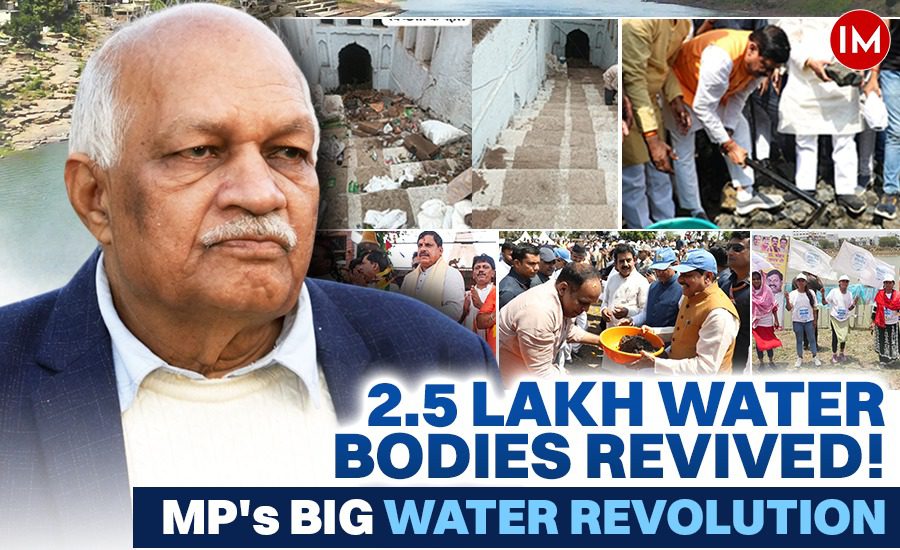
The campaign has already achieved remarkable results. According to Tiwari, nearly 2.5 lakh water structures have been repaired or rejuvenated by the state government. The number continues to grow through multiple government departments and community participation.
All 55 districts of Madhya Pradesh are now part of the mission. One notable example comes from Bhopal.
A stream that had virtually disappeared over the past eight years has been revived largely through voluntary efforts by nearby villagers. Such examples, Tiwari says, demonstrate the power of collective action.
USING TECHNOLOGY TO PROTECT WATER
While community participation remains central, technology is playing an equally important role. The Central Ground Water Board has carried out groundwater surveys across the state and developed QR-code based systems that allow districts to monitor groundwater conditions.
Veer Bharat Nyas, in collaboration with ISRO and the Madhya Pradesh Council of Science and Technology, has undertaken satellite mapping of nearly 6,000 water bodies.
The project compares historical and present-day conditions to understand changes over the past fifty years.
Satellite mapping has also been completed for five major cities—Bhopal, Indore, Ujjain, Gwalior and Jabalpur—to assess groundwater status and support future planning.
INDUSTRY, SCIENCE AND TRIBAL KNOWLEDGE COME TOGETHER
The campaign has brought together an unusually diverse group of stakeholders. Industrial leaders, scientists, environmental experts, artists and tribal communities have all participated.
Major industries have been encouraged to adopt responsible water-use practices and support water conservation efforts.
Tiwari particularly emphasised the wisdom of tribal communities, describing them as “children of nature” whose traditional understanding of forests, rivers and ecology offers valuable lessons.
Workshops, exhibitions and artistic programmes have also been organised to strengthen public awareness.
HELPING FARMERS SECURE THEIR FUTURE
Agriculture consumes the largest share of water resources. Recognising this, the campaign actively involves farmers. The initiative encourages cultivation of crops requiring less water while promoting efficient irrigation practices.
It also complements larger river-linking projects such as the Ken-Betwa project and agreements involving rivers like the Chambal. These efforts are expected to make nearly six lakh hectares of agricultural land more productive while improving long-term water security.
A GLOBAL MESSAGE FROM MADHYA PRADESH
Water scarcity is no longer an Indian problem. Many countries in West Asia already face severe shortages of drinking water. Island nations face rising sea levels. Ancient civilisations such as the Maya collapsed partly because of water scarcity.
Tiwari believes every region will need its own solutions, but Madhya Pradesh’s community-based model offers valuable lessons.
Several countries have shown interest in understanding the campaign’s approach, and the state is open to sharing knowledge internationally.
“Water conservation cannot remain only a government programme. It has to become a social value and a moral duty. Water itself must become our dharma,” he says.
THE ROAD AHEAD
The Jal Ganga Samvardhan Abhiyan has already expanded significantly since its launch.
What began along the banks of the Shipra River has now reached every district, village, town and city of Madhya Pradesh.
The mission aims to expand further over the coming years by integrating central government schemes, technological innovations and greater public participation.
As the monsoon returns each year, he urges people not to forget the hardships of water scarcity experienced during dry months. Balanced and responsible use of water, he says, is the only path forward.
The Jal Ganga Samvardhan Abhiyan is therefore much more than a conservation programme. It is an attempt to transform water conservation into a lasting public movement—one that combines tradition with technology, government action with community participation, and environmental responsibility with cultural values.
In an age when experts warn that future conflicts may revolve around water rather than oil, Madhya Pradesh’s message is both simple and timely: saving water today is the only way to secure tomorrow.
Also Read – From Border Guardian to Gujarat’s Top Cop: The Journey of GS Malik, the State’s 41st DGP