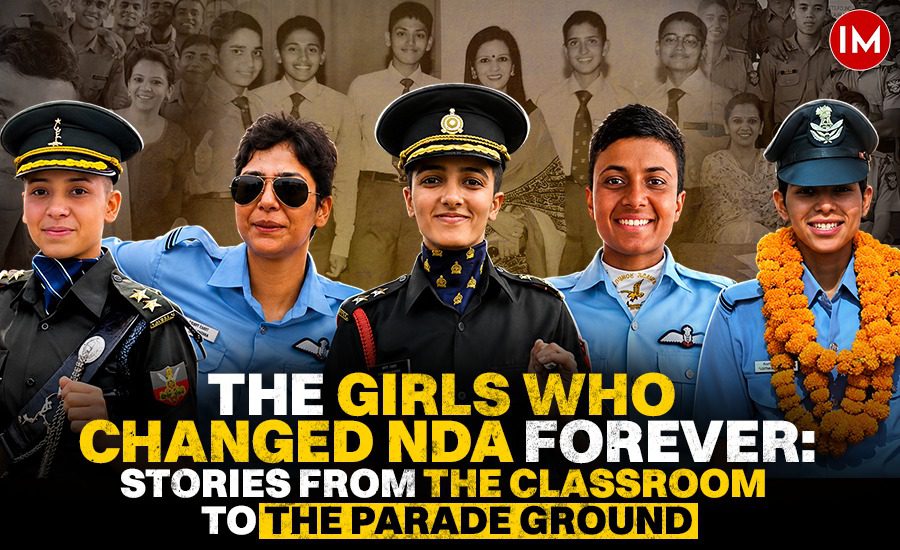
When 17 young women marched through the gates of the National Defence Academy (NDA) in 2022, they were not just joining India’s premier military training institution. They were stepping into history.
Their arrival came months after the Supreme Court’s landmark 2021 judgment that opened the doors of NDA to women. For decades, the academy had trained only men. Now, the first batch of women cadets carried not just their own dreams but also the hopes of generations who had fought for equal opportunity.
For the faculty at NDA, the moment was equally memorable.
Among them was Dr. Pragya Bajpai, Professor at NDA, who had spent years teaching classrooms filled only with male cadets. Watching young women take their seats for the first time was a moment she had waited for.
“After the Supreme Court’s landmark verdict, it came to us as a pleasant surprise. We were really looking forward to it. Seeing girls in the classroom was a completely different experience,” Dr. Bajpai told Indian Masterminds.
Watch The Interview Here :
A CLASSROOM THAT CHANGED HISTORY
The idea of women joining NDA had long been debated inside the academy. Cadets discussed it during debates and group discussions. Faculty members knew change might come one day, but few knew when.
Then came the Supreme Court verdict.
When the first women entered the classroom, Dr. Bajpai noticed something unexpected.
“They all had the same crew cut. I actually had to take a moment to recognise who the girls were. The uniform is an equaliser. Everyone looks the same, and that is exactly what it is meant to do,” she said.
The academy made no distinction in appearance or discipline. The same uniform. The same haircut. The same standards.
Equality began from day one.
Also Read – The ‘One Extra Mark’ Formula That Helped Somya Jain Secure AIR 346 in UPSC 2025
NO SPECIAL TREATMENT, ONLY THE SAME STANDARDS
Many wondered whether women would need a different training model.
Inside NDA, that question disappeared quickly.
According to Dr. Bajpai, every cadet already comes from a different background. Some study in Sainik Schools. Others come from civilian schools. Their confidence levels, communication skills and life experiences vary widely.
“We are already used to teaching students from different backgrounds. Our job is to bring everyone to the same standard in three years,” she said.
Communication classes also follow the same philosophy.
Cadets are taught that words are as important as weapons. They must speak with clarity, precision and purpose. Military leaders are expected to say less but make every word count.
Whether boy or girl, every cadet learns the same lesson.
WHEN 17 GIRLS BECAME ONE TEAM
The first few days naturally came with hesitation.
Initially, the girls sat together. But that phase did not last long. The academy’s demanding routine slowly erased barriers.
One memory remains unforgettable for Dr. Bajpai.
During the academy’s 13-km cross-country run, the girls who finished early did not simply celebrate their own success. They stayed back to cheer for every teammate who was still running.
“One girl started shouting, ‘Come on! You can do it!’ Then another joined her. Soon all 17 were cheering together. Their voices gave us goosebumps. The passion with which they encouraged each other was unforgettable,” she recalled.
That spirit of teamwork became their greatest strength.
THE TOUGHEST TESTS CREATED THE STRONGEST BONDS
Life inside NDA is demanding for every cadet.
The academy’s rigorous training includes long-distance runs, camps, endurance exercises and physically exhausting routines.
For women cadets, there were additional physical challenges. Yet the expectations remained the same.
“Nobody is exempted. Unless there is a genuine medical issue, everyone has to complete the training. They know that all these hardships make them stronger,” Dr. Bajpai explained.
She says the first term is often the hardest. It is during those first few months that cadets learn emotional control, discipline and resilience.
Teachers also become counsellors.
“Sometimes we play the role of a teacher, sometimes a mentor, sometimes even a mother. When girls don’t know whom to approach, they come to us,” she said.
FROM NERVOUS TEENAGERS TO CONFIDENT LEADERS
Perhaps the biggest transformation happens quietly.
Cadets arrive as teenagers, unsure of themselves. They leave with confidence that is visible in every step.
“When they join, you can easily see they come from different backgrounds. But when they pass out, their confidence, their posture, the way they walk and speak—you simply cannot imagine how much they have changed,” Dr. Bajpai said.
The first women cadets also had another challenge.
Unlike the boys, they had no senior women to guide them through academy life. They had to build that culture themselves.
Instead of depending on seniors, they became each other’s support system.
Within one term, they had formed a family.
AN EMOTIONAL PASSING OUT PARADE
Watching the first women cadets graduate was an emotional moment for everyone at NDA.
Faculty members had witnessed years of debate before finally seeing history unfold.
“It was a moment of great pride. When they were leaving, I spoke to all of them. There were tears in their eyes, but there was also a smile and immense pride. They knew they had made the nation proud,” Dr. Bajpai said.
The journey had come full circle.
The young women who entered the academy carrying expectations were now leaving as commissioned officers ready to serve the nation.
A LEGACY THAT WILL INSPIRE GENERATIONS
Today, new batches of women cadets walk through the same gates with greater confidence.
They know someone has already walked that path before them.
Dr. Bajpai believes the first batch has written a new chapter in India’s military history.
“They proved that if they fought for the right to enter NDA, they could also complete the journey successfully. They have become an example for every young girl in the country. Nothing is impossible,” she said.
The professor believes history will always remember these pioneering women not simply because they were the first, but because they proved that courage, commitment and competence have no gender.
The Supreme Court judgment opened the gates.
The first batch of women cadets proved they belonged inside.
Also Read – From Barracks to Books: How Rajnandgaon Police Is Building Futures Through ‘Pahal’