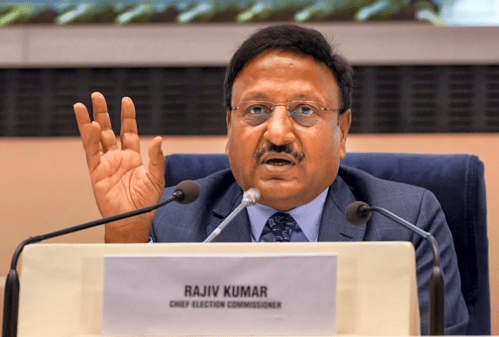
Mumbai: HDFC Bank has appointed former Finance Secretary and former Chief Election Commissioner (CEC) Rajiv Kumar, an IAS officer of 1984 batch from Bihar cadre, as its proposed Part-Time Non-Executive Chairman for a period of three years, marking the end of months of uncertainty following the resignation of former chairman Atanu Chakraborty earlier this year. The appointment, however, remains subject to the approval of the Reserve Bank of India (RBI).
The private sector lender also appointed Kumar as an Additional Independent Director for a four-year term beginning June 30, 2026, subject to shareholders’ approval. He is expected to succeed interim chairman Keki M. Mistry, who has been overseeing the board since March 2026.
The appointment brings to HDFC Bank one of India’s most experienced civil servants, who has held several top positions in finance, banking, public administration and election management over a distinguished public career spanning nearly four decades.
HDFC Bank Ends Months of Leadership Uncertainty
Mr Kumar’s appointment comes after a turbulent period for India’s largest private sector lender.
Former Chairman Atanu Chakraborty resigned in March 2026, citing that certain developments and practices within the bank were inconsistent with his personal values and ethics.
Following his resignation, HDFC Bank commissioned an independent legal review by Wilson Sonsini Goodrich & Rosati and Wadia Ghandy & Co. The investigation concluded that the allegations made by Chakraborty were not substantiated.
Thereafter, veteran banker Keki M. Mistry assumed the role of Interim Chairman, while the bank searched for a permanent successor.
With Rajiv Kumar’s selection, the bank aims to provide long-term stability to its board leadership.
Role as Part-Time Non-Executive Chairman
As Part-Time Non-Executive Chairman, Mr Kumar will primarily provide strategic guidance and governance oversight to the Board of Directors.
His responsibilities will include:
- Providing independent oversight on corporate governance
- Guiding long-term strategic decisions
- Strengthening board effectiveness
- Ensuring regulatory compliance
Unlike executive directors, he will not be involved in the bank’s day-to-day operations, which will continue to be managed by the executive management team.
Distinguished Career in Public Service
Ex-IAS Kumar has served the Government of India for nearly four decades in several high-profile administrative and financial positions.
A retired 1984-batch IAS officer of the Bihar cadre (now Jharkhand cadre), he retired as Finance Secretary in February 2020 after serving as Secretary, Department of Financial Services from 2017 to 2020.
During his tenure, India’s banking sector was grappling with rising non-performing assets (NPAs), weak balance sheets and mounting capital requirements.
Architect of Banking Reforms and the ‘4R Strategy’
One of Mr Kumar’s most significant contributions was leading the government’s comprehensive public sector banking reforms.
He oversaw the implementation of the widely recognised “4R Strategy”, comprising:
- Recognition of stressed assets
- Resolution through the Insolvency and Bankruptcy Code (IBC)
- Recapitalisation of banks
- Reforms to improve governance and lending practices
The strategy played a pivotal role in cleaning up India’s banking system.
Led Historic Public Sector Bank Recapitalisation
Mr Kumar’s tenure coincided with one of the biggest banking reform exercises in India’s history.
Under his leadership:
- The Government infused more than ₹3 lakh crore into public sector banks.
- 27 state-owned banks were consolidated into 12 larger banks, aimed at improving operational efficiency, scale and competitiveness.
- He played an instrumental role in raising deposit insurance coverage from ₹1 lakh to ₹5 lakh, significantly strengthening depositor confidence.
Experience Across India’s Financial Institutions
Apart from serving as Finance Secretary, Rajiv Kumar has also served on the Boards of several premier financial institutions, including:
- Reserve Bank of India (Central Board)
- State Bank of India (SBI)
- National Bank for Agriculture and Rural Development (NABARD)
His extensive experience in financial regulation and banking governance is expected to benefit HDFC Bank’s board.
Tenure as India’s 25th Chief Election Commissioner
Ex-IAS Kumar joined the Election Commission of India as Election Commissioner on September 1, 2020, before assuming charge as India’s 25th Chief Election Commissioner (CEC) on May 15, 2022.
During his tenure, the Election Commission successfully conducted several major elections, including:
- Presidential Election 2022
- Vice-Presidential Election 2022
- Multiple State Assembly Elections
- 2024 Lok Sabha Elections
- Jammu & Kashmir Assembly Elections
The 2024 Lok Sabha Election became the world’s largest democratic exercise, involving approximately 969 million registered voters, with around 642 million votes cast.
Faced Political Criticism During 2024 General Elections
Rajiv Kumar’s tenure as Chief Election Commissioner was not without controversy.
During and after the 2024 Lok Sabha elections, several Opposition parties accused the Election Commission of bias and questioned its neutrality.
Criticism also arose over delays in releasing final voter turnout data, resulting in petitions before the Supreme Court and demands for greater transparency.
However, Mr Kumar consistently rejected these allegations, maintaining that:
- India’s electoral system remained transparent and robust.
- Delays in voter turnout figures were procedural because polling teams needed to return Electronic Voting Machines (EVMs) and statutory documents before reconciliation.
- There was no credible evidence of tampering with Electronic Voting Machines (EVMs).
Farewell Remarks
During his farewell address in February 2025, he remarked that the Election Commission was increasingly becoming a “convenient scapegoat” for political parties unwilling to accept electoral outcomes.
He emphasized that political parties participate in every stage of the electoral process and have sufficient opportunities to raise objections during polling itself. According to him, post-election allegations without evidence undermine public confidence in democratic institutions.
About Rajiv Kumar
Mr Kumar is one of India’s most accomplished civil servants with extensive experience in governance, finance, banking, and public administration.
Born on 19 February 1960 in Hasanpur, Amroha district of Uttar Pradesh, he belongs to the 1984-batch IAS, originally allotted to the Bihar cadre, which later became the Jharkhand cadre after the state’s bifurcation.
During his illustrious career, he has held numerous key positions, including:
- Finance Secretary, Government of India
- Secretary, Department of Financial Services
- Chief Election Commissioner of India
- Election Commissioner
- Secretary and Additional Secretary in multiple ministries
- Director and Executive Director in various public institutions
- Divisional Commissioner
- District Magistrate and Collector
His experience spans financial sector reforms, banking governance, public administration, and electoral management, making him one of the most experienced administrators to join the board of India’s largest private sector bank.
Educational Background
Mr Kumar possesses a diverse academic background that combines science, law, management and public policy.
His qualifications include:
- Bachelor of Science (B.Sc.) from St. Stephen’s College, Delhi
- Bachelor of Laws (LL.B.) from Delhi University
- Post Graduate Diploma in Management (PGDM)
- Master’s Degree in Public Policy
- Alumnus of TERI School of Advanced Studies
His multidisciplinary education later helped shape reforms across finance, banking, pensions and governance.
RBI Approval Still Pending
Although HDFC Bank’s Board has approved Rajiv Kumar’s appointment, it will become effective only after obtaining:
- Reserve Bank of India (RBI) approval
- Shareholders’ approval for his appointment as Additional Independent Director
Once approved, he will formally assume office as the Part-Time Non-Executive Chairman for a three-year term.
The appointment is expected to provide strategic continuity and strengthen governance at HDFC Bank following a period of leadership transition.
Read Also: Who Is Atanu Chakraborty? Former IAS Officer Whose Sudden HDFC Bank Exit Triggered Market Shock