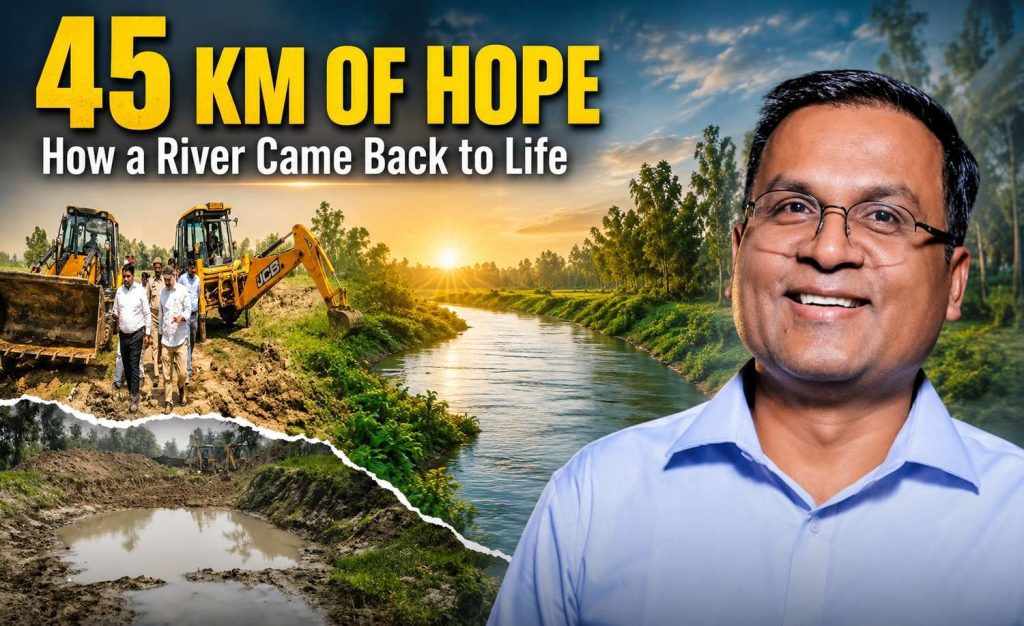
The river that once nourished fields, replenished groundwater, sustained biodiversity, and served as the lifeline of hundreds of villages in Shahjahanpur district of Uttar Pradesh, had slowly disappeared beneath layers of encroachment, silt, neglect, and unchecked development. What remained was a scar across the landscape – dry stretches converted into agricultural fields, blocked channels, disappearing ponds, and fading memories of a river that once flowed throughout the year.
Today, however, the story is changing.
Across villages of Puwayan and Banda blocks, people are once again witnessing a sight many believed they would never see again – water flowing through the Bhainsi. Children who had only heard stories about the river are now seeing it with their own eyes. Farmers are hopeful about improved irrigation. Environmentalists see the return of an ecosystem. Villagers see the revival of their heritage.
At the heart of this transformation lies an extraordinary example of administrative leadership and community participation. Under the Uttar Pradesh Government’s “One District-One River” Rejuvenation Campaign, District Magistrate and 2013 batch IAS officer Dharmendra Pratap Singh has emerged as a modern-day Bhagirath, leading a mission that is restoring not just a river, but an entire ecological and social landscape.
The revival of the Bhainsi River stands today as one of Uttar Pradesh’s most inspiring stories of environmental restoration – a model that proves that when administration and citizens work together, even rivers can be brought back to life.
The Lost River of Shahjahanpur
The Bhainsi River, a significant tributary of the Gomti River, originates from the Bhainsar pond in Pilibhit district before entering Shahjahanpur. Another stream originating near Gahloiya village in Banda block joins it near Dalelapur. Together, the river travels approximately 56 kilometres before meeting the Gomti.
Historically, the Bhainsi was much more than a water body. It was an integral part of the social, cultural, agricultural, and ecological life of the region. Villagers remember a time when the river flowed throughout the year and supported farming, livestock, groundwater recharge, and local biodiversity.
However, over the last three decades, the river gradually disappeared.
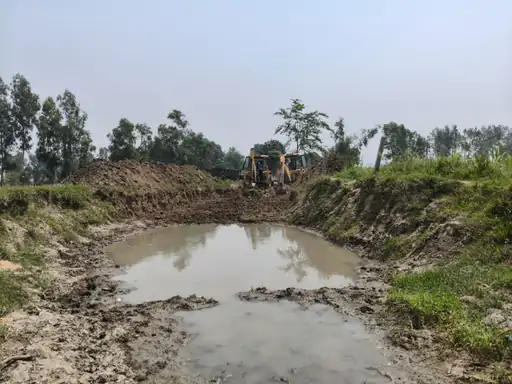
Encroachments expanded across its natural course. Farmers began cultivating crops such as sugarcane and maize on the dried riverbed. Traditional ponds connected to the river were occupied. Natural drainage channels became blocked. Rainwater harvesting systems deteriorated. The river’s flow diminished year after year until large stretches vanished completely.
A river that once sustained life had become almost invisible.
The Beginning of a New Chapter: One District-One River Campaign
Recognizing the ecological importance of the Bhainsi, the Shahjahanpur district administration launched a comprehensive rejuvenation initiative under the Uttar Pradesh Government’s flagship “One District-One River” Campaign.
Under the leadership of District Magistrate Dharmendra Pratap Singh, the administration prepared a multi-level action plan aimed at restoring the river’s natural flow, removing encroachments, reviving connected water bodies, and ensuring long-term sustainability.
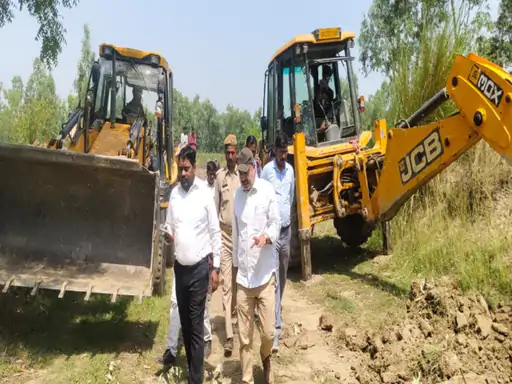
Following a field inspection by the District Magistrate at Pann Ghat in Puwayan, a detailed review meeting with technical experts and administrative officers was conducted. Soon after, excavation and restoration work formally commenced.
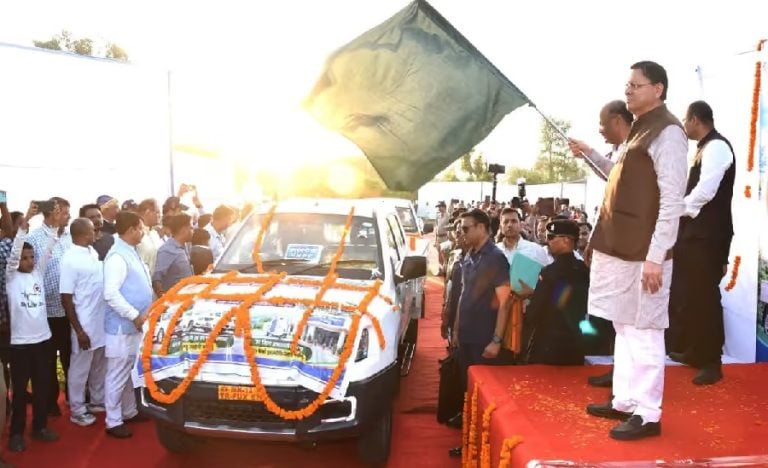
On May 8, 2026, District Magistrate Mr Singh inaugurated the second phase of the river rejuvenation project, marking the beginning of one of the district’s most ambitious environmental restoration initiatives.
A River Reclaimed Through Public Participation
One of the most remarkable aspects of the Bhainsi rejuvenation project is its community-driven nature.
Rather than relying solely on government funding, the campaign evolved into a people’s movement. Villagers, social organizations, environmental groups, local leaders, students, and volunteers came together with a shared mission—to bring back their river.
The movement gained momentum under the inspiring slogan –
“Ek Hazaar Haath, Bhainsi Ke Saath” (A Thousand Hands for the Bhainsi)
Meetings were organized across villages. Awareness campaigns were conducted. Citizens pledged their support. Local organizations such as Lok Bharti mobilized communities and helped coordinate restoration activities.
The campaign even witnessed children contributing from their savings, symbolising the emotional connection that local communities have with the river.
Each village took ownership of specific stretches of the river, ensuring continuous monitoring and protection.
Large-Scale Excavation: Restoring the Natural River Channel
The first major intervention involved reclaiming and re-establishing the river’s original course.
IAS Singh said, “Excavation work began in May–June last year at Pann Ghat in Puwayan and gradually expanded to multiple Gram Panchayats.”
Initially, nine JCB machines were deployed across nine Gram Panchayats of Puwayan block. Later, the operation expanded significantly with more than 24 JCB and Poclain excavators working across the river corridor.
The excavation effort focused on:
- Removing accumulated silt deposits.
- Clearing blocked channels.
- Restoring the original river width and depth.
- Reconnecting fragmented sections of the river.
- Removing obstacles preventing natural flow.
According to Additional District Magistrate Arvind Kumar, excavation of the second channel of the river, covering nearly 25 kilometres, is progressing rapidly. More than 17 kilometres have already been completed.
As a result of continuous efforts, the natural flow of the Bhainsi has already been restored across approximately 45 kilometres, while work continues toward reconnecting the river to its final destination at the Gomti Sangam.

Strict Monitoring Ensures Accountability
The administration established a rigorous monitoring mechanism to ensure transparency and efficiency.
For every JCB machine deployed:
- A Gram Panchayat Officer was assigned.
- A Nodal Officer was designated.
- A Lok Bharti representative was deployed.
Daily progress reports are submitted to the Block Development Officer, and field inspections are conducted regularly.
The District Magistrate made it clear that the campaign would not remain a symbolic exercise.
Any negligence in implementation would invite strict action.
This system ensured that restoration efforts remained result-oriented and transparent.
Removing Encroachments and Restoring Natural Heritage
One of the biggest challenges was the widespread encroachment on the riverbed and associated water bodies.
The administration undertook a determined anti-encroachment drive, reclaiming land that had gradually been occupied over the years.
Fields, unauthorized structures, and agricultural activities that obstructed the river’s natural flow were identified and removed.
In addition, nearly 80 ponds and water bodies located within the river’s catchment area were freed from encroachments and restored.
These ponds now function as natural recharge structures, helping rainwater percolate into the ground and support the river system.
The restoration of these traditional water bodies has significantly strengthened the river’s ecological network.
Creating a Sustainable Water System
The administration’s vision extends beyond excavation.
District Magistrate Dharmendra Pratap Singh has emphasized that true rejuvenation requires creating a sustainable water ecosystem.
Once excavation is completed, the next phase includes:
Construction of Check Dams
Check dams will be built to regulate water flow and maintain adequate water levels throughout the year.
A major check dam is also planned near the river’s origin area connected to the Sharda canal system to ensure consistent water availability.
Catchment Area Restoration
Blocked feeder channels and drainage systems are being restored so that rainwater naturally reaches the river.
Groundwater Recharge
The river’s revival is expected to significantly improve groundwater levels across surrounding villages.
Farmers anticipate improved irrigation availability and reduced dependence on external water sources.
A Green Shield for the Future
To ensure that the Bhainsi never disappears again, the administration has adopted a long-term ecological protection strategy.
Massive Afforestation Drive
More than 40,000 trees have been planted along both sides of the river.
The plantation drive aims to:
- Prevent soil erosion.
- Strengthen riverbanks.
- Improve biodiversity.
- Enhance groundwater recharge.
- Create green ecological corridors.
The Forest Department has been directed to prepare extensive plantation plans, particularly during the monsoon months of July and August.
Biological Fencing
Wire fencing and protective measures are being installed along riverbanks to prevent future encroachments and safeguard newly restored sections.
Local residents have been appointed as “Tree Guardians” responsible for protecting saplings and ensuring their survival.
Scientific Importance of River Rejuvenation
Experts believe that restoring rivers is critical for ecological stability.
Senior scientist Daya Srivastava explains that when a river’s natural course is obstructed, its entire water cycle gets disrupted.
Groundwater Department engineer Ganesh Negi highlights the importance of natural underground water sources beneath rivers, often referred to as artesian systems, which both feed and recharge river flows.
The revival of the Bhainsi is therefore expected to improve:
- Groundwater levels.
- Soil moisture.
- Agricultural productivity.
- Biodiversity.
- Climate resilience.
Villages Witness the Return of Water
The impact of the project is already visible.
Residents of villages including Devkali, Mirpur, Rasulapur, Nevada Dah, Jevan, and many others are witnessing water return to areas that had remained dry for years.
Farmers are optimistic about improved irrigation. Women expect reduced dependence on distant water sources.
Environmental groups see increasing bird activity and vegetation growth around restored stretches.
For many villagers, the return of flowing water represents the return of life itself.
Jal Chaupal: Building a Culture of Water Conservation
Recognizing that river rejuvenation must be supported by public awareness, District Magistrate Dharmendra Pratap Singh has also focused extensively on community engagement.
Under his guidance, the District Ganga Committee organized a “Jal Chaupal” at Subhash Chandra Bose College in Devkali village of Banda block.
The event highlighted:
- Water conservation.
- Importance of rivers.
- Sustainable water management.
- Community participation in environmental protection.
Competitions were organised and prizes distributed to encourage youth participation and foster a culture of environmental stewardship.
The Jal Chaupal reinforced the message that protecting rivers is not solely the responsibility of government agencies—it is a shared social responsibility.
Leadership Behind the Transformation
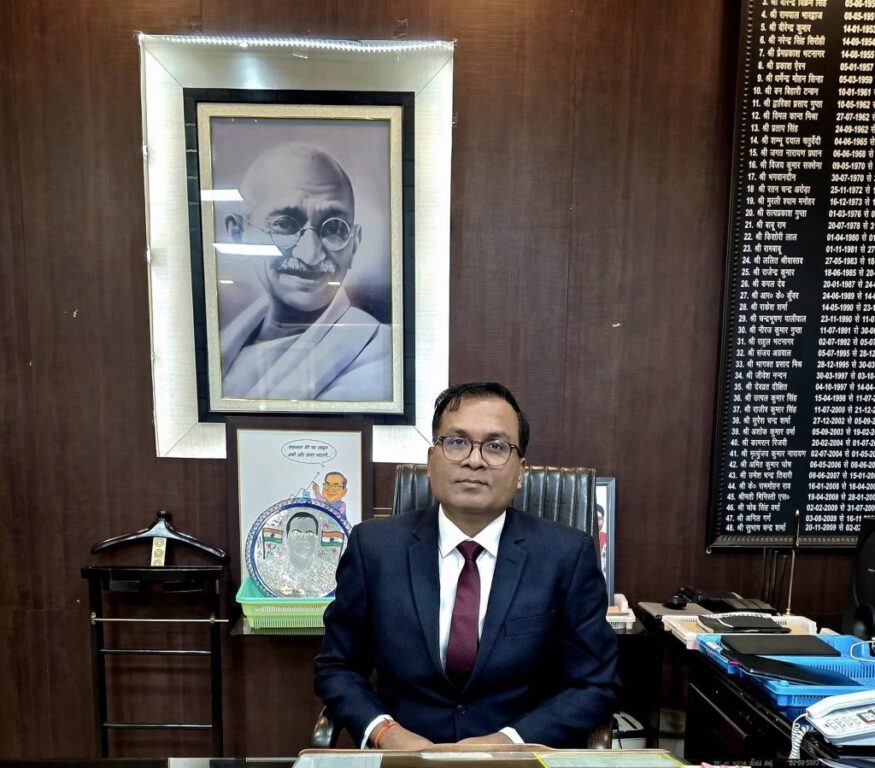
The success of the Bhainsi River rejuvenation campaign is closely associated with the leadership of District Magistrate Dharmendra Pratap Singh.
A 1996-batch PCS officer promoted to the IAS in 2013, Singh currently serves as the District Magistrate and Collector of Shahjahanpur.
Known for his proactive administrative approach, he has consistently emphasized public participation, transparency, and sustainable development.
His regular field visits, village meetings, and direct engagement with citizens have infused new energy into the campaign.
Many villagers now affectionately describe him as the modern-day Bhagirath of Bhainsi.
Voices from the Mission
District Magistrate Dharmendra Pratap Singh
“The Bhainsi River is not merely a water channel; it is a part of our natural heritage. Reviving it means restoring our ecology, strengthening groundwater, supporting farmers, and securing the future of coming generations.”
“This campaign is based on public participation and transparency. The administration and citizens are working together to ensure that Bhainsi flows once again in its natural form.”
Additional District Magistrate Arvind Kumar
“The excavation work is progressing rapidly. With coordinated efforts and community support, we are moving steadily towards restoring the complete river system.”
A Model for River Rejuvenation Across India
The Bhainsi River rejuvenation initiative demonstrates that environmental restoration does not always require massive budgets.
With strong administrative leadership, community participation, scientific planning, and collective ownership, even rivers that have disappeared for decades can be revived.
The project has become a model of low-cost, high-impact river restoration—showing how local communities, social organizations, and government institutions can come together to restore ecological balance.
The River Flows Again
The story of Bhainsi is more than the story of a river.
It is the story of a district reclaiming its natural heritage. It is the story of villagers refusing to let their lifeline disappear. It is the story of an administration that chose action over symbolism.
Most importantly, it is proof that when communities unite around a common purpose, nature responds.
Today, as water once again moves through the rejuvenated stretches of the Bhainsi River, it carries with it not only rainwater and sediment – but also hope, resilience, and the promise of a sustainable future for Shahjahanpur.
The river that had vanished from the landscape is flowing once again.
And with it, a new chapter has begun.