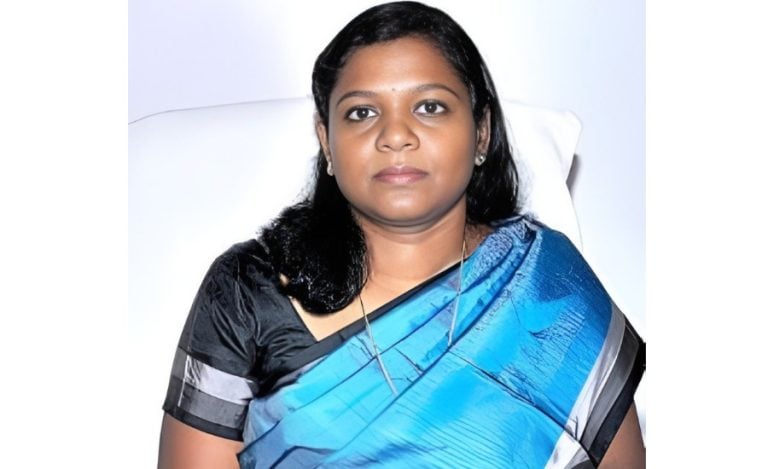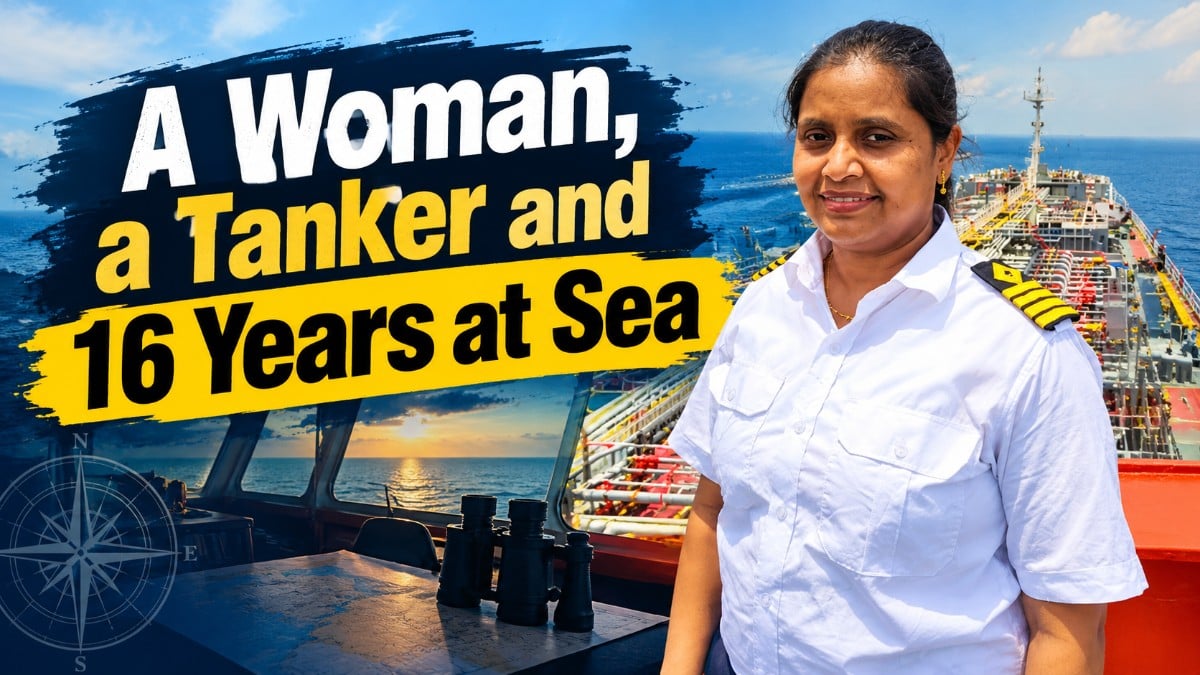
For Capt Ritu Kumari, a career at sea was never a childhood dream. She was preparing for the IIT-JEE entrance examination when she secured admission to T.S. Chanakya, a maritime training institute, through her rank. At the time, she did not even realise that the course would lead her to a career at sea rather than engineering. Sixteen years later, she has become a tanker captain, breaking barriers in a profession where women remain underrepresented.
Hailing from a village in Bihar, Capt Ritu has achieved several milestones in her career. She is the first woman captain among the alumni of T.S. Chanakya and the first woman captain to command a tanker with Great Eastern Shipping Company. She is also among the first few women captains in India and across the world. Her achievements have earned her the Shakti Ratna Award from the Maritime Union of India.
Her journey has involved demanding assignments, long working hours, high-pressure decisions and moments that tested her confidence. Yet, she has continued to move forward, guided by the satisfaction of doing her job well and the desire to take on greater responsibilities.
FROM IIT-JEE PREPARATION TO LIFE AT SEA
There was no single person or event that inspired Capt Ritu to join the Merchant Navy. Her entry into the profession happened almost by chance. While preparing for IIT-JEE, she secured a place at T.S. Chanakya through her entrance rank. It was only after admission that she learnt more about the career she had chosen.
Initially, what attracted her to the profession was the training, the uniform and the facilities at the institute. She was also drawn to the prospect of earning well and travelling around the world. Over time, the career became much more than an opportunity to see different countries. It became a path towards professional growth and leadership.
Also Read – Air Marshal Ashutosh Dixit: From Fighter Cockpit to Chief of the Indian Air Force
College life, however, was not always easy. Being the only female cadet in her batch often made her feel lonely. But once she stepped onboard a ship, she decided to focus on her performance rather than the challenges of being different.
Speaking to Indian Masterminds, Capt Ritu said, “Once onboard, I only concentrated on my performance.” That focus helped her navigate the demands of a profession where practical skills, discipline and responsibility matter every day.
LEARNING THE DEMANDS OF TANKER OPERATIONS
Working on tankers comes with its own set of challenges. Cargo loading, discharging and tank cleaning require careful planning and coordination. These operations become even more demanding for senior officers, particularly the chief officer and the captain, who must ensure that work is completed safely and efficiently.
For Capt Ritu, every difficult operation became an opportunity to learn. Overcoming challenges gave her a sense of accomplishment and strengthened her commitment to the profession.
One of the toughest periods of her career came when she served as chief officer on a vessel that operated on an extremely demanding schedule. The ship was engaged in voyages lasting around 16 hours and carried four grades of cargo. It also had to undertake back-to-back loading, discharging and tank-cleaning operations.
She spent nine months on the vessel, including the period before her promotion to captain. The workload tested her ability to manage cargo operations and handle pressure. But the experience also prepared her for the responsibilities that came with command.
“Breaking a barrier and reaching on top after embarking on a journey of 16 years was highly significant to me,” she told Indian Masterminds.
Her hard work as chief officer paid off when she became captain. She received appreciation from stakeholders associated with the vessel and from companies she had worked with earlier. For her, the recognition was proof that the difficult years had helped build the experience needed to lead a ship.
A VOYAGE THAT TESTED HER LIMITS
Another assignment that left a lasting impression on Capt Ritu was a demanding voyage while she was working as chief officer with Scorpio Shipping Company. After arriving at an Australian port with a loaded vessel, the crew discharged the cargo and loaded five different grades for delivery to five separate receivers at five ports.
Maintaining proper segregation between cargo grades was essential. The ports were only six to eight hours apart, leaving little time to rest between operations. For around 15 days, she experienced different loading and discharging situations with minimal, and sometimes no, rest.
The ship’s pumps were operating at their maximum rated capacity. At the same time, both the shipping company and the Australian ports maintained strict standards for safety and performance.
The experience demanded physical endurance, mental strength and constant attention. It also changed how she viewed her own abilities.
Reflecting on the voyage, Capt Ritu explained to Indian Masterminds that the workload and pressure transformed her both professionally and personally. “The responsibilities in this voyage removed all kinds of fear inside me and gave me a confidence that now I can do anything in my life,” she said.
For her, the voyage was not simply a difficult assignment. It was a turning point that helped her develop the confidence to handle greater responsibilities.
WHEN A COMPASS FAILURE TESTED HER RESILIENCE
Life at sea can change in seconds, and a captain must be prepared to respond to unexpected situations. Capt Ritu recalls one such moment when she was taking a vessel out of a port without a marine pilot. The ship called at the port frequently, so she had experience navigating that route.
Just after leaving the berth, while still inside the breakwater, the vessel’s gyro compass failed. Ahead lay a narrow channel followed by an area with heavy traffic and several vessels at anchor.
With the gyro compass unavailable, she had to navigate using visual observation and a magnetic compass. The situation demanded composure, awareness and sound judgement.
She remembers the incident as a real test of resilience. Experiences like this have shaped her approach to command, reinforcing the importance of staying calm and making decisions under pressure.
LIFE AT SEA: MORE THAN A JOB
A career in the Merchant Navy requires long periods away from home. Capt Ritu’s contract as a master typically lasts four months, while junior officers and crew members may spend longer periods at sea. She comes from Bihar, where many people move to other parts of the country for work and return home only once or twice a year. She says she is able to visit home more frequently than many of them. Family members can also accompany seafarers onboard in certain ranks, subject to the applicable arrangements.
Working with people from different cultures and nationalities has given her a broader perspective. She says she prefers sailing with multinational crews because the experience allows her to learn from different people and adopt positive practices.
For Capt Ritu, life at sea has become an important part of who she is. “I have not only worked on ship, I have lived life on ship. I have been a happy sailor,” she told Indian Masterminds.
She believes the profession has taught her to be real and spontaneous. It has also helped her develop independence, adaptability and the ability to work with people from varied backgrounds.
AN AWARD AND A MESSAGE FOR WOMEN
Receiving the Shakti Ratna Award from the Maritime Union of India is a recognition of the effort Capt Ritu has put into her career despite the challenges she has faced. But she hopes its significance will extend beyond her own achievement.
She believes greater visibility for women in the Merchant Navy can encourage more of them to enter the profession, continue through its demanding stages and aim for leadership positions such as captain and chief engineer.
Her message is particularly important for women who may never have considered a career at sea because they lack information or role models. The profession can seem unfamiliar, especially to students from places where maritime careers are rarely discussed.
Capt Ritu wants young people to know that their background need not limit their ambitions. “I too belong to a village in Bihar, if I can reach here, so can every one of you irrespective of your background,” she said.
HOW TO JOIN THE MERCHANT NAVY
Capt Ritu also wants to make the entry process clearer for aspiring seafarers. According to the eligibility details she shared, candidates seeking the relevant entry routes should have passed Class 12 with at least 60 per cent in Physics, Chemistry and Mathematics, along with 50 per cent in English in Class 10 or Class 12. Eligibility criteria should be checked against the latest requirements of the relevant course and institution.
Students can explore a three-year B.Sc. in Nautical Science or a one-year Diploma in Nautical Science (DNS). They may need to appear for the Indian Maritime University Common Entrance Test (IMU-CET) or complete the admission process specified by individual pre-sea training institutes, which may include written and oral assessments.
Capt Ritu also advises candidates to explore company sponsorship opportunities. Depending on the admission route and entrance rank, candidates may be allotted a college, complete their training and join a company for onboard placement. Some colleges may assist with placement where sponsorship has not been secured in advance. Students should verify the current admission, sponsorship and placement conditions before applying.
From entering maritime training without fully understanding the career to commanding a tanker after 16 years at sea, Capt Ritu Kumari’s journey shows how an unexpected beginning can lead to an extraordinary destination. Her story is not only about becoming a captain. It is about learning through difficult assignments, building confidence through experience and making space for more women in a demanding profession.
Her message to young women is simple: explore the opportunities, take the first step and do not let your background decide how far you can go.
Also Read – Chhattisgarh’s Rural Bus Revolution: How the State Is Reconnecting Remote Tribal Villages