“I didn’t remember that humans have 32 teeth. Yet I became a dentist. Later, I didn’t remember how many states India had. Yet I secured AIR 483 in UPSC.”
Few success stories begin with such unimaginable loss.
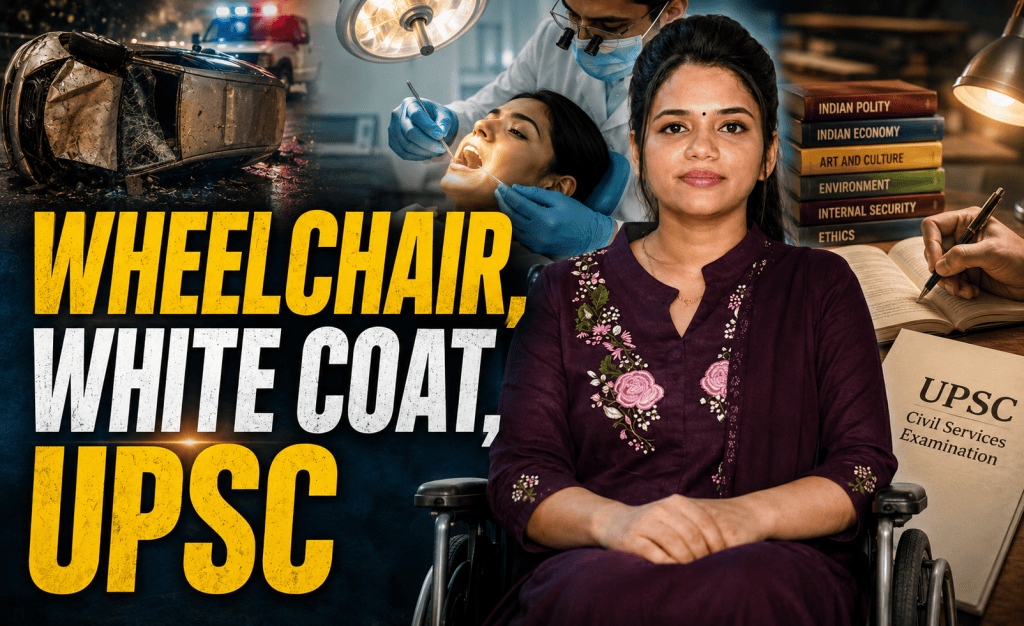
When Dr Athira Sugathan woke up after spending 28 days on a ventilator, she did not know who she was. She could not recognise her parents, siblings, friends or even remember her own name. Doctors told her she would never walk again because of a severe spinal cord injury sustained in a road accident. Her memories had vanished. Her dreams seemed buried beneath hospital beds, wheelchairs and silence.
Years later, the same woman would not only rebuild her memory from scratch but also complete her Bachelor of Dental Surgery (BDS), become a wheelchair model, work for the rights of persons with disabilities, and finally secure All India Rank 483 in the UPSC Civil Services Examination 2025.
Speaking to Indian Masterminds, Athira’s story is not merely about cracking UPSC. It is about rebuilding an entire life after losing everything.
WHEN LIFE WAS ERASED IN A SINGLE MOMENT
The accident changed everything.
For nearly a month, Athira remained unconscious on a ventilator.
When she eventually opened her eyes, there was only one familiar face.
“I remembered only my mother. I didn’t remember my own name, my family, my friends or even my past. It felt as though my entire life had been erased,” she told Indian Masterminds.
Also Read – Rejected by Top PSUs, Chosen by UPSC : How GRID-INDIA Engineer Pawan Kumar Cracked UPSC ESE in First Attempt
As her awareness gradually returned, she asked doctors the one question that mattered.
Would she ever walk again?
The answer shattered her.
Doctors informed her that her spinal cord injury had left her permanently paralysed.
She refused to accept it.
Every day she tried to get out of bed. Every day she failed. Every failure ended in tears.
Five months later she returned home, completely bedridden.
Visitors came every day—not to celebrate survival but to console. Her face was scarred. Her head had been shaved. She could not even sit without support.
Her world shrank to a single room.
LEARNING HER OWN LIFE AGAIN
Recovery was unlike anything she had imagined. Her mother patiently helped her recognise family members. Her sister slowly narrated stories from her past.
One day a friend casually mentioned that before the accident she had already completed the third year of her BDS course. Athira was stunned.
“I couldn’t even remember how many teeth a human being had. Yet everyone was telling me I was studying to become a dentist,” she recalled.
Months later she gathered the courage to look into a mirror. She saw scars, an injured eye, dark patches across her face and no hair. Then she looked at old photographs on her mother’s phone. The smiling young woman staring back at her felt like someone else.
She broke down.
THE SENTENCE THAT CHANGED EVERYTHING
During physiotherapy, a nurse made a remark that would unknowingly transform Athira’s life.
“She told me I would spend my life in a wheelchair and should forget my big dreams. She even suggested my parents could help me run a small shop.”
Those words hurt. But they also ignited something within her. Around the same time she watched her mother cry every day. That was the moment Athira decided something had to change.
“I realised my suffering was hurting my family too. I decided I would stop crying in front of them.”
Slowly she accepted that she might never walk again. Instead of chasing miracles, she chose independence. She dedicated herself to physiotherapy until she became an independent wheelchair user.
REBUILDING A DOCTOR FROM SCRATCH
The next challenge was education. Athira wanted to complete her BDS degree. The problem was that she had forgotten almost everything she had ever studied. She collected textbooks from the first year onwards and began learning again—page by page.
“I started from the beginning. Slowly my memories returned along with my confidence.”
Her return to college was emotionally exhausting. Every day she navigated classrooms and clinics in a wheelchair. She constantly wondered whether patients would trust her.Then came one patient who changed everything.
THE BLESSING THAT RESTORED HER CONFIDENCE
An elderly woman around 75 years old visited the Oral Surgery department for tooth extraction.Athira performed the procedure carefully.When it was over, the patient smiled.
“Earlier when my other teeth were removed, it was extremely painful. Today I didn’t feel any pain at all.”The woman held Athira’s hands, blessed her and thanked her.
“That moment changed everything. For the first time after my accident, I felt I truly could become a good dentist.”
Her confidence slowly returned. Despite lingering memory issues, she developed her own learning method. She made handwritten notes for every subject, revised repeatedly and practically lived inside her books. During university examinations she followed an almost unimaginable schedule.
She slept only between 3 p.m. and 7 p.m., then studied continuously until 7 a.m.Whenever she became exhausted, she looked outside the hostel window. Students walked freely, laughed with friends and enjoyed the life she once had. Instead of breaking her spirit, those scenes became motivation.
Eventually, Athira passed BDS with First Class, completed her internship and officially became Dr Athira Sugathan.
HOW A WHEELCHAIR BECAME A RAMP
Recovery wasn’t limited to academics. Athira wanted society to stop looking at her with pity. She entered wheelchair modelling.
Soon she became the showstopper at Kerala Fashion League and was later selected as a finalist for Miss Wheelchair India. Although the grand finale was cancelled because of the COVID-19 pandemic, the journey itself transformed her.
“The fashion industry gave me confidence. It taught me to love myself again. People no longer saw me with sympathy. They saw confidence.”
Media coverage followed. She started using Instagram, sharing her journey and inspiring thousands. The wheelchair had become a symbol not of limitation but of resilience.
WHY SHE CHOSE CIVIL SERVICES
During the COVID-19 pandemic, Athira volunteered with an NGO working for persons with disabilities. There she encountered a different reality.
She met people struggling not because of disability itself, but because of inaccessible infrastructure, poor implementation of welfare schemes and social neglect. One interaction stayed with her forever.
A young woman with mental illness shared how she had been exploited by relatives. Athira realised how vulnerable persons with disabilities often are.
“That conversation reminded me of my own experience after the accident. I wanted to become someone who could stand up for people like us.”
She realised that while dentistry allowed her to change individual lives, civil services offered the opportunity to transform systems. That thought became her new dream.
THE UPSC STRATEGY THAT WORKED
Athira’s UPSC preparation lasted nearly four years. Like many aspirants, she initially believed success meant reading more books.
She later realised the opposite.
“UPSC is not about the number of books you read. It is about how many times you revise them.”
Her preparation rested on a few simple principles: For Prelims, she limited her sources, repeatedly revised them, solved previous year papers and practised mock tests extensively. For Mains, she focused on answer writing, enriching answers with current affairs, committee recommendations, government schemes and simple diagrams.
She developed concise handwritten notes that became shorter and sharper after every revision. For the Personality Test, she prepared her Detailed Application Form thoroughly, attended mock interviews and stayed updated with current affairs.
“Before entering the interview room, I imagined myself as a confident IAS officer. That mindset reflected naturally in my body language.”
Most importantly, she stopped comparing herself with others.
“Every unsuccessful attempt taught me something valuable. I treated failure as feedback, not the end of the journey.”
A LIFE OF SACRIFICE
UPSC preparation demanded complete commitment. Athira isolated herself for years.
No family functions.
No holidays.
No shopping.
No movies.
Only hospital visits for monthly check-ups interrupted her routine. She survived on about five hours of sleep, constantly feeling she should study more. Yet every sacrifice strengthened her resolve.
AIR 483: MORE THAN JUST A RANK
When the UPSC Civil Services Examination 2025 results were declared, Athira secured AIR 483. The achievement meant far more than clearing one of India’s toughest examinations. It symbolised the completion of a journey that had once seemed impossible. Reflecting on her extraordinary life, she shared perhaps the most powerful lesson of all.
“I didn’t remember that humans have 32 teeth. Yet I became a dentist. Later, I didn’t remember how many states India had. Yet I secured AIR 483 in UPSC.”
She smiles before adding,
“32 became Dentistry. 28 became AIR 483. These are not just numbers. They tell the story of my pain, struggle, sacrifice, sleepless nights, hope and determination.”
Today, Dr Athira Sugathan measures success differently.
“Life may change your path. It cannot stop your destination unless you stop believing in yourself.”
For someone who once forgot her own identity, she has now become an inspiration for thousands striving to find theirs.
Also Read – Rejected by Top PSUs, Chosen by UPSC : How GRID-INDIA Engineer Pawan Kumar Cracked UPSC ESE in First Attempt