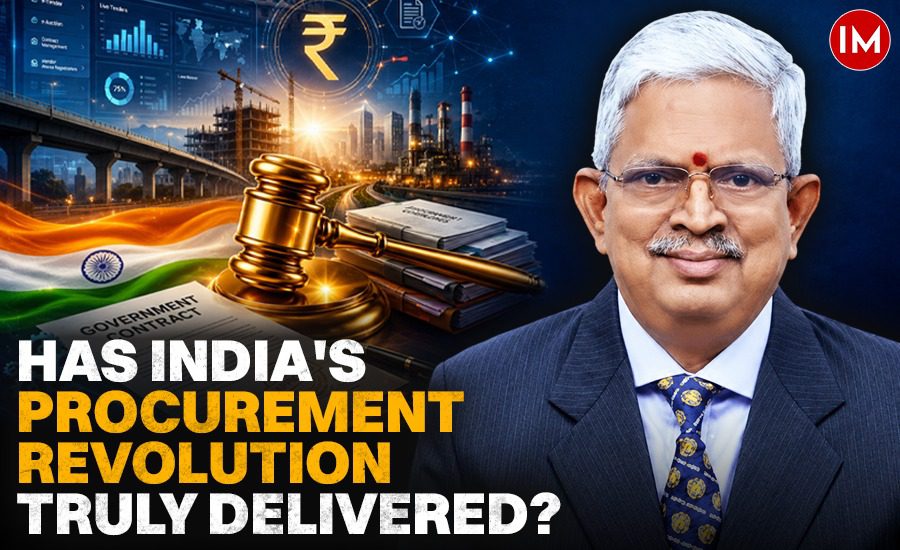
By P Sesh Kumar
When the Government e-Marketplace (GeM) was launched in 2016, it promised nothing less than a complete overhaul of public procurement in India. In the first part of this series, we traced how the platform replaced the decades-old DGS&D rate-contract system and evolved into one of the world’s largest public procurement marketplaces, facilitating transactions worth nearly Rs 5.4 lakh crore every year.
Its promise was compelling. Procurement would become faster because paperwork would disappear. It would become more transparent because every transaction would leave a digital trail. It would become more competitive because any eligible seller could participate. Most importantly, technology would reduce discretion and make government spending more accountable.
Nearly a decade later, the platform has undoubtedly changed the face of public procurement.
But every reform involving public money must eventually answer one fundamental question.
Also Read- Government e-Marketplace: India’s Procurement Revolution Under the Auditor’s Lens (Part II)
Who verifies whether the claims made by the system actually hold true?
Has GeM delivered the savings it frequently highlights? Has competition genuinely improved? Has digitisation reduced procurement risks or merely shifted them into a digital environment?
To answer those questions, one has to move beyond official success stories and look at what auditors, Parliament and international institutions have observed.
HAS THE CAG REALLY LIFTED THE BONNET?
The answer is both yes and no.
The most substantial independent scrutiny of GeM so far came through the Comptroller and Auditor General’s (CAG) Union Government (Commercial) Report No. 18 of 2020. However, it is important to understand what this audit actually examined.
Contrary to what many may assume, the CAG did not undertake a nationwide performance audit of government procurement through GeM. It did not evaluate whether ministries across the country were consistently obtaining better prices, better quality or better value for taxpayers.
Instead, Chapter IV of the report focused primarily on the functioning of the GeM Special Purpose Vehicle (SPV) itself. The audit examined the platform’s governance framework, technology architecture and compliance mechanisms rather than procurement outcomes across India.
Even within this limited scope, the findings raised several important questions.
One of the first issues concerned the platform’s much-publicised savings. GeM has frequently highlighted the financial benefits generated through digital procurement. The CAG, however, observed that the methodology used to calculate these savings lacked adequate benchmarking and robust comparison mechanisms. Without scientifically sound benchmarks, the audit noted, the savings being projected could potentially overstate the actual financial gains achieved through procurement.
The observation did not reject the possibility that GeM generates savings. It simply questioned whether those savings were being measured with sufficient rigour.
Technology itself also came under scrutiny.
Although GeM is built upon a digital foundation, the CAG observed that the application had not been benchmarked for the scale of users it was expected to serve. Questions were raised regarding scalability and long-term performance, while usability deficiencies continued to persist despite the platform’s rapid expansion.
The audit also uncovered concerns relating to data quality.
Reliable procurement depends upon reliable information. Yet the CAG found weaknesses in the platform’s validation controls. Sellers were able to enter unrealistic years of experience, while company incorporation dates displayed by the system did not always match official Corporate Identification Number (CIN) records. The audit identified around 211 instances where incorporation years differed from official records and another 117 cases where the incorporation year reflected by the system was later than the corresponding year recorded in the CIN database.
At first glance, these may appear to be minor technical discrepancies. In reality, procurement systems rely heavily on accurate vendor information. Weak validation mechanisms can create opportunities for inaccurate disclosures and, potentially, manipulation.
The audit also examined one of GeM’s most important promises—faster payments to suppliers.
For Micro, Small and Medium Enterprises (MSMEs), timely payment is often as important as winning the contract itself. Delayed payments directly affect working capital and business continuity. Yet the CAG found that, as of September 2019, only around 25 per cent of payments were being made within the prescribed timelines.
Another area where expectations did not fully translate into accountability was the buyer-seller rating mechanism. GeM had introduced ratings with the intention of encouraging better procurement practices and greater responsiveness from government buyers. However, the audit observed that poor ratings rarely resulted in any meaningful corrective action. Departments that consistently received adverse feedback continued to function without any effective mechanism compelling timely payments or improvements in performance. In practice, the rating system remained largely informational rather than enforceable.
WHAT THE CAG DID NOT EXAMINE
Perhaps equally significant is what the audit left untouched.
The 2020 audit was conducted before GeM entered its period of explosive expansion. Since then, the platform has migrated to cloud infrastructure, introduced several new functionalities and grown into a marketplace handling procurement worth more than Rs 5 lakh crore annually.
Yet India still does not have a publicly available nationwide performance audit examining some of the most fundamental questions surrounding public procurement.
Are prices consistently competitive across different product categories? Has competition broadened or narrowed over time? Are cartelisation risks being effectively detected? Are departments receiving goods of the quality they intended to purchase? Above all, is taxpayer value being independently verified?
These remain largely unanswered questions.
Equally noteworthy is the absence of a dedicated Public Accounts Committee (PAC) report focused exclusively on GeM.
For a platform of this magnitude, the absence of such comprehensive institutional scrutiny is itself significant.
The wiring has been inspected.
The machine itself still awaits a full performance evaluation.
WHAT PARLIAMENT OBSERVED
Parliament has not ignored GeM.
Its examination, however, has largely been indirect.
The Department-related Parliamentary Standing Committee on Commerce, in its 172nd Report on Promotion and Regulation of E-Commerce in India, presented in June 2022, discussed GeM while examining the broader digital commerce ecosystem.
The Committee’s observations largely centred on improving participation by smaller businesses. It recommended wider awareness programmes for MSMEs, greater handholding support to help them navigate the platform and exemption from the then applicable 0.5 per cent GeM commission. It also highlighted supply shortages in certain high-value procurement categories and suggested measures to address these gaps.
These recommendations were subsequently reviewed through the Committee’s 176th Action Taken Report, submitted in March 2023.
While these observations contributed meaningfully to improving participation, they did not delve into deeper procurement questions relating to competition quality, price discovery, bid manipulation or systemic leakages.
Those issues continue to receive relatively limited parliamentary attention.
WHAT THE WORLD BANK TELLS US
India is by no means the first country to embrace electronic procurement.
The World Bank has studied digital procurement systems across numerous countries and its conclusions are both encouraging and instructive.
According to the Bank, successful electronic Government Procurement (e-GP) systems strengthen governance by creating transparent audit trails, improving public expenditure management and accelerating the wider adoption of digital technologies across government.
But the Bank also issues an important caution.
Technology alone does not create integrity.
Successful e-procurement requires strong legal frameworks, mandatory adoption across government departments, integration with financial management systems, elimination of parallel manual procurement channels and continuous institutional oversight.
Perhaps the Bank’s most significant conclusion emerges from comparative international research.
Countries with stronger institutions derive the greatest benefits from digital procurement systems.
Technology strengthens institutional capacity.
It cannot substitute for it.
Nor does digitisation, by itself, eliminate corruption.
LESSONS FROM THE UNITED NATIONS
The United Nations offers another fascinating point of comparison.
Its United Nations Global Marketplace (UNGM) serves as a common supplier portal for more than forty UN organisations, including WHO, UNICEF, WFP, FAO and UNHCR. Collectively, these organisations procure goods and services worth over USD 22 billion every year.
Unlike GeM, however, the UN follows a federated procurement model. The marketplace primarily serves as a supplier discovery platform, while procurement decisions continue to be managed independently by individual agencies.
Another distinctive feature of the UN system is its graduated vendor verification framework. Suppliers undergo different levels of scrutiny depending upon the value of contracts and the associated procurement risks. Lower-risk vendors face relatively straightforward registration procedures, whereas participation in high-value contracts requires significantly deeper due diligence.
The approach demonstrates how procurement oversight can be tailored according to risk rather than applying identical verification standards across every transaction.
WHEN INDIA’S CAG AUDITED THE UNITED NATIONS
Perhaps the most interesting comparison comes from India’s own constitutional auditor.
While auditing GeM domestically, the Comptroller and Auditor General has also served as the External Auditor for several major United Nations organisations, including the World Health Organization (WHO), the Food and Agriculture Organization (FAO), the International Labour Organization (ILO) and the World Food Programme (WFP).
The findings reveal a striking similarity in procurement challenges across the world.
At the WHO, the CAG observed weaknesses in emergency procurement during the COVID-19 pandemic. Technical specifications for personal protective equipment were often poorly defined, quality assurance processes remained weak, pricing and payment inconsistencies emerged, consultants were relied upon extensively and competitive bidding procedures were frequently bypassed. In one particularly striking instance, emergency cholera kits intended for Ethiopia arrived only after the outbreak had already subsided.
The audit of the FAO revealed a different set of concerns, though the underlying governance issues looked remarkably familiar. Procurement plans frequently bore little resemblance to actual purchases, performance securities were waived even for high-value contracts, documentation was missing in nearly 71 per cent of direct procurement cases and delegated financial limits for direct purchases were not clearly defined.
Different organisations.
Different continents.
Yet remarkably similar governance failures.
Weak specifications.
Poor documentation.
Emergency procurement becoming a convenient justification for bypassing competition.
The lesson is impossible to ignore.
Whether procurement takes place in Delhi, Geneva or New York, technology alone cannot eliminate governance risks.
Strong institutions, independent audits and continuous vigilance remain indispensable.
TO BE CONTINUED…
In the next part of this series, we return to India’s procurement ecosystem to examine the vulnerabilities that still remain. We explore what state-level audits have uncovered, the loopholes that continue to enable manipulation, the questions every auditor should ask, the role of Independent External Monitors (IEMs), and why, ultimately, no digital platform—however sophisticated—can ever replace institutional integrity or human conscience.
About The Author– (Mr. P Sesh Kumar is a retired 1982-batch officer of the Indian Audit and Accounts Service (IA&AS) who servedas Director General of Audit at the Comptroller & Auditor General of India.)
Disclaimer – (The views and opinions expressed in this article are solely those of the author and do not necessarily reflect the views of Indian Masterminds. For feedback or queries, please write to [email protected].)
Also Read – Government e-Marketplace: India’s Procurement Revolution Under the Auditor’s Lens (Part II)