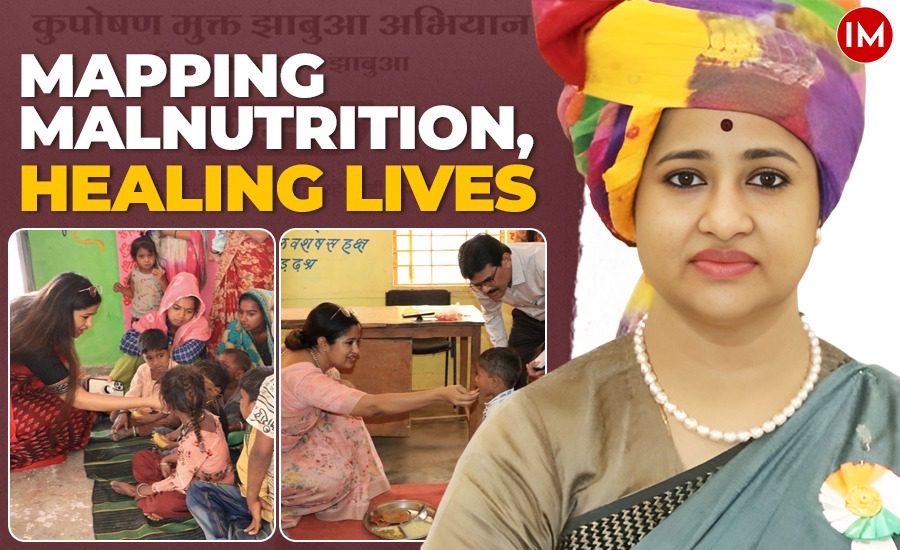
In the rugged tribal hills of Jhabua, Madhya Pradesh, where generations of undernourished children lived in the shadows of poverty and neglect, a mother’s care brought light. Not just one mother, but hundreds of them – called “Moti-Aai”, meaning “Elder Mother” in the local Bhili dialect – who came forward to nourish, nurture, and revive the health of the most vulnerable children in their hamlets.
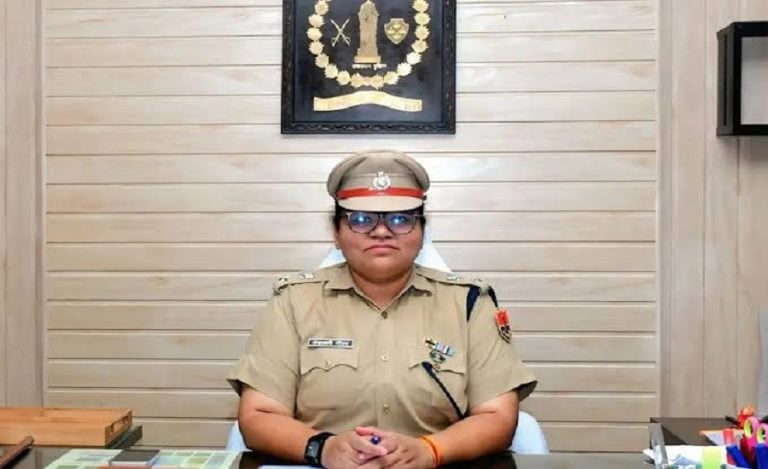
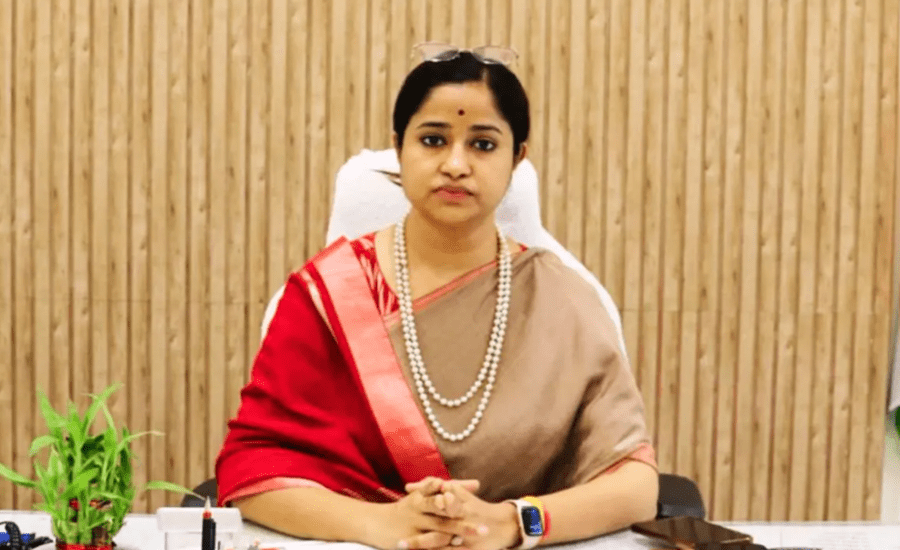
The change didn’t come from policies sitting in files. It began on the ground, door to door, mother to mother. And leading this quiet revolution was Ms Neha Meena, a 2014 batch IAS officer of MP cadre and District Collector of Jhabua, who turned a deep-seated crisis into a community-driven campaign with heart, science, and strategy.
The ‘KuposhanMuktJhabua Abhiyan’, which translates to Malnutrition-Free Jhabua Campaign, launched in August 2024, became one of India’s fastest-impacting public health interventions – earning Ms. Meena, an IAS officer of 2014 batch & MP cadre, the Prime Minister’s Award for Excellence in Public Administration 2025.
JHABUA’s HARSH REALITIES
The odds were stark. With over 90% of the population being Bhil tribals, Jhabua lagged in almost every social metric – education, access to healthcare, nutrition, and sanitation. Seasonal migration stripped children of consistent parental care. Only 49.3% of the district was literate. Superstition often overruled science, and overburdened Anganwadi workers faced fatigue and fear in the face of rising malnutrition.
A district-wide screening of 13,503 children across 2,400 hamlets in 375 gram panchayats revealed a crisis:
- 10,691 children were found malnourished,
- Of these, 1,613 were Severely Acutely Malnourished (SAM),
- 9,078 were Moderately Acutely Malnourished (MAM).
To ensure no child slipped through the cracks, the administration fixed one goal: Make Jhabua SAM-free.
BIRTH OF THE ‘Moti-Aai’ Model
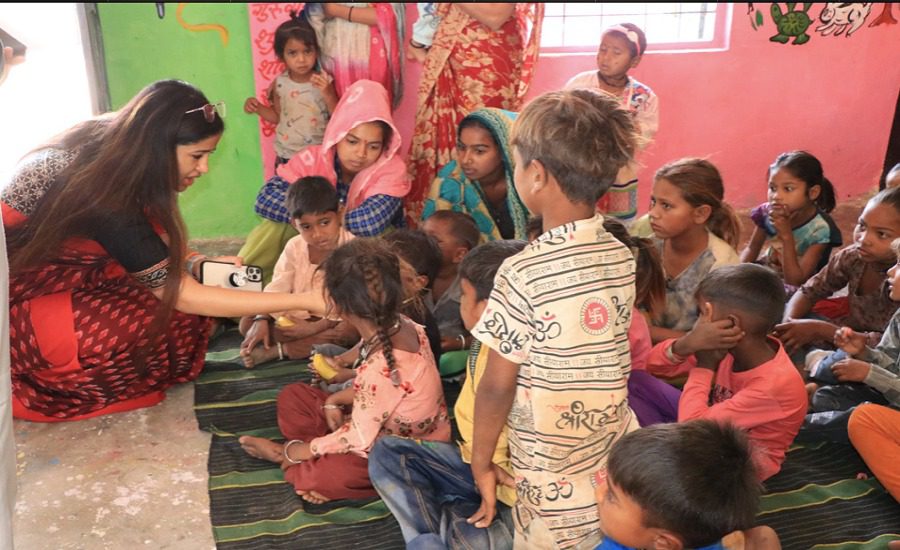
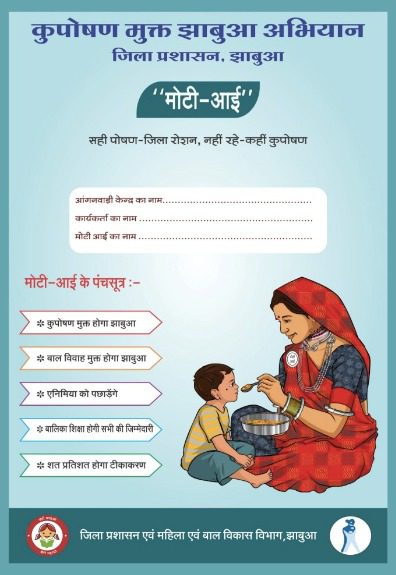
The core insight of the campaign was both simple and powerful: many SAM children lacked consistent maternal care because their mothers had migrated for labor. So, the administration turned to the community itself. Women who lived in the same hamlet, who had a bond with the children and the trust of the locals, were selected as ‘Moti-Aais’ – elderly caregivers trained to act as mother figures for malnourished children.
A total of 1,950 SAM and borderline MAM children were mapped with 1,325 ‘Moti-Aais’, each responsible for feeding, massaging, tracking, and loving “their child” like their own.
“When mothers are absent, a village must rise to mother its children. That’s the spirit behind Moti-Aai,” said Neha Meena to Indian Masterminds, while explaining the emotional backbone of the campaign.
HOLISTIC CARE
Each identified child under the ‘KuposhanMuktJhabua Abhiyan’ was issued a detailed, custom-designed profile card. These cards meticulously recorded the child’s medical details, birth history, vaccination status, socio-economic background, and nutritional access, allowing the district administration to design highly customized interventions based on individual needs.
To deepen the effort, a series of 294 health camps were organized in close collaboration with the Health Department and the Women & Child Development (WCD) Department.
The camps unearthed critical insights: Over 250 children were found to be battling underlying health conditions such as sickle cell anemia and chronic anemia, which significantly complicated their nutritional recovery. Additionally, about 300 children belonged to migrant families, leaving them without consistent adult supervision. Alarmingly, 99% of the identified Severely Acutely Malnourished (SAM) children belonged to the tribal Bhil community, highlighting the deep-rooted socio-economic vulnerabilities.
Most of these children came from large families with 3-4 siblings, where parents were engaged as marginal farmers or daily-wage laborers. All collected data was uploaded in real-time onto the Poshan Tracker app, ensuring quick identification of at-risk children and enabling targeted action. To monitor progress effectively, a robust Nutrition Committee was formed, with weekly block-level reviews and monthly district-level meetings chaired personally by the Collector.
NUTRITION REIMAGINED
One of the most innovative parts of the campaign was how it blended scientific advice with traditional tribal practices. Under the guidance of doctors and AYUSH experts, local women were trained in:
- Traditional ‘maalish’ techniques using homemade ayurvedic oils, which improved circulation and muscle strength.
- Preparing nutritious laddoos, chikki, and porridge from the government’s Take-Home Ration (THR) packets.
- Understanding age-appropriate feeding, sanitation practices, and hydration for infants and toddlers.
Even more impressively, a cadre of local girls was trained to become “Nutrition Sakhis”, assisting Moti-Aais and acting as nutrition educators in their communities.
AWARENESS WITH AUTHENTICITY
The IEC (Information, Education & Communication) strategy of the campaign was rooted in cultural sensitivity. Instead of generic posters and slogans, the team created Bhili-language songs, puppet shows, street plays, and a local mascot in tribal attire who visited remote hamlets.
The campaign mottos, such as “KuposhanMuktHogaJhabua”, “Balika Shiksha HogiSabkiZimmedari”, and “Maa Nahi To Moti-AaiSahi”, were painted on school walls, community centers, and even trees.
Village leaders – Tadvi-Patels, PESA Gram Sabhas, and anganwadi workers—were mobilized as key partners. In many cases, local temple committees and SHGs (Self Help Groups) also pitched in by donating food, clothing, or funds.
“We told our people: if one child thrives, the entire village thrives. That changed everything,” said a field supervisor from Meghnagar block.
REWARDS, RECOGNITION & A RIPPLE EFFECT
To keep motivation high, the administration introduced a Rs. 1000 reward for the best-performing Moti-Aai in every panchayat. The funds came from Red Cross, community donations, and elected representatives’ discretionary grants.
The real reward, however, came in the form of stories:
- A SAM child in Petlawad block, who could barely sit up in August, started walking by February.
- A grandmother from Kalyanpura proudly fed chikki to 15 children every evening.
- Moti-Aais began referring to the children as “merabaccha” – my child – at review meetings.
STUNNING RESULTS IN JUST 6 MONTHS
By March 2025, Jhabua’s transformation was evident in data and in spirit:
- Malnourished children reduced from 10,691 to 6,240
- SAM children dropped from 1,613 to only 81
Of 1,950 mapped SAM and MAM children:
- 1,163 shifted to the normal category
- 557 improved to MAM
- Only 81 remained in SAM,
- 149 were still in migratory households
These results were verified via Poshan Tracker App and cross-checked in Anganwadi field reports.
A MODEL FOR INDIA’S TRIBAL HEARTHLANDS
The Moti-Aai campaign is now being studied as a model framework for tribal districts across India, particularly in states like Odisha, Jharkhand, Chhattisgarh, and Rajasthan. The Ministry of Women & Child Development has recommended replication of the Moti-Aai structure under POSHAN Abhiyaan 2.0.
Meanwhile, for Neha Meena, the PM’s Award is not the final reward.
“Every time a child’s weight improves, a mother returns home, or a Moti-Aai smiles with pride – that’s our real recognition,” she says.
In the once-forgotten villages of Jhabua, where hope was scarce and children often faded in silence, motherhood now has many faces. And each one, whether young or old, wears a badge of honor: Moti-Aai.