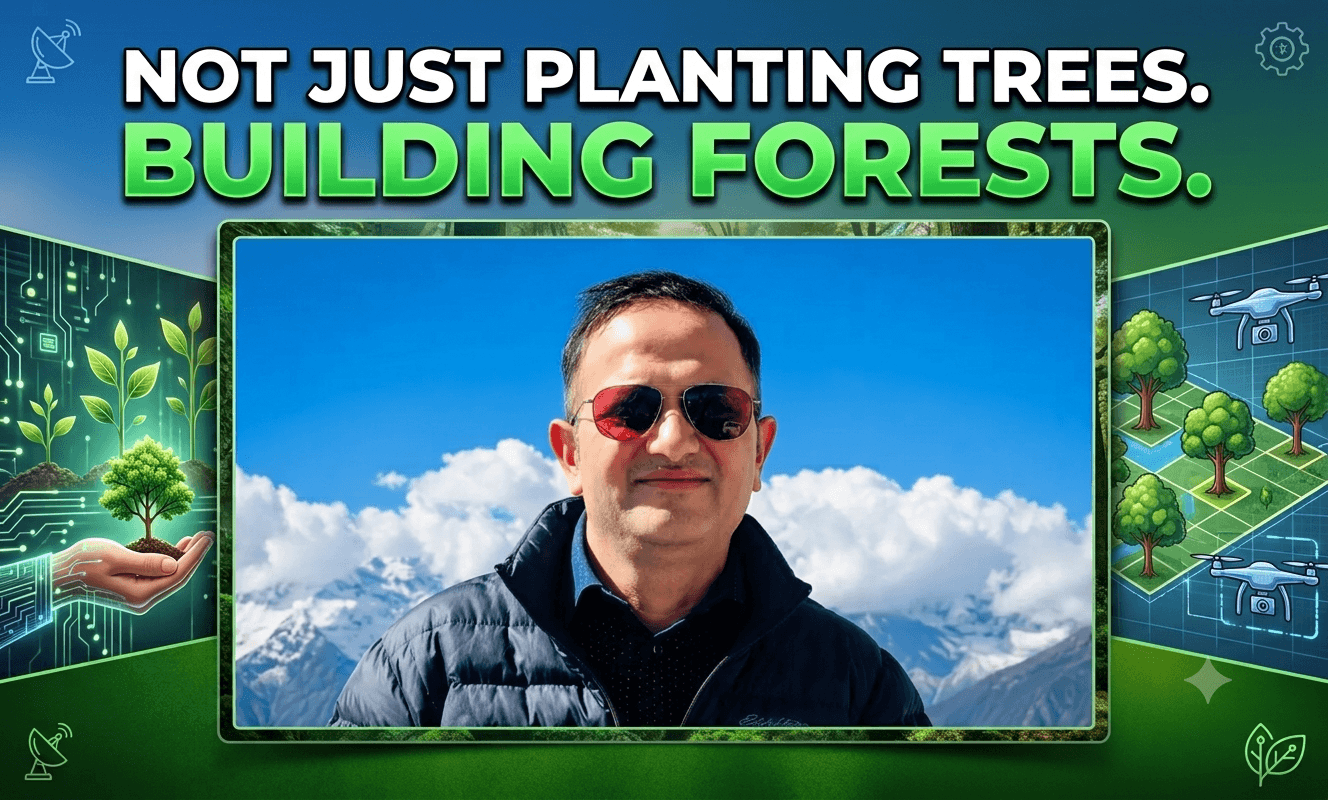
Every monsoon, thousands of saplings find their way into India’s soil. Government departments set plantation targets, funds are allocated, and hectares of land are brought under green cover. Yet one question often gets lost in the rush to plant: will these trees survive where they are planted?
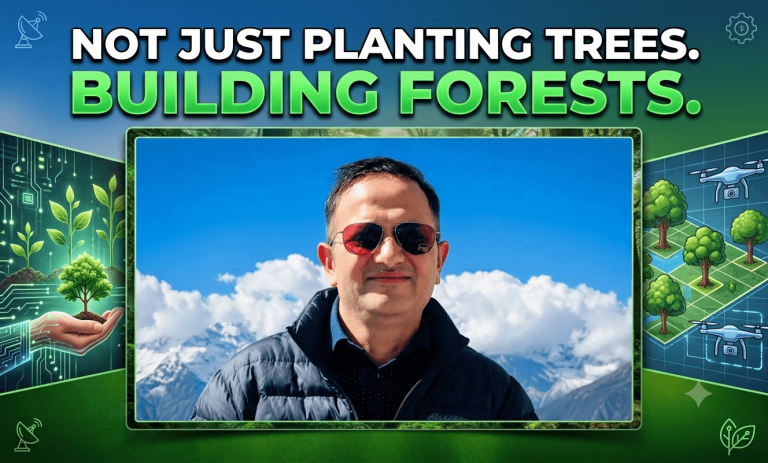
For Dr Pushpendra Rana, an Indian Forest Service officer serving in Himachal Pradesh, this question became the starting point for a different approach to forest restoration. Rather than measuring success merely by the number of saplings planted, he wanted to bring science into the decisions that determine whether a forest can flourish.
His answer lies at the intersection of ecology, public policy, geospatial science and artificial intelligence. Through two Telegram-based chatbots, WhereToPlant and WhatToPlant, Rana is working to make scientific knowledge accessible to the people who make plantation decisions on the ground.
Also read: IFS Dr Patil Nitin Kundalik: How Scientific Khair Forestry and E-Auctions Delivered 105 Crore in Himachal Pradesh
From Forest Administration to Artificial Intelligence
Rana’s work is shaped by his experience as a forest officer and his academic journey. He holds a doctorate in geography from the University of Illinois Urbana-Champaign and has worked as a postdoctoral researcher at the University of North Carolina at Chapel Hill.
His research explores how human behaviour, ecological conditions and government institutions interact, and how better evidence can improve environmental policy.
Field experience exposed a familiar weakness in plantation programmes. Officials could report how many seedlings had been planted and how much money had been spent, but those numbers did not necessarily reveal whether the intervention was appropriate or whether it produced lasting ecological benefits.
Rana began exploring how machine learning and geospatial analysis could help close that gap.
WhereToPlant: Finding the Right Ground
The first initiative, WhereToPlant, addresses a fundamental question: where should ecological restoration take place?
The chatbot uses environmental and landscape information, including climate, soil, terrain, existing vegetation and disturbance, to assess the suitability of a location. Users can access its guidance through Telegram without needing specialised knowledge of geographical information systems.
The choice of platform was deliberate. Rather than creating another mobile application, Rana’s team opted for a familiar conversational interface. WhatsApp was considered, but the costs associated with its messaging services influenced the decision to use Telegram.
The results have extended beyond the drawing board. During the 2025 plantation season, the Himachal Pradesh Forest Department undertook plantations across approximately 3,000 hectares. WhereToPlant informed site selection for more than 500 hectares across over 250 locations.
The larger lesson was equally important: technology must begin with the actual decisions faced by field staff, not simply with an impressive algorithm or an existing database.
WhatToPlant: Giving Every Tree a Better Chance
Choosing the right location is only half the challenge. The species planted there matters just as much.
Rana’s second initiative, WhatToPlant, is designed to recommend native tree species suited to particular locations. Its database draws on more than 226,000 georeferenced observations of naturally occurring trees across Himachal Pradesh.
Using 29 environmental predictors, including elevation, slope, terrain characteristics and 19 bioclimatic variables, the models estimate habitat suitability for 98 native tree species.
The system maps approximately 795,000 grid tiles, each covering around seven hectares, across the state. Its beta version was reported to be ready, with integration into WhereToPlant planned to provide more complete restoration guidance.
The work brings together collaborators including the University of Minnesota, the Indian School of Business, REST NGO and scientists associated with CSIR-Institute of Himalayan Bioresource Technology.
Where Technology Meets Local Wisdom
Rana is clear that artificial intelligence cannot restore a forest on its own. A site may appear suitable on a computer model, but grazing, fires, invasive species, extreme weather and inadequate maintenance can still undermine a plantation.
Equally important is the knowledge held by local communities. Their understanding of seasonal water availability, soil conditions, livestock movement and local land use may reveal details missing from datasets.
Rana advocates explainable recommendations, community participation and the freedom to modify or reject a model’s advice. Feedback, including the reasons behind disagreements, can help improve future predictions.
He also points to satellite monitoring, drones and forest-fire alert systems as examples of technology strengthening conservation when supported by effective institutions.
Beyond Plantation Targets
For Rana, the real promise of AI lies not in replacing forest officers or community knowledge, but in helping them make better-informed decisions.
The distinction is significant. Planting a tree is an activity; restoring an ecosystem is a much longer undertaking.
By asking where trees belong, which species can thrive and how restoration should be assessed, Rana is pushing forest governance towards a more meaningful measure of success: not merely how much land has been planted, but whether the landscape is recovering.
Also read: How IFS Sandeep Sharma Is Restoring the Beas River and Building a Climate-Smart Model for Kullu