At dusk, the grasslands of Maharashtra begin to change.
The harsh light softens over the dry plains of the Great Indian Bustard Sanctuary, and the landscape that appears almost empty during the day slowly reveals its inhabitants. Somewhere beyond the scrub and fields, a pack of Indian grey wolves moves through the fading light.
For centuries, these wolves have belonged to this landscape. Yet today, their survival depends on whether the grasslands around them can survive too.
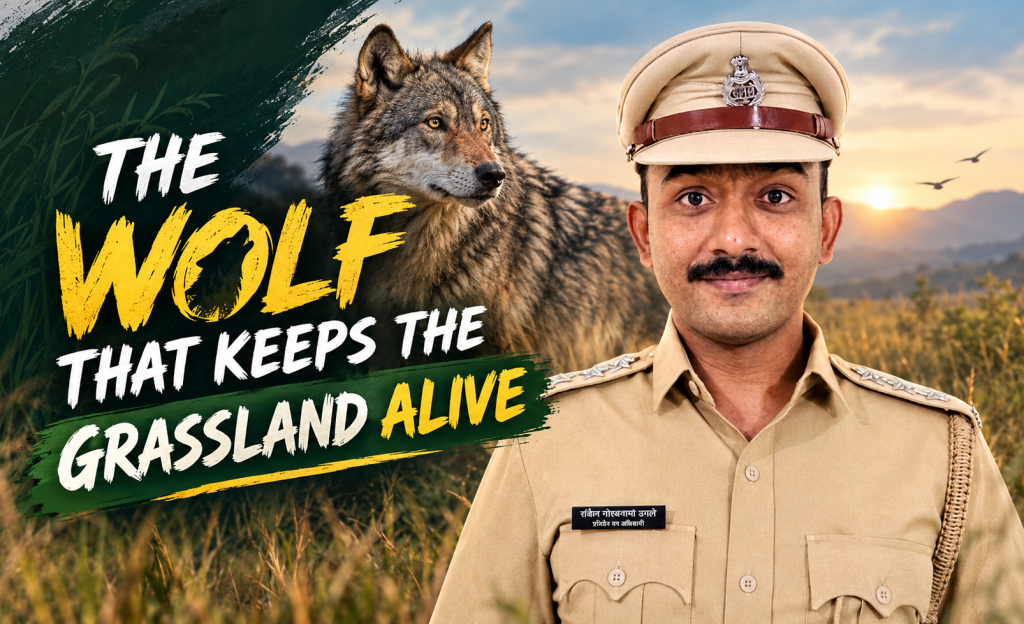
Working in the Mirajgaon Range of the Great Indian Bustard Sanctuary in Ahilyanagar, Range Forest Officer Sanket Gorakshanath Ugale is pushing for a conservation approach that looks beyond a single species. His focus is the Indian grey wolf (Canis lupus pallipes), an animal often overshadowed by India’s better-known big cats, but one that plays a crucial role in keeping grassland ecosystems functioning.
The Predator the Grasslands Cannot Afford to Lose
Established in 1979 across parts of Solapur and Ahilyanagar, the Great Indian Bustard Sanctuary was created primarily to protect the critically threatened Great Indian Bustard and its semi-arid habitat. But the same open landscape supports blackbuck, foxes, hyenas, wolves and a remarkable diversity of grassland flora.
The problem is that much of this habitat has changed dramatically.
Irrigation and the spread of sugarcane, horticulture and pomegranate cultivation have transformed traditionally dry farming landscapes. Roads, canals, railways and other infrastructure have fragmented open habitats. Exotic plants such as Lantana camara, Senna tora and Mesospharrum suaveolens have invaded grasslands, while past afforestation drives involving species such as Gliricidia and even dense tree planting have reduced the openness that grassland species require.
For wolves, the consequences are profound.
Their territories can extend across tens or even hundreds of square kilometres, bringing them into frequent contact with villages, livestock and free-ranging dogs. Unlike tigers and lions, most Indian wolves live outside conventional protected areas, in human-dominated agro-pastoral landscapes.
Ugale believes that this reality demands a different kind of conservation.
“If we want to conserve the wolf, we cannot look only at the animal. We have to look at the entire grassland ecosystem around it. If the grassland disappears, the wolf will disappear with it, and species such as blackbuck, hyena and other grassland wildlife will also decline. Every species has a role in an ecosystem, and removing even one can start damaging the balance,” Ugale shared in an exclusive conversation with Indian Masterminds.
A Disease That Can Move Through a Pack
One of the most immediate threats is not a hunter or a road, but a disease carried by domestic and feral dogs.
Canine Distemper Virus (CDV), along with Canine Parvovirus, rabies and parasitic infections, can move from dogs into wild wolf populations. Because wolves live in close-knit packs, the consequences can spread quickly.
A recent wolf death in the landscape brought the concern into sharper focus. The Forest Department and its partners are therefore working with Livestock Development Officers and NGOs on vaccination and sterilisation of free-ranging dogs around the sanctuary. Communities are also being encouraged to keep domestic dogs confined, collared and vaccinated.
The objective is not to eliminate one animal to save another, but to reduce the pathways through which disease and hybridisation reach wild wolves.
Ugale also points to another largely invisible threat: interbreeding.
Wolves and domestic dogs are closely related and can produce fertile offspring. As habitat becomes fragmented and solitary wolves lose access to other members of their species, opportunities for mating with free-ranging dogs can increase. Over time, this could dilute the genetic identity of wild Indian wolves.
When a Wolf Becomes a Neighbour
Conservation becomes considerably harder when the animal being protected lives beside farmers and shepherds.
A wolf may occupy a territory of 80 to 300 square kilometres, crossing agricultural fields and grazing areas in the process. For a marginal farmer or shepherd, losing even one or two sheep can represent a serious financial setback.
That is where conflict can turn deadly.
Retaliatory poisoning, attacks on dens and killing of adult wolves with dogs are among the threats faced by packs. To reduce this pressure, the Forest Department is working towards rapid compensation for livestock losses while conducting awareness programmes with local communities and conservation groups.
For generations, the Dhangar pastoral community and wolves shared the same broad landscape. But as traditional pastoralism declines and more families move towards settled agriculture or other livelihoods, the old relationship between people and predators is changing.
Ugale sees community participation as essential, not optional.
“For conservation to work in a landscape like this, the local community has to see some benefit from protecting the ecosystem. If we want people to participate, we have to create opportunities for them through habitat restoration, employment and responsible tourism. Conservation cannot remain something that exists only inside the Forest Department,” he stated.
Bringing Back the Grassland
The sanctuary’s restoration efforts now stretch across wildlife ranges including Mirajgaon, Rhekuri, Shrigonda, Nannaj and Karmala. Degraded grasslands are being cleared of invasive vegetation and native grasses are being restored. In the Mirajgaon Range, habitat restoration work is already underway in wolf-dominated areas.
The idea is larger than simply creating wolf habitat.
A functioning grassland supports prey species, predators and vegetation together. Healthy predator populations can help regulate herbivore numbers and reduce excessive grazing pressure, creating conditions in which native grasses can recover.
Technology has a role too. Camera traps are being placed at strategic locations, while dedicated field staff monitor wolf packs and assist with rescue operations. Current observations from different sources indicate the presence of around 70–90 wolves across the sanctuary landscape.
Yet monitoring wolves remains difficult. Their enormous home ranges, lack of distinctive individual markings and movement through human-dominated landscapes make conventional population estimation challenging.
Looking Beyond the Sanctuary Boundary
The challenge ahead is particularly important as the sanctuary’s ten-year management plan approaches its end in 2026–27. The new management plan is expected to place greater emphasis on the Indian grey wolf as part of the wider ecological restoration of the Great Indian Bustard landscape.
That means treating grasslands not as vacant or degraded land awaiting conversion, but as functioning ecosystems in their own right.
It also means addressing feral dogs, disease, hybridisation, habitat fragmentation, changing agricultural patterns and human-wildlife conflict together rather than as separate problems.
For Ugale, the larger lesson extends well beyond the wolf.
“People often think conservation is about saving tigers, lions or other famous animals. But the forest and grassland ecosystem is made up of hundreds of species, from the largest predator to the smallest organism. Every one of them matters. If we remove species one after another, the ecosystem will begin to break down. Protecting the wolf is therefore not only about saving a wolf; it is about keeping the grassland alive,” he told Indian Masterminds.
As evening settles over Mirajgaon, the grassland once again becomes quiet. But somewhere in that silence, a pack moves.
Its survival will depend not merely on how well the wolves are protected, but on whether Maharashtra can preserve the open landscapes, prey, communities and ecological relationships that have sustained them for generations.
The Indian grey wolf may not command the attention of a tiger or a lion. But in these grasslands, its presence tells a different story: one about an ecosystem still fighting to remain whole.
Also read: How IFS Sarthak Parasher Turned Around Nahan’s 70-Year-Old Forest Factory And Reinvented Forest Governance