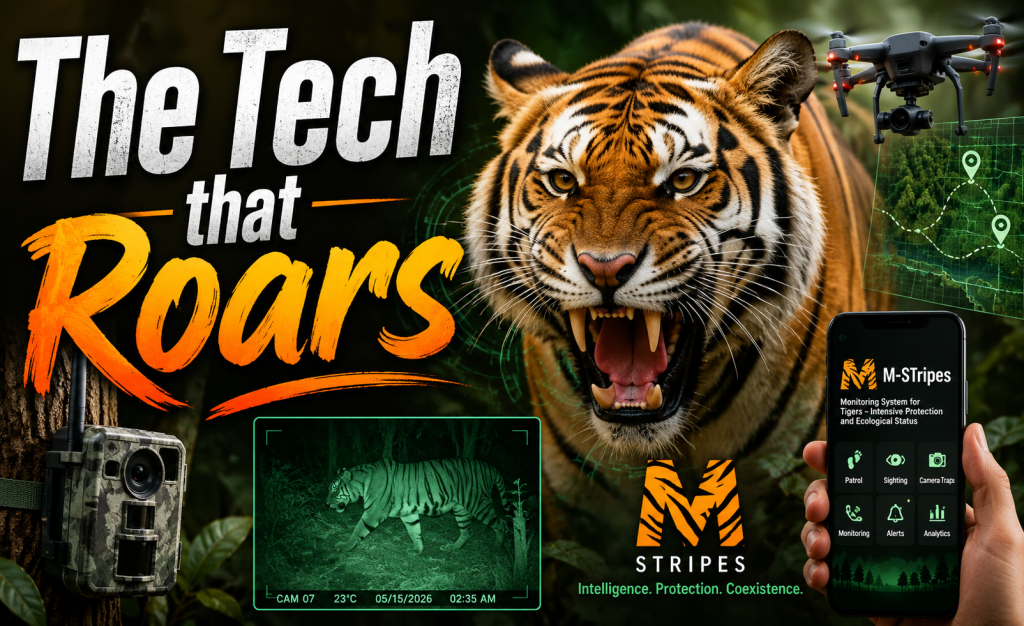
For centuries, forests protected tigers by hiding them. Today, forests are protecting tigers by watching them.
Deep inside India’s tiger reserves, invisible cameras are quietly photographing every movement. Artificial Intelligence is identifying animals within seconds. Forest guards carry GPS-enabled smartphones instead of paper diaries. Drones fly over dense forests after sunset, while sensors hidden in the wilderness listen to alarm calls of deer and langurs to predict the movement of big cats.
This is not science fiction.
It is the new face of wildlife conservation.
India, home to over 70 per cent of the world’s wild tigers, has emerged as one of the biggest examples of how technology and traditional conservation can work together. The country that once struggled to save its national animal is now using Artificial Intelligence, satellite mapping, forensic science and digital monitoring to protect more than 3,600 tigers spread across dozens of reserves.
Yet, the real story is not about machines replacing people. It is about technology making the work of forest guards, scientists and Indian Forest Service (IFS) officers smarter, faster and far more effective.
When Every Tiger Leaves a Digital Signature
Every tiger carries a unique identity. Not on a collar or a tag—but on its stripes.
Just as no two human fingerprints are identical, no two tigers share the same stripe pattern. Earlier, identifying individual tigers meant thousands of hours of manually comparing photographs. Artificial Intelligence has changed that.
During India’s latest national tiger estimation, the largest wildlife survey conducted anywhere in the world, AI-powered software such as CaTRAT (Camera Trap Repository and Analysis Tool) automatically sorted millions of camera-trap images according to species. Another software, ExtractCompare, matched stripe patterns to identify individual tigers with remarkable accuracy. What once took weeks now takes hours.
The result is faster and more reliable population estimates with far fewer human errors.
M-STrIPES: The Smartphone That Became a Forest Guard’s Notebook
Not long ago, forest guards recorded wildlife sightings in notebooks. Today, they use smartphones.
The Monitoring System for Tigers – Intensive Protection and Ecological Status (M-STrIPES) has transformed field patrolling across India’s tiger reserves.
This GPS-enabled mobile application allows frontline staff to record patrol routes, wildlife sightings, signs of poaching, forest fires and illegal activities in real time. Every photograph is geo-tagged, creating a digital record that cannot easily be manipulated.
Managers sitting miles away can monitor patrol coverage, identify vulnerable areas and deploy resources more efficiently.
The system has made conservation not only smarter but also far more transparent and accountable.
When Forests Start Listening
Sometimes, technology does not need to see a tiger. It only needs to hear the forest.
Experimental AI-powered bioacoustic sensors, currently being tested in landscapes such as Pench, continuously analyse natural forest sounds. When deer or langurs suddenly raise alarm calls—a common response to nearby predators—the sensors recognise the pattern and instantly alert forest officials and nearby villages.
Instead of reacting after a tiger enters human settlements, authorities can now receive early warnings. Such innovations are becoming powerful tools for reducing human-wildlife conflict.
Dudhwa’s Cameras That Never Blink
In Uttar Pradesh’s Dudhwa Tiger Reserve, conservation has entered the era of real-time surveillance. The reserve has introduced Remote Transmitter Receiver (RTR) cameras on a trial basis in collaboration with the National Tiger Conservation Authority (NTCA).
Unlike conventional camera traps that require physical retrieval of memory cards, RTR cameras transmit photographs directly to officials within about three minutes of capturing an image. The cameras work without flash, ensuring that animals remain undisturbed.
If approved for wider deployment, the technology could significantly strengthen anti-poaching operations by enabling instant responses to suspicious activity inside forests. Instead of discovering incidents days later, forest officials receive information almost immediately.
Also Read – Future-Ready Warehousing : How CWC Is Leveraging Technology To Store Food Grains
How Similipal Defeated Poachers with Artificial Intelligence
Technology becomes most powerful when paired with determined leadership. Few examples demonstrate this better than Odisha’s Similipal Tiger Reserve. When IFS officer Prakash Gogineni took over as Field Director, he inherited a reserve where organised hunting posed one of the biggest threats to wildlife.
Traditional patrolling alone was not enough. His team first mapped every known entry route used by poachers. Then came Artificial Intelligence.
AI-enabled surveillance cameras were installed at vulnerable locations across the reserve. Whenever movement was detected, alerts reached the control room instantly. More importantly, the cameras captured faces, weapons and valuable evidence.The department combined these digital alerts with intelligence gathered on the ground.
Suspects were tracked back to villages. Illegal gun-making units were dismantled. Hundreds of unauthorised firearms were seized. Within just eighteen months, more than 200 people were arrested. According to internal assessments, illegal hunting entries into the reserve dropped by nearly 95 per cent.
Technology did not replace field intelligence.It amplified it.
Eyes in the Sky
Dense forests often hide dangers that cannot be seen from the ground. That is where drones have become indispensable. Equipped with thermal imaging cameras, drones help track wildlife movement after dark, detect forest fires before they spread, monitor invasive species and observe tiger dispersal towards villages.
They also help map habitats, assess water bodies and monitor inaccessible terrain without disturbing wildlife. For forest managers, drones provide an aerial perspective that was once impossible.
The Rise of Smart Surveillance
Several tiger reserves are now moving beyond isolated camera traps to integrated surveillance systems. High-resolution cameras, thermal sensors and command centres together create what is often called an E-Eye surveillance network.
Introduced first in Corbett Tiger Reserve, these systems continuously monitor vulnerable forest boundaries and alert authorities about illegal intrusions, suspicious movement or fire outbreaks. The biggest advantage is speed.
Instead of waiting for routine patrols, officials receive alerts while incidents are unfolding.
Science Beyond Cameras
Modern conservation also depends heavily on satellite technology and Geographic Information Systems (GIS). Remote sensing allows scientists to monitor vegetation, forest health, water availability and habitat fragmentation across vast landscapes.
GPS and satellite telemetry help researchers understand how tigers move between forests, identify wildlife corridors and predict future dispersal patterns. These scientific insights guide habitat restoration, corridor planning and conflict management. Technology has turned conservation from reactive protection into predictive planning.
Forensics, Sniffer Dogs and Invisible Evidence
Not every conservation battle is fought inside forests. Many end in courtrooms.
Wildlife forensic laboratories now analyse DNA, tissue samples and geographic evidence to strengthen prosecutions against wildlife criminals. Specially trained sniffer dogs have also become valuable members of conservation teams.
One of the best-known examples is Genie, a Belgian Malinois deployed in Madhya Pradesh, whose tracking abilities have helped solve numerous poaching cases and identify wildlife contraband. Scientific evidence has made convictions stronger and wildlife crime investigations more effective.
People Still Matter Most
Despite every technological breakthrough, India’s conservation success still depends on people. Forest guards continue to patrol remote forests in difficult terrain. Anti-poaching camps remain operational throughout the year.
During the monsoon, when roads disappear under floodwaters, staff often rely on elephants and boats to reach vulnerable locations. Many reserves also work closely with local communities, tribal groups and former hunters who possess deep knowledge of forest landscapes. Technology may provide information. People decide how to act on it.
The Future of Conservation
More than fifty years ago, the architects of Project Tiger believed protecting the tiger meant protecting the entire ecosystem. That philosophy remains unchanged. Only the tools have evolved.
Artificial Intelligence now recognises tigers before humans can. GPS applications record every patrol. Drones scan forests from above. Cameras send photographs within minutes. Sensors listen to forests that never sleep.
Together, these innovations are transforming wildlife protection from a reactive exercise into a proactive science. India’s tiger recovery is no longer only a conservation success story.
It is increasingly becoming a technology story—one where algorithms, satellites and smart devices work alongside courageous forest guards to ensure that the roar of the tiger continues to echo through India’s forests for generations to come.
Also Read – IPS Sumit Ramteke on the Cases That Changed His Career and Shook Organized Crime | Video Interview