Every month, nearly 80 crore Indians receive foodgrain through the Public Distribution System — a welfare operation of a scale unmatched almost anywhere in the world. Behind that number lies a quieter, less-celebrated question: how does that grain stay safe, clean and available between the farm and the ration shop? For decades, the answer has been resting substantially on the shoulders of the Central Warehousing Corporation.
India’s economic aspirations are closely linked with the strength of its logistics infrastructure. As the nation strives towards Viksit Bharat, efficient supply chains, scientific storage, and technology-enabled logistics determine not only economic competitiveness, but also food security, ease of doing business and national resilience.
At the heart of this transformation stands the Central Warehousing Corporation (CWC) – a Navratna CPSE offering Warehousing & Logistics Services, under the Ministry of Consumer Affairs, Food & Public Distribution, Government of India.
For over six decades, CWC has been one of India’s most trusted logistics institutions, supporting farmers, industries, exporters, importers and government agencies through an extensive nationwide network. Operating more than 950 warehouses across the country, it is no longer merely a provider of storage space — it is rapidly evolving into a digitally empowered logistics enterprise redefining public sector warehousing through artificial intelligence, intelligent automation and data-driven governance.
The Silent Pillar of National Development
Warehousing often remains an invisible component of the economy, yet every successful supply chain depends on it. Every bag of foodgrain safely stored, every export container efficiently handled, every industrial commodity scientifically preserved — contributes to national productivity.
India’s food security architecture depends on an unbroken chain: procurement, scientific storage, and last-mile distribution. CWC sits at the most critical and vulnerable link of that chain — the storage stage — where a single lapse in managing inventory, external weather adversities, moisture or pest control can turn wholesome grain into wastage overnight. As PDS coverage and procurement volumes have grown, CWC’s mandate has evolved from simply providing shed space to actively engineering loss prevention, quality assurance and real-time accountability across a nationwide network.
Cutting the Subsidy Burden
Food security is ultimately a fiscal challenge as much as a logistical one. Every bag of foodgrain lost to spoilage, pilferage or poor handling adds directly to the government’s subsidy bill without feeding a single citizen. CWC’s Digital Transformation 2.0 has been built around this reality, creating a sustainable and scalable Smart Warehousing Ecosystem. Real-time monitoring at godowns with automated transactional entries in core operational areas of Gate, Weighbridge, yards and godowns, AI-based Bag Counting and Face recognition, advanced surveillance for fire, smoke and rodent activity, and IoT-based gas sensors that track carbon dioxide and phosphine levels, have driven a drastic reduction in storage losses compared to pre-transformation levels, translating into valuable saving of foodgrain annually from spoilage and pilferage. In an operation of this scale, even marginal improvements in storage integrity translate into crores of rupees in savings for the exchequer — savings that ultimately hold down the food subsidy burden.
From Digitisation to a Digital Intelligence Ecosystem
CWC’s first wave of digital transformation, between 2015 and 2024, digitised core functions — warehousing, finance, HR, legal, engineering and inspections — through more than 45 standalone e-tools, moving the organisation to a near-paperless operation. Digital Transformation 2.0 goes further, replacing these fragmented e-tools with a single unified, AI-powered ERP platform, Bhandaran 360, built on SAP S/4HANA, and integrated with Smart Warehousing System. It consolidates 45-plus legacy systems into 41 integrated modules with over 35 external integrations spanning WDRA, FCI, banks Railways, Customs ICEGATE, and GST systems — giving CWC, one real-time source of truth, across its entire pan-India operation.
Technology at Every Critical Touchpoint: CWC Smart Warehousing Ecosystem
Technology has value only when it solves real operational challenges. The most vulnerable points in any warehouse operation nation-wide are its physical touchpoints — gates, weighbridges, yards and godowns — where manual handling has traditionally invited delays & errors, and remained largely opaque. Smart Warehousing system automates precisely these points. FASTag and ANPR-enabled gate systems, geo-tagged biometric based smart locks, AI-based bag counting, and Face Recognition Systems for authorised quality inspections working alongside IoT sensors that continuously track storage conditions, striving to further optimize storage losses to near-zero level.
This vision became reality on 18th June 2026, when Union Minister of Consumer Affairs, Food & Public Distribution Shri Pralhad Joshi inaugurated CWC’s AI- and IoT-Enabled Smart Warehousing System at Bharat Mandapam, New Delhi — rolling out the advanced surveillance, automation and monitoring across 215 warehouses nationwide, alongside felicitation of Best Performing Warehouses under the Depot Darpan framework. Technology, in that moment, stopped being an additional layer over warehousing and became the operating system of the warehouse itself.
Intelligence Across the Entire Supply Chain
Transformation does not end at foodgrain storage.In the EXIM based Warehousing front, CWC’s Container Freight Stations and Inland Container Depots are also adopting intelligent logistics solutions designed for the demands of international trade.
Digital Twin yard management enables precise mapping of container movements. AI-assisted smart inventory systems provide accurate cargo tracking and warehouse utilisation. OCR-enabled container identification, automated vehicle verification and integration with port systems, customs platforms and multimodal logistics databases ensure faster cargo movement while reducing documentation and manual intervention.
Such capabilities align CWC with global logistics practices where visibility, speed and accuracy increasingly define competitiveness in trade facilitation, with a vision to reduce overall logistics cost. As India expands its manufacturing base and export ambitions, these capabilities become indispensable.
Depot Darpan, The Data-powered Governance
Perhaps the most consequential shift is in governance itself. Depot Darpan, a centralised monitoring portal developed with direct inputs from the Department of Food & Public Distribution, rates every warehouse on a Star Rating based on their Infrastructural Capabilities and Operational Efficiency parameters – giving Warehouse Managers, Regional Offices, corporate leadership and the Ministry a shared, real-time view of infrastructure health and compliance. This is not a mere dashboard — it converts oversight from a periodic inspection exercise with restricted visibility into a continuous, evidence-based governance system that the Administrative Ministry itself can monitor. In this framework, every warehouse strives to be a 5-star rated warehouse, with the performance closely monitored by the top management and the Ministry. Setting this as a benchmark framework for assessment, the Ministry intends to have the Depot Darpan Assessment implemented by all the public warehouses, nation-wide, including the State Warehousing Corporations and State Civil Supplies Corporation run warehouses, for which CWC is offering Consultancy services for their overall performance improvement.
India AI Impact Summit 2026
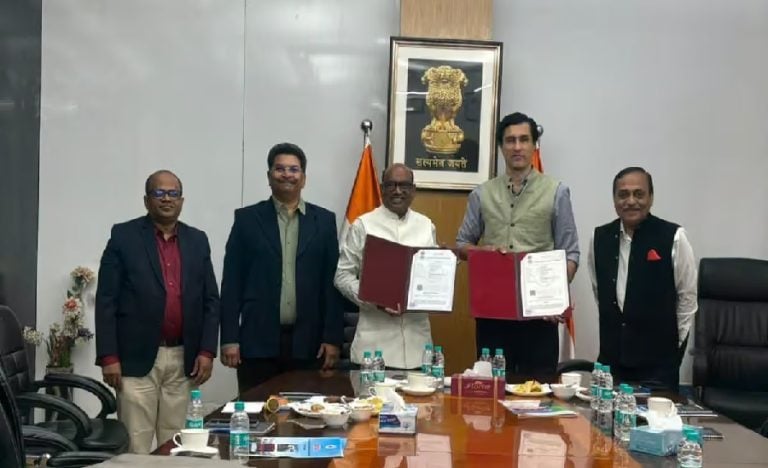
CWC showcased its Smart Warehousing and Smart EXIM solutions at the Summit, drawing appreciation from national and international bodies. The United Nations, Niti Aayog, MeitY and ministries spanning Agriculture, Coal, Steel, Defence and Ports, alongside strong interest from startups, cooperatives and researchers. The visibility converted swiftly into substance. CWC signed an MoU with an Indian Institute of Science initiative to collaborate on robotics in warehousing and supply chain, and entered advanced discussions with CDAC’s Maritime Digital Centre of Excellence on AI-powered port logistics. Most striking was the international resonance: State Informatics Limited, a key technology partner of the Government of Mauritius, expressed interest in a government-to-government MoU to deploy CWC’s Smart Warehousing and Smart EXIM solutions across Mauritius and other African nations. An Indian public-sector innovation, built to feed 80 crore citizens at home, is now emerging as an exportable blueprint for food-logistics infrastructure abroad.
Measuring Transformation
The financial impact of this transformational journey is measurable and steep. CWC’s profit before tax (PBT) has grown more than three-fold — from Rs 283 crore in 2015-16 to Rs 908 crore in 2025-26 — even as employee strength was more than halved. Income per employee rose nearly five-fold to Rs 1.96 crore, and profit per employee climbed nearly seven-fold to Rs 49.48 lakh over the same period. In the latest year alone in FY 2025-26, revenue grew by around 30 per cent and PBT by nearly 28 per cent, while turnaround time at warehouses improved by roughly 30 per cent and space utilisation by more than 20 per cent.
Recognition
These outcomes have drawn attention well beyond India. CWC’s Digital Transformation 2.0 has been reviewed and endorsed by the UN World Food Programme, academic institutions including IIM-Ahmedabad, and a visiting Israeli ministerial delegation, and has won recognition including the SKOCH Gold Award 2026, the CMO Asia International Award 2026, the Champions Award 2025 from the Indian Express Group, PSE Excellence Awards 2026, the only PSU to have been felicitated in ET AI Awards Conclave 2026, ET Government PSU Leadership & Excellence Award 2025 – besides many other accolades. The transformational initiatives of the Corporation are recognized by the Central Vigilance Commission (CVC), Standing Conference of Public Enterprises (SCOPE), Institute of Certified Public Accountants (ICPA), etc. Inspired by the Smart EXIM initiative, M/s GAIL has sought our services in Smart Container Yard Management at their Mangalore facility. Various State Warehousing Corporations, along with international stakeholders at the India AI Impact Summit 2026, are also exploring adoption of the same model — a strong signal that this is a replicable template, not a one-organisation exception.
Towards Viksit Bharat
As India moves towards Viksit Bharat 2047, CWC’s vision extends beyond running efficient warehouses. It is to build an intelligent, predictive logistics backbone where technology anticipates risk before it materialises, where every stakeholder — from the farmer depositing grain to the Ministry monitoring national stocks — has real-time visibility, and where public warehousing infrastructure does not merely meet global standards but helps set them. Through its Consultancy Cell, CWC is already extending this expertise to various Government agencies, State Warehousing Corporations and international partners, reinforcing the case that scientific, technology-led warehousing is not a support function to food security — it is one of its foundations.
A foodgrain saved through better storage is, quite literally, a foodgrain that need not be grown again. That principle, more than any single technology, is what CWC’s transformation is ultimately about.
About The Author – Mr. Santosh Sinha is Managing Director of Central Warehousing Corporation
Also Read – Private: How ‘Anna Chakra’ Put India’s Food Security Model on the Global Analytics Map